
Retail-distribution buyers specifying mobile ground robots in 2026 face a hard fork between lane-following AGVs and free-navigation AMRs, with the choice now driven as much by WMS architecture and facility power infrastructure as by the unit price of the vehicle [S2][S5].
The global mobile-robot market, AGVs plus AMRs, is projected by LogisticsIQ to reach USD 13.2 billion by 2026, while Symbotic's May 2026 market update notes that AGV revenue share is expected to fall from roughly 33% of total mobile-robot revenue in 2024 to about 20% by 2030 [S4][S5]. For retail distribution specifically, that reweighting maps onto SKU volatility, order profile churn, and aisle density rather than raw throughput.
AGV vs AMR in a retail DC: the topology gate
Lane-guided AGVs move on magnetic tape, embedded wire, or floor-sensor tracks and follow a scripted route every cycle, which makes them the lowest-risk option for fixed A-to-B pallet moves where the same SKU mix repeats thousands of times a day [S2][S6]. The same 2026 guidance recommends AGVs when routes are stable, traffic is centrally controlled, payloads run heavy, and the ROI case depends on cycle-by-cycle predictability rather than responsiveness [S2].
Free-navigation AMRs use onboard LiDAR, cameras, and SLAM mapping to re-plan around dropped pallets or foot traffic, which is the architecture that retailers with high SKU churn and seasonal peak swings now gravitate toward [S2][S3]. An AGV robot deployment wins on unit cost and cycle determinism; an AMR robot deployment wins on layout flexibility and lower civil-works spend. The decision point is whether the retail DC's aisles, totes, and order profiles change more than once per quarter.
Payload class and unit-cost brackets
Retail shelves and totes sit in the 50–500 kg bracket and are almost always handled by compact AMR fleets with shelf-lift or roller-top attachments, with Mobile Industrial Robots covering this band from MiR100 up to MiR1350 for heavier pallet transport [S3]. Pallet-level work at 1000–3500 kg per trip still defaults to AGV tuggers or heavy AMR pallet units, where the per-vehicle spend moves into a different band and the battery and motor sizing have to be re-checked against facility power distribution capacity.
Symbotic's 2026 update frames the global mobile-robot market at the system level, and its 2024–2030 share-shift projection (33% AGV → 20% AGV) is the cleanest single signal of where retail DCs are actually placing their next purchase orders [S5]. That signal is consistent with Trossen Robotics' 2026 buyer guide, which positions AGVs as a fit where the warehouse can hold more inventory in a smaller footprint by using fixed corridors [S6].
Charging, batteries, and facility-side electrical work
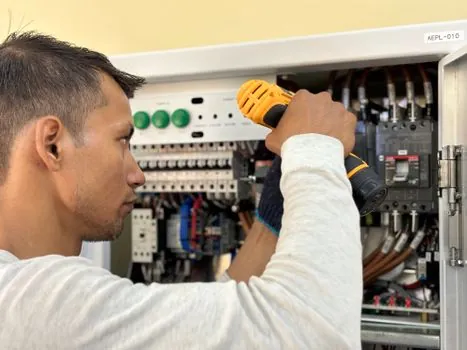
Every AGV or AMR dock is a small load on the building's power distribution box, and the dock count drives the distribution cabinet layout more than the robot count does, because opportunity-charge stations pull 30–80 A per port and most DC electrical rooms are not pre-engineered for that density. Lithium iron phosphate (LFP) battery packs are now standard on 2026 retail-fleet vehicles for cycle-life and thermal stability, but the specifier still has to validate cell UN38.3 transport and the dock's short-circuit coordination upstream. [S2]
Where retail DCs handle flammable aerosol or solvent SKUs, any in-aisle mobile robot also has to be reviewed against the site's hazardous-area classification, and the mobile-robot vendor's EX rating has to drop into the same document set as the fixed explosion-proof distribution hardware. This is not a marketing footnote; an AGV battery vent inside a Class I Div 2 zone is a real audit finding, and a 2026 procurement spec that ignores it will be sent back by the safety reviewer.
WMS, fleet manager, and PLC integration gates
Free-navigation AMR platforms ship with REST, MQTT, or OPC UA fleet managers, and the spec gate is whether the site WMS can publish pick-list, tote, and order-complete events back to the fleet manager at sub-second latency [S2][S3]. Lane-guided AGVs, by contrast, usually integrate through PLC ladder or fieldbus, and the integrator cost there is dominated by traffic-control logic at intersections, not by the vehicle hardware itself.
The 2026 vendor map from Fdata lists Amazon Robotics, MiR, Geek+, Locus Robotics, GreyOrange, OTTO Motors, Seegrid, Fdata, Agility Robotics, and Clearpath Robotics as the ten most relevant AMR suppliers, with Geek+ cited as holding the top global AMR market share for seven consecutive years [S3]. GreyOrange is positioned in the same 2026 ranking as a focus on end-to-end order automation in large logistics and retail fulfillment centers [S3]. Specifiers should weigh that list against lead time, local service coverage, and whether the vendor's fleet manager supports the WMS already on site, rather than treating market share as a quality proxy.
Selection rules of thumb for a 2026 retail DC

Pick lane-guided AGVs when the DC runs the same pick path more than 80% of the time, when pallet moves dominate tote moves, and when the floor is already marked for forklift traffic. Pick AMRs when the aisle layout is re-slated within 12 months, when SKU velocity is highly seasonal, or when the facility is leased and the next tenant change will force a redesign [S2][S6]. In mixed fleets, retail DCs are increasingly running AMR tote runners on the pick face and AGV pallet tuggers on the dock-to-stage loop, which lets each topology do what it is good at.
Total-cost comparison should include floor marking, charger circuits, traffic-control PLC work, fleet-manager licenses, and the cost of mapping and re-mapping per re-layout, not just the per-vehicle sticker [S2]. SpriMoon's AgvDistribution reference on GitHub is a useful open-source starting point for engineers sketching fleet-coordination logic, although it is a research implementation rather than a production controller [S1].
Standards and sourcing notes for the specifier
Mobile-robot safety in most retail DCs is governed by ISO 3691-4 for driverless industrial trucks, and any vehicle that operates in mixed pedestrian aisles also has to clear ANSI/RIA R15.08 in North America. Battery systems should meet UN38.3 for transport and UL 2580 or IEC 62619 for cells, and chargers must coordinate with the building's protective earth and RCD scheme. The specifier should treat vendor claims of "ISO compliant" as a starting line, not a finish line, and pull the actual test certificates before release. [S2]
The next decision node to track is whether the retail DC's WMS vendor publishes a public API for the chosen fleet manager, and whether the local electrical contractor can deliver opportunity-charge stations on a 6–10 week lead time. Signals worth watching through the rest of 2026 are any WMS-side API changes at the top three retail platforms and any revision to ISO 3691-4 that touches mixed-traffic pedestrian zones, both of which will reset the integration-cost line on the comparison table above. A second-order check is to read a non-related industrial spec walkthrough, such as this face shield selection map, to calibrate how a structured selection-gate write-up reads before signing the AGV purchase order.