
Electronics SKUs are the worst case for a general warehouse rack: light unit loads, high SKU count, ESD-sensitive, and a real mix of master packs and inner packs. The default pick for that profile is a roll-formed selective pallet rack on a 96 in. or 108 in. upright, with bolted teardrop connections and individual lane FIFO so each SKU gets its own pick face [S3][S2].
Most electronics DC builds in 2026 still lead with selective racking, push back for the slow movers, and pallet flow rack lanes for date-sensitive or build-to-sequence SKUs. That stack of three racking types, plus a clear aisle policy and an ESD floor, covers roughly 80% of the greenfield electronics projects we see specified today [S3].
Why electronics handling breaks a generic rack spec
Standard GMA pallets weigh 48 x 40 in., 1,500-1,800 lb loaded in food and beverage, but electronics loads sit closer to 250-900 lb per pallet because the product is light and the master packs are oversized [S2]. Light loads mean dynamic beam deflection matters more than raw capacity, so a 96 in. beam at 5,000 lb rated load with a 0.063 in. deflection limit is a better match than a heavy-duty 10,000 lb beam that the load will never reach.
ESD is the second driver. Bare painted steel uprights and painted wire decks will hold a static charge; a painted rack on an ESD floor is fine for pallets wrapped in anti-static stretch film, but open bin pick faces need a different surface treatment. The conservative play is a powder-coated or zinc-plated frame plus ESD plastic pallets at every pick location, with the rack itself bonded to the floor ground.
Finally, electronics DCs cycle SKUs faster than any other vertical: 12-30 turns per year is common, and obsolete SKUs get pulled in months. That churn kills any rack layout that cannot be reconfigured without torches, so bolted teardrop connections win over welded or structural bolted frames that need a wrench on every beam [S3].
Three rack types to compare for an electronics DC
Selective, push back, and pallet flow cover most greenfield electronics builds, and the choice is driven by SKU count, pick face, and FIFO requirements rather than load weight. [S2]
Selective rack, roll-formed teardrop: every pallet accessible from the aisle, frame heights 8-24 ft, beam lengths 8-12 ft typical, beam capacity 5,000-10,000 lb per pair. This is the default for the 60-70% of SKUs that need a live pick face and random access.
Push back rack: 2-6 pallets deep on wheeled carts, last-in-first-out per lane, fits high-density reserve storage. Good for 20-30% of SKUs that are slow movers or bulky cables and connectors, less good for any SKU with a date code or firmware revision.
Pallet flow rack, full-width steel rollers: first-in-first-out, slope 0.375-0.5 in. per foot, speed controlled by magnetic or friction brakes.
For a greenfield 50,000 sq ft electronics DC, a typical layout is 70% selective, 20% push back, 10% flow, with 9-12 ft aisles for counterbalance or reach trucks. Drive-in and cantilever do not appear on most electronics spec sheets: drive-in is for very low SKU count and high pallet count, and cantilever is for long goods, which electronics rarely ship.
Frame, beam, and deck spec gates
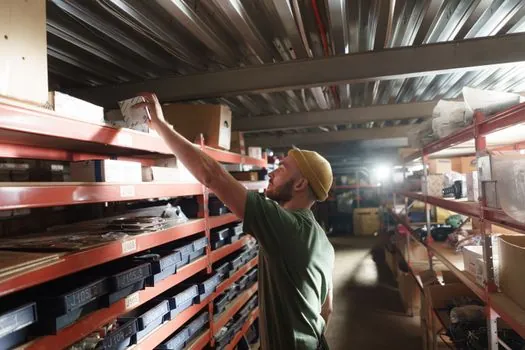
Frame gauge and beam profile do more for safety than beam capacity stickers do. For an electronics DC, the spec gates I would not negotiate are: roll-formed teardrop uprights in 14 ga or 13 ga steel, base plates 4 x 4 in. minimum with four anchor bolts per post, and beams listed by RMI/ANSI MH16.1 or the local equivalent. [S1]
Beams: step beams in 96 in., 108 in., and 144 in. lengths, 3-rib or 4-rib profiles, 5,000-7,500 lb per pair for the typical 8 ft span, safety factor 1.67 on yield. Wire decks, if used, 2 x 4 in. mesh, 6 ga, with a waterfall edge so the plastic pallet does not hang up on a sharp corner.
Load plates and column guards: column guards on every upright that faces a forklift aisle, 12 in. high, 4 in. deep, bolted to the floor with three 1/2 in. wedge anchors. A single column strike at the wrong spot is the most common rack failure mode in any DC, electronics included, and the cost of a column guard is one-tenth the cost of a damaged upright swap.
ESD, smoke, and fire: the often-skipped sub-spec
Electronics DC fires are not storage fires, they are lithium-ion and polymer events. A 12 ft high rack of cardboard master packs in a lithium-ion reserve area behaves like a Class A fuel bed, and sprinkler density, in-rack sprinkler spacing, and aisle width all interact with the rack layout. [S1]
Two practical gates: keep lithium-ion SKUs on a separate pallet flow lane group with 8 ft clear from any other commodity, and ask the AHJ for the in-rack sprinkler demand at the highest beam level, not just the ceiling density. Most 2026 electronics DC insurance carriers also want a 4-6 in. kickplate at the rack base to keep pallet debris out of the under-aisle area.
For the ESD layer, specify racks bonded to building ground with a 6 AWG braid at every other upright, ESD floor (1 x 10^6 to 1 x 10^9 ohm to ground) under the pick aisle, and ESD plastic pallets with a surface resistivity in the 10^6-10^9 ohm range. The combination is what kills static at the pallet, not at the rack.
Lead time, used vs new, and the integrator question
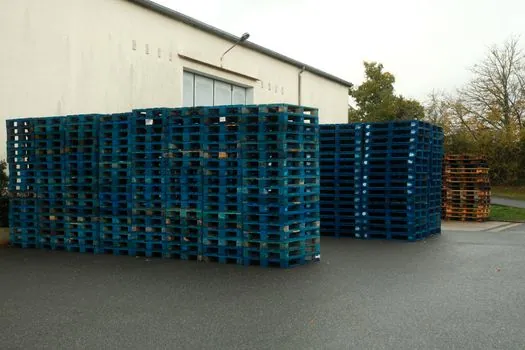
Lead time on new roll-formed selective rack out of North American mills is 4-8 weeks for standard teardrop and 10-16 weeks for structural or seismic-Z rated frames as of mid-2026, per current integrator guidance [S3][S5]. Used teardrop from a stocking distributor in Minnesota and the Midwest can be on a truck in 3-10 days for common beam lengths, with the catch that you inherit the existing paint and possible column damage [S1].
For a small electronics stockroom under 1,000 pallet positions, a used selective rack with a third-party inspection is a fine starting point. For a new build above 5,000 positions, or any build in a seismic design category C or higher, new rack with a PE-stamped layout is the only defensible answer, because the used market does not reliably stock matched-capacity frames for large runs [S4].
The integrator question matters because electronics DCs are layout-heavy, not just rack-heavy. A material handling integrator that does preliminary drawings, anchor plans, and permit sets will save a quarter of the design cost of a separate racking vendor plus structural engineer [S3].
Failure modes and what to inspect
Three failure modes show up repeatedly in electronics DC rack audits: column damage at the floor (forklift impact, not seismic), missing or loose anchors (often after a floor repair), and overloaded beams in a push back lane that was sized for a different pallet footprint. None of these are visible from a sales sheet; they are visible only on a floor walk. [S1]
The audit gates: anchor torque check on a sample of 1 in 10 base plates, column guard presence and height, beam safety clips on every beam (the wire pin is not a clip), and a load poster at every rack row showing the rated beam load and the heaviest pallet the row is actually carrying.
For a related spec map on the components that move inside the rack, see this roller bearing selection for material handling: 2026 spec map write-up, which covers the bearings behind the pallet stacker and flow-roller hardware on a flow lane.
Trackable signals for the next quarter: the UL 1973 listing cycle for lithium-ion rack storage, the ANSI MH16.1 revision status (seismic design maps and beam deflection factors), and any movement on powder-coat color standardization across major rack mills, which currently runs 12-18 stock colors and forces a paint touch-up on every mixed-fleet retrofit.