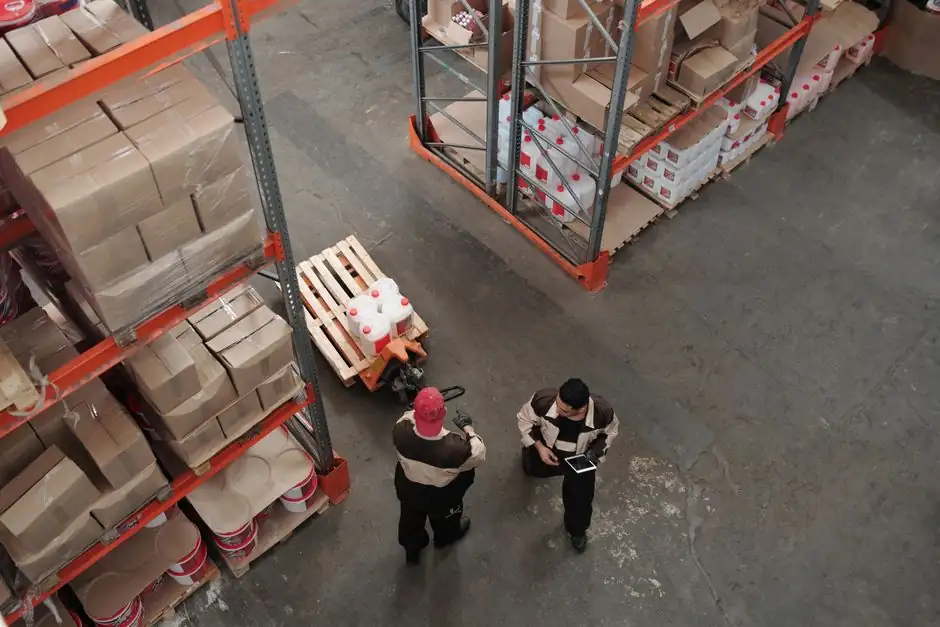
Selective teardrop pallet racks with 4,000–6,000 lb per pair of beams are the default for active pharmaceutical SKUs, with hot-rolled or cold-rolled ASTM A36 uprights and powder-coat or galvanized finish specified to keep the rack envelope cleanroom-friendly. Palletized pharma loads commonly run 250–1,500 lb per pallet, so beam capacity is almost always governed by the rack's stiffness and connection geometry, not the steel yield. AISI 1043
The core constraint in pharma distribution is not raw capacity; it is the combination of lot traceability, FIFO rotation, and the ability to clean around and through the rack envelope.
Upright and Beam Steel: Grade, Section, and Finish
Most spec-grade selective racks use roll-formed uprights from 2.0–3.0 mm cold-rolled steel strip, with yield in the 235–355 MPa band, which is the same range as structural A36 hot-rolled sections used in heavier American-style racks [S1][S4]. Box-closed profiles (closed-back columns with internal ribs) are now standard on racks rated above 6,000 lb per pair, because open-back C-sections lose torsional stiffness once frame height exceeds 24 ft.
Step-beam and box-beam cross-sections dominate the pharma tier; box beams in the 3.5–5.0 in. depth range deliver tighter deflection under 1,500 lb pharma loads and pair cleanly with the standard 1.5 in. or 2 in. upright slot pitch used on Interlake, Dexion, Schaefer, and Redirack-compatible frames [S4]. The teardrop key-lock connection is the de facto interface on import racks because the same teardrop accepts most replacement beam hooks, simplifying spare-part logistics across mixed-vendor sites.
Surface finish is a real spec gate in pharma-adjacent warehouses, not marketing. Hot-dip galvanized or epoxy powder-coat finishes reduce particulate shedding in ISO 7/Class 10,000 buffer zones, and bare mill-finish steel is rejected by most QA teams because cold-rolled strip can shed micro-flakes during forklift impact. A powder-coat line in the 60–80 µm thickness range is the commonly accepted band for ambient pharma distribution; thicker zinc duplex systems (galvanize plus powder) are used in cold-storage docks where condensation is persistent.
Capacity Math: Beam Load, Frame Load, and Deflection
Per-pair beam capacity is the number on the spec sheet, but the operating load in a pharma warehouse rarely pushes it; the typical 4,000 lb selective beam pair is operating at 1,000–1,500 lb, so the live-load safety factor is already 2.5–4x. The real failure driver is forklift impact at the end frame, which is why column protectors and row-end guards are specified, not optional. MHIA and EN 15635 both treat impact as a normal design case, not an exceptional one, and seismic zones multiply that by the horizontal load factor [S1].
Frame load (upright axial capacity) is computed as the sum of beam-pair loads on the frame, multiplied by the bay count. A 24 ft tall, 12 ft deep frame with four beam levels running 4,000 lb pairs carries roughly 16,000 lb per bay, and the floor-anchored baseplate is what actually transfers that to the slab; 0.5 in. wedge anchors at 4 in. embedment on a 6 in. slab is the typical install pattern in non-seismic US sites [S1].
Deflection, not yield, often controls serviceability. The common rule used by US rack engineers is L/180 vertical deflection at rated load, and L/200 for pick-facing beams where flat-card readability matters. Spec sheets from Asian OEM lines frequently publish higher deflections at the same rating; that is the single most important line item to check before accepting a low-bid quote on a regulated warehouse [S2][S5].
Selective vs Drive-In vs Push-Back vs Pallet Flow
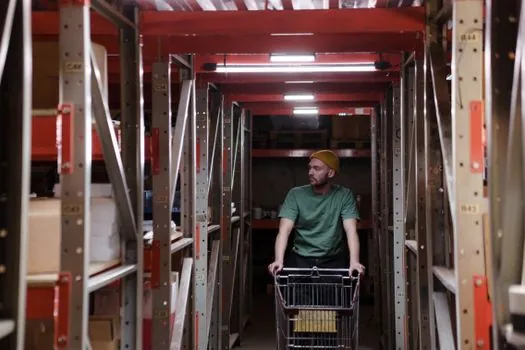
Selective teardrop gives 100% SKU access, uses the most floor space (aisle 8–10 ft for counterbalance or reach trucks, or 5–6 ft for turret trucks), and is the only system that supports true FIFO rotation. Drive-in and drive-through collapse aisle count by sharing the storage lane; first pallet in is last pallet out, so they only fit batch reserve and full-pallet overstock, not active picking. Push-back uses inclined carts on rails and gives LIFO with higher density than selective, around 2–6 pallets deep per lane, without a forklift entering the rack [S2].
Pallet flow (gravity carton flow on rollers) gives true FIFO at high density, but it requires a dedicated load and pick aisle, slope is factory-set (typically 1.5–2.0 in. per 10 ft), and it does not tolerate the variable pallet weights common in pharma. A look at the option stack by four decision criteria: density (drive-in highest, selective lowest), selectivity (selective 100%, drive-in 1 lane), FIFO capability (selective and pallet flow only), and forklift-driven install (selective and drive-in; push-back and flow need trained crew) [S2].
For a regulated pharma DC with active picking plus 5+ pallets of batch reserve, the typical hybrid is selective racking for the forward-pick face and either drive-in or push-back for the reserve in a separate zone. That keeps GMP zone separation clean and avoids using one rack type for two different inventory policies. A review of roller bearing selection for material handling: 2026 spec map is useful here, because the rollers inside push-back carts and pallet-flow lanes are the wear items that drive long-term maintenance cost.
Seismic, Anchoring, and Code Compliance
US seismic design for storage racks lives in the RMI/ANSI MH16.1 framework, and California's amendments plus local jurisdictions (LADBS, OSHPD) routinely demand site-specific seismic calculations on the permit set. The supplier's role here is to provide stamped calculations; the buyer's role is to provide the site's Ss and Sd values, the Importance Factor, and the site class [S1]. Anchoring is not a footnote, it is the load path: wedge anchors, sleeve anchors, or post-installed anchors in the 0.5–0.75 in. diameter range are common, and the slab must be verified for thickness, compressive strength, and rebar clearance before install.
Outside the US, EN 15635 (steel static storage systems) and the EN 15512 (design) pair govern the European market, while Chinese GB/T 28576 covers rack performance testing; many Asian OEMs also publish FEM 10.2.06 calculations on request for export projects. For Canadian projects, CAN/CSA B72 governs seismic design. The same rack profile (e.g. 3 in. x 3 in. upright, 12 ga) can carry different rated loads under each code, so a single spec line without a code reference is a known source of procurement error.
For pallet rack frames paired with adjacent powered assets in a pharma warehouse, the power distribution box and power distribution feeds for any rack-integrated scanners or conveyors need to be designed around the seismic displacement of the rack; a 12 in. lateral at the top of a 24 ft frame in a high-seismic zone is not unusual, and that movement has to be accommodated in flexible cable routing.
Cleanroom, ESD, and Lot-Traceable Operations
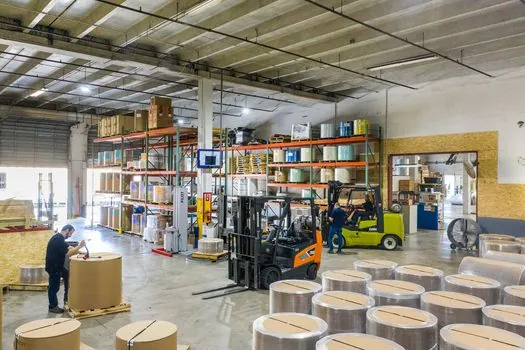
Pharma distribution does not always sit inside an ISO-classified cleanroom, but the cold-chain and packaging buffer zones often do. Rack selection in those zones favors stainless or galvanized uprights, smooth-welded or fully-enclosed baseplates, and either no floor anchoring (mobile compactor) or anchoring patterns that do not generate concrete dust during install. Epoxy floors in 2–3 mm thickness are commonly used under racks in pharma buffer zones to enable wash-down and to seal the slab against biological growth [S2].
For controlled-temperature storage (2–8 °C cold rooms), rack steel must be specified for the temperature band; standard A36 retains adequate toughness down to roughly -20 °C, but galvanic compatibility with floor coatings, anti-condensate heaters, and refrigerant line hangers becomes a real engineering interface. A reference cross-check against AGV robot selection for retail distribution: 2026 spec, payload, and topology gates is useful for sites planning autonomous retrieval, because the rack's bay width, floor flatness tolerance, and upright skew directly limit AGV reach envelope.
Storage rack encyclopedic reference for spec-builders, including column-and-beam frame geometry and common failure modes, sits in the pallet rack entry; the broader storage rack page covers cantilever, carton flow, and mezzanine interfaces. A practical explosion-proof distribution panel is the right call only where the rack zone sits inside a classified hazardous area, which is rare in pharma but real in solvent warehouses co-located with API plants.
Procurement, Inspection, and Lifecycle Costs
Lifecycle cost in pharma rack decisions is dominated by impact damage, not corrosion; a single forklift strike can take an end frame out of service for a week while replacement parts are sourced. The pragmatic mitigation is to spec a small emergency stockpile of column protectors, row-end guards, and one spare pair of beams per 100 bays, and to contract the supplier for a 24–48 hour replacement-parts SLA [S1].
On the used-rack side, US brokers in the San Francisco Bay Area and Delhi/NCR regions actively buy, sell, and rent compatible teardrop frames, and the OEM-compatibility claim (Interlake, Dexion, Schaefer, Redirack) is the right search filter when sourcing [S1][S3]. For new racks out of Asia, the credible suppliers on Made-in-China publish load-test reports and CE documentation but vary widely in stated deflection; the due-diligence pass is to require independent test data and a FEM/MH16.1 calculation, not just the spec sheet [S5].
Signals to track between now and the next quarterly review: updates to RMI/ANSI MH16.1 seismic provisions (published on roughly a 5-year cycle), EN 15512 amendments, and any post-incident updates from FM Global on rack fire-sprinkler density rules. On the operations side, watch for AGV-vendor rack-compatibility lists and for warehouse-DC insurance carriers tightening seismic-anchoring documentation requirements.