
Roll-formed selective pallet rack remains the dominant storage system for chemical shipping operations, with stocking distributors carrying step beams, teardrop frames, and wire decking in standard 96 in. and 108 in. frame heights for drum and tote loads [S1][S2].
For chemical drum loads in 30-55 gallon containers, common bay capacities run 20,000-30,000 lb per pair of beams, and pallet support channels, column protectors, and row spacers are specified alongside the rack to control fork impact and aisle geometry [S2][S3].
Selection criteria for chemical-shipping bays
Four variables drive a chemical-shipping rack spec: palletized load weight, drum/container type, deck drainage need, and corrosion exposure, with frame finish and beam gauge typically locked in after those four are resolved [S1][S3]. For IBC tote loads in 275 gallon polyethylene cages, expect loaded pallet weights of 2,800-3,200 lb, which usually require medium-duty roll-formed beams rated at 5,000-6,000 lb per pair at standard 96 in. spans [S2]. Steel drum loads on 4-drum pallets commonly push 2,000-2,400 lb and fit comfortably on light-to-medium selective beams with wire deck overlays for spill containment [S1][S4]. Liquid chemical bays almost always specify wire decking rather than solid steel or wood decks, because the open grid catches drips at the pallet interface and supports sprinkler spray patterns in fire-rated warehouses [S1][S2][S4].
Roll-formed vs structural: which fits chemical shipping
Roll-formed teardrop frames dominate chemical-shipping installations because the bolted teardrop connection lets damaged uprights be swapped without cutting or welding, a critical feature in aisles exposed to corrosive vapor or repeated fork impact [S1][S2][S3]. Structural channel rack, with welded or bolted C-channel beams, is reserved for heavy-pallet chemical operations, for example steel-drum stacks above four high or palletized bag-in-box acid loads above 4,000 lb, where frame-section stiffness and heavier beam gauges (4 in. or 6 in. structural step beams) are required [S1][S3]. A practical comparison: roll-formed selective at typical capacities 20,000-30,000 lb per bay, lead time measured in days from Ohio or East Coast stocking warehouses [S1][S3]; structural selective at 30,000-50,000+ lb per bay, lead time commonly 3-6 weeks because most stocking distributors do not inventory structural step beams [S1][S2][S3]. Most chemical warehouses specify roll-formed teardrop first, then upgrade to structural only where the pallet weight or fork-truck class (5,000 lb capacity stand-up counterbalance vs 3,000 lb reach) pushes beyond roll-formed limits [S1][S2][S3].
Decking, containment, and drainage hardware

Wire decking is the default chemical-shipping deck because the welded wire grid catches minor drum leaks at the pallet interface while still passing water through the bay, and standard 46 in. x 44 in. wire decks fit a GMA-style 48 in. x 40 in. pallet footprint with safe overhang on all four sides [S1][S2][S4]. Two wire-deck patterns dominate chemical warehouses: 2 in. x 4 in. rectangular grid (J & L Wire, Nashville Wire Products) for general drum/tote storage, and 1.5 in. x 4 in. denser grid for smaller containers where smaller items can fall through the larger openings [S2]. For operations storing FIFRA- or RCRA-regulated liquids, rack layout typically pairs wire deck with a separate floor-level spill pallet, not a deck-level containment pan, because deck-level pans add dead load and trap water that accelerates frame corrosion in coastal or wash-down environments [S1][S3]. Pallet support channels (often 1.5 in. x 5/8 in. cold-rolled channel) are specified in lieu of wire deck only for sealed GMA pallets of dry goods, never for open-head drums where the channel can pinch the drum chime [S2].
Frame finish and corrosion control for chemical exposure
Standard powder-coat frames (manufacturer-standard gray or safety yellow) are the baseline for indoor chemical warehouses, and one East Coast distributor explicitly markets Made-in-USA roll-formed rack and wire deck as the default SKU for general chemical storage [S1][S3]. For wash-down, coastal, or chloride-exposed aisles, hot-dip galvanized frames and pre-galvanized wire decks are the practical upgrade, because the zinc coating sacrifices before the steel and the galvanic layer holds up under repeated rinse cycles far better than a single-coat powder finish [S1][S2]. Stainless (304/316) rack components are rarely specified outside pharmaceutical or food-grade chemical bays, because the cost premium roughly 4-6x the powder-coated baseline per linear foot is hard to justify for general hazardous-chemical drum storage, and hot-dip galvanizing covers the corrosion envelope at a lower cost premium [S1][S3]. Column protectors (ram-guard style bolted to the floor at the rack base) are routinely added in chemical aisles because fork impact is the most common failure mode for upright frames in this service, and a single column protector retrofit is far cheaper than a full-frame replacement after a forklift strike [S2][S3].
Code, fire, and seismic gates for chemical bays
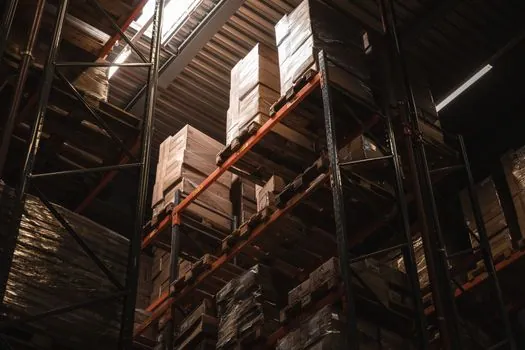
Three compliance gates matter for a chemical-shipping rack: seismic bracing per the local building code, NFPA 13 sprinkler interaction, and OSHA 1910.176 material-handling clearances, with most stocking distributors in the US carrying engineered seismic kits for Risk Category II/III facilities [S1][S2][S3]. Seismic kits typically add cross-aisle and down-aisle bracing, heavy-duty base plates, and anchor bolts that pull the rack frame to the floor slab, with the exact kit content driven by the seismic design category (SDC) and the rack height-to-base ratio [S1][S3]. NFPA 13 generally treats palletized commodity storage differently from open-frame rack storage, and chemical warehouses storing Group A plastics in drums typically need either in-rack sprinklers or a higher ceiling-only density, which in turn drives beam spacing and frame height choices at the layout stage [S1][S2]. OSHA 1910.176(c)(1) requires at least 18 in. clearance between the rack face and aisle for hand/pallet-truck operation, and most chemical-shipping layouts bump that to 12 ft for counterbalanced fork trucks with a 180-degree turning radius, which has to be locked in before frame count and beam length are quoted [S1][S2].
Manufacturer ecosystem and where to source
Five North American rack manufacturers dominate the chemical-shipping channel: Ridg-U-Rak, Steel King, Nashville Wire Products (wire deck), J & L Wire (wire deck), and the legacy Interlake/Mecalux teardrop installed base, with most stocking distributors carrying at least three of those brands in new and used inventory [S2][S3]. Used pallet rack is a significant supply channel, with one East Coast distributor advertising 35 years of new-and-used roll-formed inventory and a separate Ohio-based distributor describing itself as that state's largest stocking supplier of both new and used racking [S1][S3]. A complete chemical-shipping bay spec typically bundles frame, pair of beams, two wire decks, four safety clips, two column protectors, and the seismic anchor kit, and this is the SKU set that the major US stocking distributors quote in 48 hours from regional warehouses in Pennsylvania, Minnesota, Ohio, and Connecticut [S1][S2][S3][S4]. For European-spec chemical sites, stow group markets racking systems produced to the highest quality standard with scalable safety features, which matters when a US-rolled frame is being evaluated against a EU-EN 15635 load-marked alternative at a multi-national plant [S5].
Who this is for, and where the spec breaks

This spec map fits drum, tote, and palletized bag chemical operations inside a fixed warehouse footprint, and it does not fit outdoor drum storage, where open-mesh cantilever or covered outdoor rack is the correct system, or flammable-liquid warehouses where FM Global data sheet 8-9 may require narrower rack spans and additional in-rack sprinklers [S1][S2][S3]. It also assumes a slab of adequate thickness for seismic anchor pull-out; facilities with marginal slabs need a slab analysis before the rack is anchored, because a seismic kit on a thin slab is worse than no kit at all [S1][S3]. For broader e-commerce and pallet-rack context, see the pallet rack selection for e-commerce fulfillment guide, and for the air-solenoid side of a chemical packaging line, the Air Solenoid Valve Selection for Chemical Processing: 2026 Spec Map covers the pneumatic controls that ride above these racks.
Track the next stocking-distributor inventory refresh dates at Mustang Material Handling and Pallet Rack Now, and the next NFPA 13 cycle affecting in-rack sprinkler rules for Group A plastic drum storage; both will move the spec map before the next major re-quote.
The underlying component specifications are covered under pallet rack, storage rack, and chemical anchor.