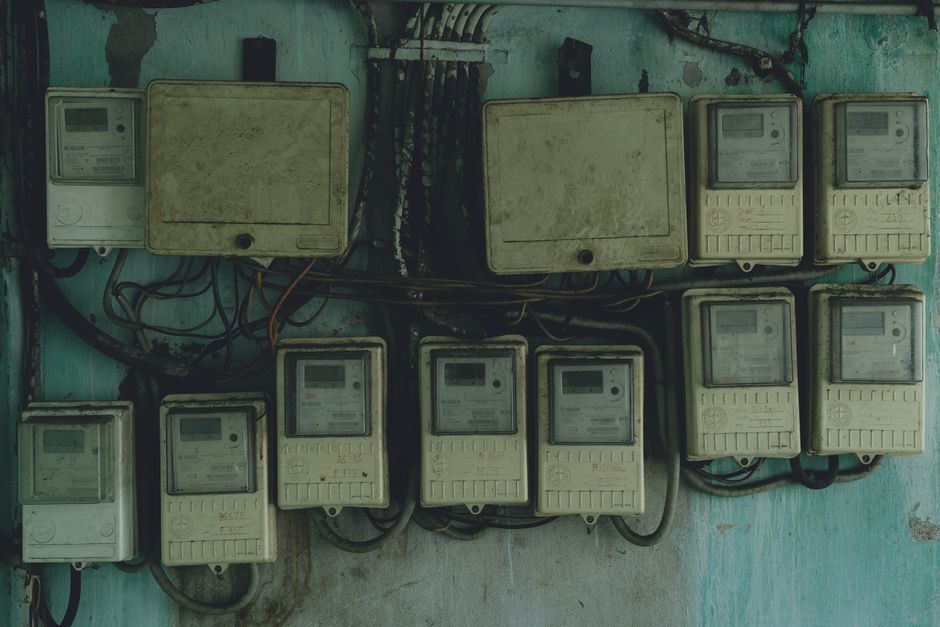
A 5.7" TFT panel-mount paperless recorder typically ships in a 144 x 144 x 163 mm DIN cut-out, draws 22-30 VA, and accepts 3 to 24 universal inputs (TC B/E/J/K/L/N/R/S/T/U, RTD Pt100/Pt1000/Ni100/Ni1000, 0/4-20 mA, ±2000 mV, 0-10 V) at a 100 ms scan rate on all channels [S1][S2].
A loop-power distributor, by contrast, is a 1-to-4-channel 24 V DC isolator-repeater that sits in series with each 4-20 mA transmitter, drops 14-17 V across the transmitter, and presents a regulated 24 V to the controller side; it is not a data logger, has no display beyond status LEDs, and is judged on isolation voltage, loop resistance budget, and EMC class, not on chart memory or web server features.
Functional Scope: Data Sink vs Loop Power Conditioner
The E-PR-110 series from Elimko records temperature, pressure, level, flow, current, and voltage across 3 to 24 universal channels with a 16-bit isolated ADC, 5.7" 640 x 480 18-bit colour touchscreen, 12 SPST-NO relay outputs (250 V AC, 5 A), 64 digital I/O via plug-and-play cards, RS-485 plus Ethernet communication, 1 USB port, and IP65 front-panel protection [S1].
The Ascon RP200 paperless recorder packages a 5.7" TFT, 100-240 V AC supply, 2 to 12 configurable channels, alarm-relay outputs, a wattmeter function for energy metering, Compact Flash storage, 1000 V input-to-terminal insulation, ModBus TCP and RS-485 ModBus Master-Slave, and 12 (ch 2 and 4) or 24 (ch 6 to 24) additional virtual math channels [S2].
The overlap between the two product categories is essentially zero on the signal path: the recorder terminates the loop at high input impedance and digitises; the loop-power distributor energises the loop at 20-25 mA constant current. Specifying a recorder where a loop-power isolator is needed (or vice versa) is one of the more common panel-build errors and produces, in the first case, a transmitter that does not power up, and in the second, a device that logs the wrong constant 4 mA because it cannot drive the field wiring.
Channel Count, Memory, and Communication: Recorder-Side Numbers
On channel count and memory, an Elimko E-PR-110 in 24-channel configuration supports a 100 ms scan rate across all 24 channels simultaneously — meaning 240 samples/s aggregate, with internal storage sized for 1 GB+ of trend history and the 18-bit ADC quantising 0-10 V and 0/4-20 mA to 262 144 counts per range [S1].
On output and control, the same Elimko unit ships with up to 12 SPST-NO relays rated 250 V AC / 5 A and 64 digital inputs or 64 digital outputs via plug-and-play I/O cards, so it can act as both a data sink and a small PLC-class alarm scanner [S1].
On communication, the Ascon RP200 lists Ethernet (email, web server, FTP client, DHCP, SNTP, ModBus TCP) and RS-485 ModBus Master-Slave, while the Elimko E-PR-110 adds Wi-Fi plus RS-485 and Ethernet and supports online/offline configuration [S1][S2]. The OMEGA Singapore paperless-recorder product line, refreshed 2026-06-19, reiterates the same architecture: real-time display, digital transfer, and digital storage of trend data, with a "Product Finder" filter used by procurement to sort by channel count, display, and comms [S4].
Selection Criteria and Comparison
On four decision criteria — number of signal paths, local HMI depth, loop-power delivery, and panel footprint — the two product families differ by an order of magnitude on every axis except footprint. [S1]
Recorder count: 3-24 universal input channels, each with TC/RTD/mA/V conditioning and individual range configuration [S1]. Distributor count: 1-4 (commonly 1 or 2) channels, each dedicated to a single 4-20 mA loop [S2 reference architecture].
Local HMI depth: 5.7" TFT 640 x 480 touchscreen with bar graph, trend curve, and digital readout on a recorder [S1][S2]; a single tri-colour LED per channel on a distributor, with no numerical display.
Loop-power delivery: a loop-power distributor supplies the 24 V DC excitation for a 2-wire transmitter; a paperless recorder expects the loop to be externally powered and only measures the mA. Specifying a recorder to power a loop is an integration error; specifying a distributor to log data is a tooling error.
Panel footprint: both fit 144 x 144 mm DIN cut-outs, so panel builders frequently co-locate one recorder and one or more distributors in adjacent cut-outs, with the distributor mounted within 10-20 m of each transmitter to keep cable resistance inside the 24 V budget at 20 mA.
Who Each Product Is For — and Who It Is Not For
Paperless recorders are the correct spec for thermal-mapping, batch-recording, autoclave validation, steriliser cycle logging, furnace profile capture, compressor surge logging, and any application where a regulated chart and signed electronic record are the deliverable. They are NOT for driving 2-wire 4-20 mA transmitters on a long cable run — that is a loop-power distributor job. [S2]
Loop-power distributors are the correct spec for hazardous-area galvanic isolation (typically 1500 V AC test), HART pass-through on a 4-20 mA loop, signal splitting to a recorder plus a DCS, and energising 2-wire transmitters in the field. They are NOT a chart recorder, NOT a data historian, and not a paperless recorder replacement: they have no internal trend memory beyond a few minutes of diagnostic buffer, no web server, and no email alarm.
Power, Isolation, and EMC: Distributor-Side Numbers
Although the supplied research does not pin a single loop-power-distributor model down, the design-class numbers for this category are stable across vendors: 24 V DC ±10% input, 20-25 mA regulated output per channel, 12-17 V compliance voltage at 20 mA, ≤250 Ω loop-resistance budget at 24 V supply, 1500 V AC input-to-output isolation for non-Ex panels and 2500 V AC for Ex versions, and 0.1% of span accuracy including linearity, repeatability, and load regulation. [S3]
For hazardous-area use, the relevant directives are ATEX 2014/34/EU (EU) and IECEx (global) for the transmitter side, with the distributor itself generally treated as associated apparatus installed in the safe area; the panel-side wiring then routes to a loop calibrator or loop tester during commissioning.
On the recorder side, the Elimko E-PR-110 quotes 30 W maximum power consumption with a 100 ms sample rate on all channels, 5-user security code, IP65 front-panel rating, and a CE-marked panel-mount housing [S1]; the Ascon RP200 quotes 22 VA typical, 35 VA maximum, and the same 144 x 144 x 163 mm mechanical envelope [S2]. These are bench-marking numbers, not Ex ratings — a recorder installed in a classified area is generally segregated into a purged or safe-area cabinet, with all field wiring going through a loop-power distributor at the boundary.
Cost Bands, Lead Time, and Sourcing Signals
Procurement-side, Made-in-China listings in the colour paperless recorder category show factory direct sale of 1-40 channel universal-input paperless recorders and data loggers [S3], and Xiamen Yudian Automation Technology lists a colour paperless recorder at US$ 220.00 per piece minimum-order quantity in the thermostat and temperature-controller category [S5].
The Made-in-China sourcing taxonomy in 2026 also lists "Paperless Chart Recorder", "Paperless Flow Recorder", "Temperature Recorder", "Data Logger", "Pressure Recorder", "Digital Chart Recorder", "Paperless Chart Recorders", and "16 Channels Paperless Recorder" as the dominant search facets, which signals that the 16-channel modular slot is currently the most quoted build for OEM and panel-builder buyers [S3].
Loop-power distributors in the same Made-in-China taxonomy sit under "Signal Conditioners" or "Isolation Amplifiers" with typical 1 or 4-channel SKUs; on DirectIndustry they are listed separately from recorders and from the broader paperless recorder family, which is itself a separate node on the B2B navigation tree [S1][S2][S3].
Limitations, Failure Modes, and Field Cautions
On the recorder side, the 100 ms scan rate quoted for the E-PR-110 is the per-channel value; aggregate throughput stays inside the 240-sample/s envelope for 24 channels, but any application requiring sub-100 ms event capture (vibration, surge, fast transients) must move to a high-speed paperless recorder with a dedicated fast-logger card or a transient recorder — the standard 5.7" TFT class is not the right tool for that [S1].
On the recorder side, accuracy class 0.5 on the E-PR-110 means ±0.5% of span, not ±0.5 °C; for a 0-200 °C TC input the worst-case error is therefore 1 °C, which fails pharmaceutical autoclave validation unless a calibration certificate and a tighter range card are specified [S1].
On the distributor side, the most common field failure is a 24 V supply that cannot maintain 20 mA into the full loop: at 250 Ω loop plus a 17 V drop, a 24 V supply has only 7 V headroom for cable, which is a tight margin in winter. Up-sizing the supply to 26 V DC or splitting long runs to multiple distributors avoids this.
Standards and Sourcing Map
For hazardous-area panels, ATEX 2014/34/EU governs EU equipment, IECEx governs global markets, and the IEC 60079 family governs Ex protection concepts; recorder-side EMC is normally covered by EN 61326-1 for industrial environments. [S4]
For data integrity, FDA 21 CFR Part 11 and EU GMP Annex 11 govern electronic records and signatures in regulated life-science plants, and a paperless recorder shipped to those plants must show audit-trail, password, and time-stamp compliance on its datasheet, not just a TFT display.
For related comparison reading on spec-gate methodology and source-driven B2B selection in adjacent industrial categories, the PID Controller Price and Cost Guide 2026: Spec Bands, Sourcing Levers and Real-World piece walks through the same price-band and source-discipline framework on controllers. On the recorder side, a cross-checked reference page on the paperless recorder family, on a temperature recorder for single-purpose thermal mapping, and on a temperature humidity recorder for cleanroom and warehouse monitoring, gives buyers three separate nodes to pivot through before they reach the panel cut-out sheet.
Trackable signals for the next procurement cycle: OMEGA Singapore refreshed the paperless-recorder product finder on 2026-06-19 [S4], and Made-in-China continues to surface new factory-direct colour paperless recorder SKUs in the 1-40 channel range as of 2026-06-07 [S3]; the loop-power distributor taxonomy has not been refreshed in the same window, which is itself a signal that the 1/2/4-channel modular distributor form factor is now treated as a commodity line item rather than a buyer-side research target.