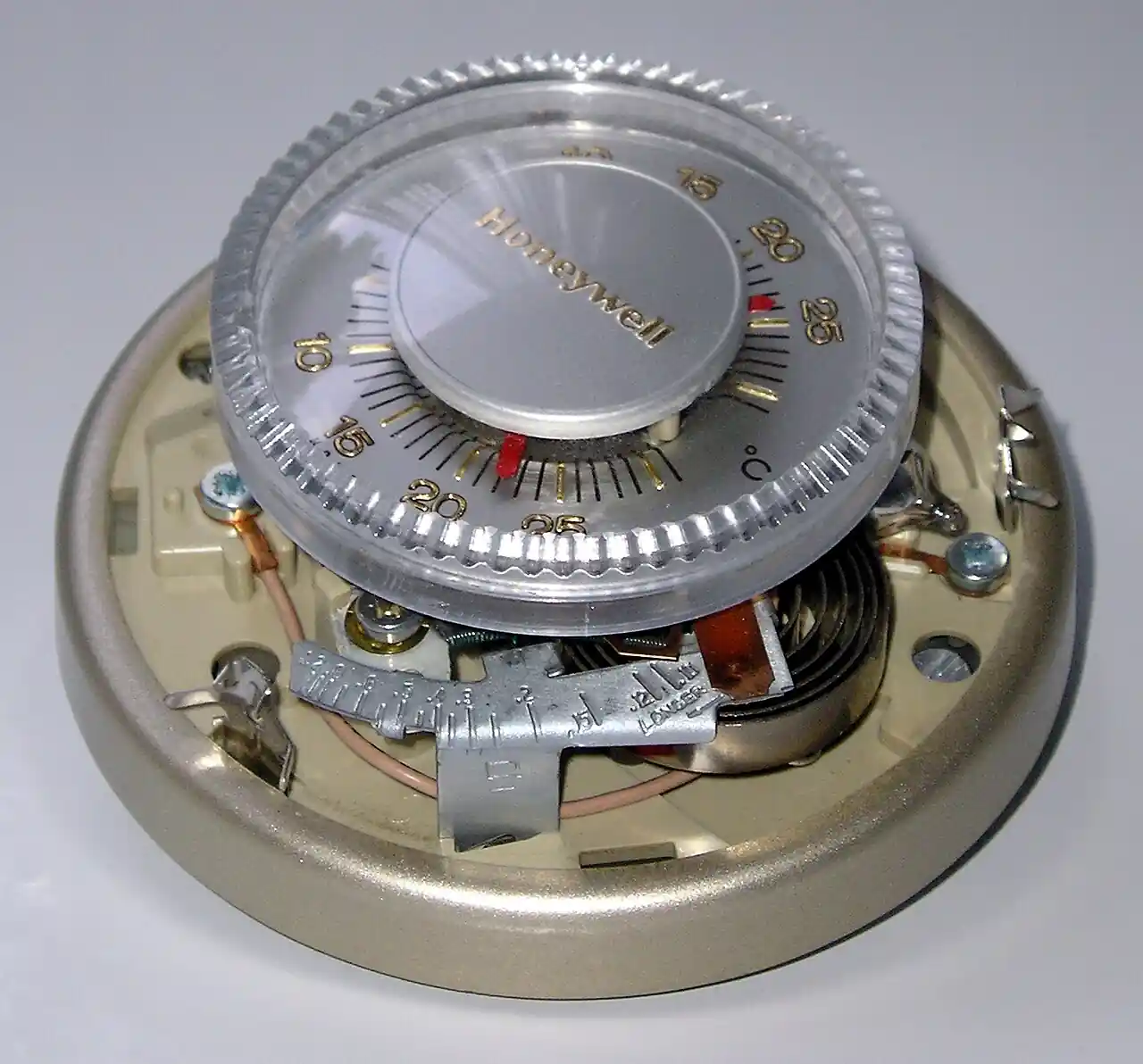
A thermostat is a self-contained control device that switches an electrical circuit on or off when temperature crosses a preset value. It is the most widely deployed temperature control element in the world, from the bimetal disc inside a kettle to the wall stat that governs a building HVAC loop. Unlike a panel temperature controller, a classic thermostat does not display a process value or run a tuning algorithm: it senses, compares against a fixed or dial-set point, and switches a contact with a built-in differential.
This guide treats the full thermostat family used in industrial, commercial, and appliance work: mechanical bimetal and bulb-and-capillary devices, wax-element valves, snap-action limits and thermal cut-outs, and modern electronic, programmable, and communicating thermostats. The aim is to map a process requirement to a sensing principle, a voltage class, a switching differential, and a governing standard, so an engineer can specify the right part rather than the cheapest one.
This guide is aimed at industrial purchasing engineers and design engineers. It covers 6 chapters from sensing principles, mechanical and electronic types, voltage and switching classes, spec-sheet decoding, to selection decisions, with 7 selection FAQs and manufacturer comparisons. All parameters reference the IEC 60730 series (Part 1 general, Part 2-9 temperature sensing controls), EN 215 for thermostatic radiator valves, and ASHRAE Standard 55 and 90.1 public references.
Chapter 1 / 06
What is a Thermostat
A thermostat is a temperature-actuated switch. It contains a sensing element that responds to temperature, a setpoint mechanism that defines the switching value, and an electrical contact that opens or closes to start or stop a heating or cooling load. The word comes from the Greek for "constant heat," and the defining behavior is on-off action: a thermostat does not modulate output, it commands a load fully on or fully off as temperature crosses a threshold. Because of an intentional switching differential between the trip point and the reset point, the controlled temperature always cycles within a band rather than holding a single value.
It is important to separate a thermostat from two neighboring devices that engineers often conflate. A temperature sensor, such as a thermocouple or RTD, only produces a signal proportional to temperature and switches nothing. A temperature controller is a microprocessor instrument that reads such a sensor, displays the value, and runs an algorithm, including PID, to modulate an output. A thermostat sits between them as a complete but minimal device: it senses and switches in one self-contained unit, usually with no display and no tuning. On a typical purchase order the word thermostat denotes the inexpensive mechanical or basic electronic switch, while the panel instrument is called a controller.
The history of the thermostat is one of the oldest in automatic control. In 1620 Cornelis Drebbel built a mercury thermostat to regulate a furnace, and in 1830 Andrew Ure patented a bimetal version for textile mills. In 1883 Warren Johnson patented a room thermostat for buildings and founded what became Johnson Controls. In 1886 Albert Butz patented the damper-flapper furnace control that grew into Honeywell. The snap-action bimetal disc that defines modern limit thermostats was commercialized by Spencer Thermostat, later the Klixon brand now owned by Sensata Technologies. Electronic thermostats arrived with low-cost semiconductors in the 1980s, and connected, learning thermostats reached the mass market after 2011.
The application scale of thermostats is enormous. The same functional element appears in a 5 USD appliance limit switch, a 30 USD residential wall stat, and a several-hundred-dollar explosion-rated process thermostat for a hazardous-area heater. Temperature ranges run from cryogenic freezer controls near minus 40 degrees Celsius to furnace and exhaust limits above plus 300 degrees Celsius, with one-shot thermal cut-offs available well beyond that. No single thermostat spans this range; selection is the act of matching a sensing principle, contact rating, differential, and enclosure to a specific duty.
Four engineering attributes determine whether a thermostat is fit for purpose: the calibration tolerance at the setpoint, the switching differential, the contact rating relative to the load it must break, and the action type, meaning whether it is an operating control or a protective limit. These attributes, more than brand or price, decide reliability over a service life that for a buried appliance limit may exceed a decade of unattended cycling.
Chapter 2 / 06
Thermostat Types and Classification
Thermostats can be classified along several independent axes: by sensing principle (bimetal, bulb-and-capillary, wax element, electronic), by control voltage (line voltage versus low voltage), by function (operating control versus protective limit), and by reset behavior (auto reset, manual reset, one-shot). Mixing these axes is the most common source of selection error: a buyer may correctly pick a bimetal disc but specify an auto-reset where a manual-reset safety limit is legally required. The table below summarizes the major families an engineer will encounter.
Bimetal disc thermostats are the workhorse of fixed-setpoint switching. A dished bimetal disc holds one curvature until temperature reaches its calibration point, then snaps to the opposite curvature, driving a contact open or closed in a single crisp motion. There is no slow drift across the contact, which avoids arcing and contact welding. These devices are sealed, compact, need no external power to sense, and are produced in the hundreds of millions for appliance limits and motor overload protection. The Klixon and Therm-O-Disc lines are the reference products in this family.
Bulb-and-capillary thermostats place a fluid-filled bulb at the point to be sensed and connect it through a thin capillary tube to a bellows or diaphragm at the dial. Fluid expansion drives the bellows against a snap-action switch. Their advantage is remote sensing: the dial and contacts can sit on a panel while the bulb reaches into an oven cavity, a tank, or a duct several meters away. The dial gives an adjustable setpoint over a wide range, which is why they govern ovens, deep-fat fryers, and water heaters. Their differential is usually fixed near 2.5 percent of the scale range and is not user-adjustable, and better units add ambient compensation so a change in dial-head temperature does not shift the trip point.
Wax-element thermostats do not switch a contact at all; they actuate a valve. A sealed charge of wax expands sharply through its melting transition, driving a piston that strokes a valve stem. The classic example is the thermostatic radiator valve, where the head modulates hot-water flow to hold a room setpoint, and the automotive engine thermostat, which opens a coolant bypass near 85 to 90 degrees Celsius. Wax elements are modulating and self-powered but slower than electronic control; liquid-charge heads respond faster than wax. Line and low voltage room thermostats and smart thermostats are treated in detail in Chapter 4, since their defining distinction is electrical rather than thermal.
Chapter 3 / 06
Sensing Principles and Technologies
Every thermostat converts temperature into a mechanical or electrical change that ultimately moves a contact. Four sensing technologies dominate: bimetal expansion, fluid expansion in a bulb, wax phase change, and electronic thermistor measurement. Each has a characteristic accuracy, response speed, cost, and temperature envelope, and none is universal. The comparison table below frames the engineering trade-offs before each principle is described.
Bimetal sensing bonds two metals with different coefficients of thermal expansion, typically a high-expansion alloy such as brass or a nickel-manganese-iron grade laminated to low-expansion Invar (a 36 percent nickel-iron alloy with near-zero expansion). When heated, the laminate bends toward the low-expansion side. In a strip form this deflection is gradual and is used in dial thermometers and slow contacts; in a dished disc form it stores elastic energy and snaps over at the calibration temperature, giving the positive switching that defines a limit thermostat. The element needs no power to sense, tolerates shock and vibration, and is inherently fail-safe in many designs, but its tolerance is coarse and its self-heating under contact current adds error.
Fluid expansion sensing fills a metal bulb with a liquid, a gas, or a vapor-pressure charge whose volume or pressure changes with temperature. The change is transmitted through a fine capillary to a bellows or diaphragm that strokes a snap switch. Liquid-charge systems give a near-linear scale; vapor-pressure charges are nonlinear but immune to capillary-length errors and need no ambient compensation. The key engineering caution is that with liquid and gas charges the temperature of the capillary and the dial head can shift the reading, which is why quality units are ambient compensated. Bulb materials are usually copper or stainless steel, with stainless required for corrosive or food-contact duty.
Wax-element sensing exploits the large, repeatable volume change of a paraffin wax as it melts. Sealed in a brass cup with a rubber boot and a piston, the wax expands several percent through its transition and drives the piston with high force, enough to stroke a valve against system pressure. The transition temperature is set by the wax formulation. Wax motors are robust and self-powered and are the standard for automotive engine thermostats and thermostatic radiator valve heads under EN 215, but they are slow and have noticeable hysteresis, so they suit modulating valve duty rather than precise switching.
Electronic sensing reads a negative-temperature-coefficient thermistor, or sometimes an RTD or silicon sensor, with a microcontroller that compares the measured temperature to a stored setpoint and drives a relay, triac, or low-voltage signal. This is the basis of every digital, programmable, and smart thermostat. It offers the tightest tolerance, the fastest response, an arbitrary and software-defined differential, scheduling, multi-stage staging, and network communication. Its disadvantages are that it needs a power supply, commonly drawn from the 24 V common wire or a battery, and that the sensor must be sited away from self-heating electronics or a warm wall to read true room temperature.
Chapter 4 / 06
Voltage Classes, Wiring, and Standards
For room and equipment thermostats the single most consequential classification is the control voltage, because it determines wiring, contact rating, and whether the thermostat switches the load directly or merely signals a control board. Getting this wrong is not only a malfunction but a safety hazard, since the two classes use incompatible wiring. The table contrasts the two voltage classes side by side.
Attribute
Line Voltage Thermostat
Low Voltage Thermostat
Operating voltage
120 or 240 V AC
24 V AC
Role
Switches the heater load directly
Signals a control board or relay
Contact current
Up to ~22 A resistive
Milliamps
Wiring
Mains-rated, thick conductors
Thin low-voltage bell wire
Typical control swing
±2 to ±4 °C
±0.5 to ±1 °C
Typical loads
Baseboard, convector, unit heater
Furnace, heat pump, air handler
Line voltage thermostats are wired in series with the heating load and carry its full current. They are the standard control for electric baseboard, convection, and resistance heaters, where there is no central control board to signal. Because the contacts make and break a large resistive or inductive load, the contact rating must be checked against the heater wattage with margin, and the thermostat must be rated for the supply voltage. Their bimetal sensing tends to allow a wider swing, often several degrees, before switching. Electronic line voltage stats reduce that swing but still must carry mains current through their relay.
Low voltage thermostats operate a 24 V AC class-2 control circuit fed from the equipment transformer and do not handle load current. They send a call to the furnace or air-handler control board, which switches the actual heating, cooling, and fan loads through relays and contactors. This separation is why central HVAC almost universally uses 24 V control: one transformer powers many control devices safely, wiring is small, and the thermostat can be electronic and precise. The terminal letters R, W, Y, G, and C, with O or B added for heat pumps, define the call functions, and the C common conductor supplies continuous power to a smart thermostat. The thermostat reacts more tightly here because it only switches a signal, not a load.
The governing safety framework for both classes is the IEC 60730 series, Automatic electrical controls. Part 1 sets general requirements, and Part 2-9 covers particular requirements for temperature sensing controls, explicitly listing boiler thermostats, fan controls, temperature limiters, and thermal cut-outs. The standard is adopted as UL 60730 and CSA E60730 in North America and as EN 60730 in Europe, where it underpins CE marking under the Low Voltage and EMC directives. IEC 60730-1 classifies a control by its action type, where Type 1 is an operating control and Type 2 is a protective control, and for electronic controls it adds software safety Classes A, B, and C according to how the software is relied upon for safe operation. The 6th edition of UL/IEC 60730-1, published in 2024, tightened several of these electronic and functional-safety requirements.
Adjacent standards cover specific product classes. EN 215 defines requirements and test methods for thermostatic radiator valves, including hysteresis, response time, and the influence of water temperature and differential pressure. Thermal comfort and energy performance of building thermostats are referenced through ASHRAE Standard 55 for acceptable thermal environments and ASHRAE 90.1 for energy-efficient design, which mandate setback and deadband capabilities. One-shot non-resettable thermal cut-offs follow their own component standards such as the UL 60691 series. Panel temperature controllers, as noted earlier, are not in scope of IEC 60730 and instead fall under the IEC 61010 series for measurement and control equipment.
Chapter 5 / 06
Key Specification Parameters
A thermostat datasheet lists fewer numbers than a transmitter spec, but each one drives selection and a misread can cause nuisance tripping, contact failure, or an unsafe omission. Eight parameters truly matter: setpoint range, calibration tolerance, switching differential, contact rating, action and reset type, time delay or response, dielectric and ingress protection, and approvals. Each is explained below.
Setpoint range is the span over which the device can be set or is factory-fixed. Fixed bimetal limits are specified at a single nominal value, for example open at 120 degrees Celsius, while adjustable bulb thermostats give a dial range such as 30 to 320 degrees Celsius. Choose a range where the operating point sits well inside the scale, because accuracy and repeatability degrade near an end stop. Calibration tolerance is the permitted deviation of the actual trip point from the nominal value at the reference condition. Snap-action bimetal discs typically hold a few degrees, while electronic thermostats hold to within about ±0.5 to ±1 degree Celsius of the displayed setpoint.
Switching differential, also called hysteresis or dead band, is the gap between the trip temperature and the reset temperature. It is essential, not a defect: without it the contact would chatter at the setpoint. On a fixed bimetal limit the differential is built in and often listed as, for example, opens at 120 degrees Celsius and recloses at 95 degrees Celsius. On bulb thermostats it is frequently fixed near 2.5 percent of the scale range. On electronic units it is a software setting. A narrow differential holds temperature tightly but cycles the load more, shortening contact and compressor life; a wide differential reduces cycling at the cost of larger drift. Action and reset type follows IEC 60730: an operating control (Type 1) versus a protective control (Type 2), with reset behavior being auto reset, manual reset, or non-resettable one-shot for the highest-integrity cut-offs.
Contact rating defines the current, voltage, and load type the contacts can switch over their rated life. A resistive rating, for example 16 A at 250 V AC, is the simplest; inductive or motor loads (often given as an FLA and LRA, full-load and locked-rotor amps) and tungsten lamp loads derate the contacts sharply because of inrush. Pilot-duty ratings, expressed in VA, apply when the thermostat switches a coil rather than a load directly. Always confirm the rating matches the worst-case load it must break, with margin, and check whether the contact is single-pole single-throw, single-pole double-throw, or two-pole. The table below shows representative ratings across the families.
Parameter
Bimetal Limit
Bulb Thermostat
Electronic Room Stat
Setpoint
Fixed, e.g. 120 °C
Adjustable, 30 to 320 °C
5 to 35 °C comfort
Tolerance
±3 to ±6 °C
±2 to ±5% of range
±0.5 to ±1 °C
Differential
15 to 30 °C, fixed
~2.5% of range
0.3 to 2 °C, settable
Contact rating
10 to 25 A, 250 V AC
10 to 16 A, 250 V AC
24 V signal / pilot duty
Reset
Auto or manual
Auto
Electronic (none)
Enclosure
Bare / IP00 to IP65
Panel / IP54 to IP66
Wall, indoor IP20
Response and time delay: mechanical thermostats lag because the sensing mass must reach the medium temperature, so a heavy bulb in still air responds in tens of seconds while a thin disc clamped to metal responds in seconds. Some controls add a deliberate anti-short-cycle delay to protect compressors. Dielectric strength and ingress protection matter for wet, dusty, or outdoor duty: confirm the IP rating, for example IP65 for washdown, and the dielectric withstand voltage between contacts and case, commonly 1,500 to 2,500 V AC for a one-minute test. Approvals are the final gate: UL/CSA listing under 60730, EN 60730 with CE marking for Europe, VDE for the German market, and for hazardous areas ATEX or IECEx ratings on explosion-protected thermostats. A correct thermal spec on an unlisted device is not usable in regulated equipment.
Chapter 6 / 06
Selection Decision Factors
Translating the preceding chapters into a specific part follows the ordered sequence below. As with most instrumentation selection, errors come less from a single wrong number than from deciding at the wrong level too early, such as fixing on a brand before the action type is settled. These eight steps double as a fixed RFQ template.
Function and action type: First decide whether the device is an operating control that holds a setpoint or a protective limit that prevents overtemperature. A safety limit must be a Type 2 protective control with its own sensing element and its own output, never shared with the operating loop, and often manual reset by code.
Setpoint and differential: Define the nominal trip temperature and the acceptable cycling band. Choose fixed versus adjustable, confirm the differential (fixed on most mechanical units, settable on electronic), and keep the operating point inside the scale, not near an end stop.
Sensing principle and mounting: Select bimetal disc for compact fixed limits, bulb-and-capillary for remote dial-set sensing, wax element for self-acting valves, or electronic for tight comfort control. Define bulb length, capillary length, and the mounting style (surface, immersion well, duct, or wall).
Voltage class and contact rating: Decide line voltage (switches the load directly) versus low voltage (signals a control board). Match the contact rating to the worst-case load, derating for inductive, motor, and lamp inrush, and choose the contact configuration (SPST, SPDT, two-pole) and pilot-duty VA if switching a coil.
Reset behavior: Auto reset for routine cycling, manual reset where an operator must acknowledge a fault before restart, and a non-resettable one-shot thermal cut-off as the ultimate backup on high-energy heaters.
Environment and enclosure: Specify ambient temperature, media temperature, vibration, moisture, and dust, then choose the IP rating and wetted bulb material (copper or stainless). Outdoor or washdown duty needs IP65 or above; food and pharma duty needs stainless and hygienic mounting.
Approvals and certifications: UL/CSA 60730 for North America, EN 60730 with CE for Europe, VDE where required, ASHRAE setback compliance for building energy codes, EN 215 for radiator valves, and ATEX or IECEx for hazardous areas. Confirm the listing covers the exact model and rating.
Total cost of ownership: Purchase price plus installation, plus the cost of nuisance trips, contact wear, and field replacement. A 5 USD limit that fails closed on a heater can cause a far larger loss than its price; an under-rated contact that welds creates a safety incident. Specify for the consequence of failure, not the unit cost.
One last dimension is manufacturer serviceability and continuity of supply: availability of the exact fixed-temperature variant, lead time, second-source equivalents, and how long the line will be produced, since a buried appliance limit may need a drop-in replacement a decade after design. For the major families, Sensata Technologies (Klixon and Airpax), Honeywell, Emerson (Therm-O-Disc and White-Rodgers), Danfoss, Eurotherm, Resideo, Schneider Electric, and Ranco are the established sources for industrial and commercial thermostats, while Google Nest and ecobee lead connected residential units. For Chinese projects, Sanhua, Saginomiya, and domestic makers supply bulb and capillary controls at lower cost. Verify agency listings on the specific part before standardizing on any source.
FAQ
What is the difference between a thermostat and a temperature controller?
A thermostat is a self-contained on-off device that opens or closes an electrical contact when temperature crosses a fixed or dial-set value, using a mechanical sensing element (bimetal disc, bulb and capillary, or wax motor) or a simple electronic comparator. It has a built-in switching differential and, in most mechanical units, no display and no tuning. A temperature controller is a microprocessor panel instrument that reads a calibrated thermocouple or RTD, displays process value and setpoint, runs an on-off, time-proportioning, or PID algorithm, and drives an output through a relay, SSR drive, or 4-20 mA signal, with alarms, auto-tuning, and ramp-soak programs. In short, a thermostat switches at a threshold while a controller modulates around a setpoint. The two are governed by different standards: thermostats by IEC 60730, panel controllers by the IEC 61010 series.
How does a bimetal thermostat work, and what limits its accuracy?
A bimetal element bonds two metals of different thermal expansion coefficients, commonly a high-expansion alloy such as brass or a nickel-iron grade against a low-expansion Invar. As temperature rises the strip or disc curves toward the low-expansion side, and at the calibration point a snap-action disc inverts its curvature to open or close the contact with a crisp, chatter-free motion. Accuracy is limited by the element itself: typical snap-action discs hold a calibration tolerance of a few degrees, the switching differential between trip and reset is built in and often not adjustable, and self-heating from load current plus thermal lag of the metal mass add error. Bimetal devices are robust, low cost, and need no power to sense, which is why they dominate appliance limits and motor protectors, but they cannot hold a tight setpoint the way an electronic sensor and PID loop can.
What is the difference between a line voltage and a low voltage thermostat?
A line voltage thermostat switches the full mains supply, typically 120 V or 240 V AC, and acts as a heavy-duty load switch wired directly in series with an electric baseboard, convector, or resistance heater. Its contacts carry the heater current, commonly rated up to about 22 amps resistive, and it uses thick mains-rated wiring. A low voltage thermostat operates a 24 V AC control circuit fed from the equipment transformer and only signals a control board, relay, or contactor that switches the real load, so its contacts carry milliamps and its wiring is thin bell wire. Low voltage units are the standard interface for central furnaces, heat pumps, and air handlers and generally sense and react more tightly than line voltage stats, which may need several degrees of swing before they trip. Never wire a 24 V thermostat onto a 120 or 240 V circuit, or the reverse.
What do the R, W, Y, G, and C terminals on an HVAC thermostat mean?
On a 24 V AC central system the letters identify the control wires. R is the 24 V power from the transformer, sometimes split into Rh for heating and Rc for cooling with a jumper in single-transformer systems. W is the heat call that energizes the furnace or heat strips. Y is the cooling or compressor call. G switches the indoor blower fan. C is the common return that completes the 24 V circuit and is what powers a modern smart thermostat continuously. Heat pumps add O or B for the reversing valve, where O energizes in cooling and B energizes in heating depending on the manufacturer, plus an auxiliary or emergency heat terminal. Always label existing wires before removing an old thermostat, because color conventions are not universal and the letter on the terminal, not the wire color, is what defines the function.
Which standards govern thermostats?
The core safety standard is the IEC 60730 series, Automatic electrical controls, with Part 1 covering general requirements and Part 2-9 covering particular requirements for temperature sensing controls such as boiler thermostats, fan controls, temperature limiters, and thermal cut-outs. North America adopts it as UL 60730 and CSA E60730, and Europe as EN 60730 under the Low Voltage and EMC directives for CE marking. IEC 60730-1 classifies controls by action type, where Type 1 is an operating control and Type 2 is a protective control, and adds Class A to C software requirements for electronic units. Thermostatic radiator valves follow EN 215. Comfort thermostat performance in buildings is referenced through ASHRAE Standard 55 for thermal comfort and ASHRAE 90.1 for energy. Panel temperature controllers, by contrast, fall under the IEC 61010 series rather than IEC 60730.
What is a safety limit thermostat or thermal cut-out, and why is it separate?
A safety limit thermostat, or thermal cut-out, is a single-purpose protective device that de-energizes a heater if temperature exceeds a fixed ceiling, independent of the normal operating control. Under IEC 60730 it is a Type 2 protective action, and it comes in two reset styles: automatic reset, where the contact recloses once the part cools through its reset differential, and manual reset, where an operator must press a button before the circuit can restart after a fault. A separate non-resettable thermal fuse, or one-shot thermal cut-off, opens permanently as a last line of defense. The limit device must use its own sensing element and its own output and must not share the primary control loop, because runaway heating usually begins when that primary loop or its sensor fails. For burner, oven, and water heater safety, limit thermostats carry their own agency listings distinct from the operating thermostat.
Do smart and programmable thermostats actually save energy?
Yes, but the savings depend on setup and behavior rather than the hardware alone. ENERGY STAR independent field validation credits a certified smart or connected thermostat with about 8 percent heating and cooling savings, roughly 50 USD a year, while higher figures of the low to mid twenties percent that leading brands cite come from their own marketing rather than independent validation. ENERGY STAR in fact ended its programmable thermostat program in 2009 because manual-setback units did not reliably save energy in the field. The mechanism is setback: lowering the heating setpoint or raising the cooling setpoint while a space is unoccupied or at night, then recovering before occupancy. Real savings vary with climate zone, HVAC efficiency, utility rates, and how aggressively setbacks are used, and extreme setbacks can backfire by triggering auxiliary electric heat on recovery. In commercial buildings the same logic is delivered through building automation schedules rather than a wall thermostat.