
PEEK (polyether ether ketone) is a semi-crystalline thermoplastic rated for continuous use up to 260°C (500°F), and it is the highest-performance polymer commonly specified for marine bearings, seals, and pump components that face saltwater, hydrocarbon lubricants, and thermal cycling [S1][S5].
Independent tribology work has explicitly flagged PEEK composites as a candidate material for water-lubricated stern-tube bearings, with the study isolating how salt ions and lubricant chemistry shift the friction envelope of PEEK rubbing pairs [S2]. For shipboard selection, that combination of thermal headroom, hydrolysis resistance, and validated seawater tribology is the reason PEEK has displaced older bronze and phenolic bearing liners in a growing number of new-build stern-tube arrangements.
Core property set that drives marine selection
PEEK's four marine-relevant attributes are chemical resistance to hydrocarbons and seawater, mechanical strength retention when wet, thermal stability up to 260°C continuous service, and low moisture absorption that keeps dimensional and tensile properties stable in submerged service [S1]. Field exposure data cited by PEEK rodstock suppliers shows that PEEK components retain shape, tolerance, and mechanical properties through both oilfield drilling fluids and direct marine exposure without measurable swelling or creep shift [S6].
That property bundle is what separates PEEK from commodity marine plastics. Standard nylon (PA 6, PA 6/6) absorbs several percent water by mass and loses stiffness when wet; acetal (POM) hydrolyses in hot water and is limited to roughly 100°C continuous service [S3]. PEEK sits above both, which is why it is the default pick for high-load marine bushings, valve seats, and pump wear rings where the cheaper plastics cannot survive either the temperature or the chemical envelope.
PEEK vs ULTEM (PEI), POM, and PTFE: a four-way comparison
For marine engineering, the realistic high-performance polymer short-list is PEEK, ULTEM (PEI), POM (acetal), and PTFE, and the decision falls out cleanly once continuous temperature, wet stiffness, and chemical exposure are fixed [S3][S4][S5][S7].
Continuous use temperature: PEEK 260°C, ULTEM 170°C, POM ~100°C, PTFE ~260°C but with poor load-bearing capacity and high cold-flow under sustained stress [S3][S5][S7]. Seawater and humidity resistance: PEEK and PTFE are both excellent, POM degrades in hot water (thermal cycling with water is a known POM failure mode), and ULTEM is good but absorbs more moisture than PEEK, which tightens dimensional tolerance budgets [S1][S3][S4]. Mechanical load: PEEK is the strongest of the four, especially in carbon-filled grades such as PEEK-CF30, which are commonly chosen for marine bearings and gears; ULTEM offers the best rigidity per unit cost among amorphous polymers, POM is adequate for low-load bushings, and PTFE is essentially a low-friction filler rather than a structural material [S5][S7].
Cost and processability: ULTEM and POM are noticeably cheaper than PEEK and easier to machine or mould to tight tolerances, PTFE is moderate cost but soft, so the trade-off is straightforward: PEEK wins when the part sees both temperature above ~150°C and sustained mechanical load in a wet or chemically aggressive environment, while ULTEM wins on cost when the service ceiling stays at or below 170°C and dielectric or rigidity performance matters more than peak strength [S3][S5].
Where PEEK earns its place on a ship
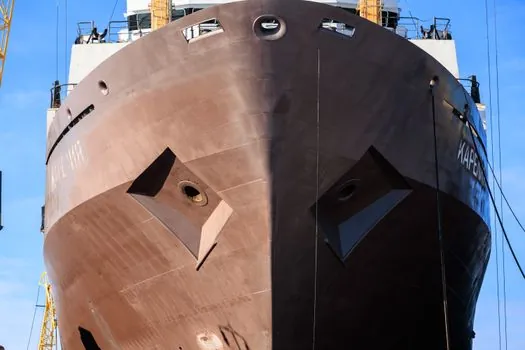
The marine applications where PEEK is the default rather than the premium choice fall into a small set of component classes. Propeller-shaft bearings and water-lubricated stern-tube liners are the headline use case, and tribology research has benchmarked PEEK composites directly under seawater lubrication for this duty [S2]. Marine valve seats, seals, and pump wear rings are the second cluster, where PEEK's chemical resistance to hydraulic fluids, fuels, and seawater plus its 260°C thermal headroom cover most shipboard fluid-system demands [S1].
Underwater fittings, structural marine hardware, and downhole-style connector insulators round out the list, and suppliers specifically call out that PEEK rod and plate stock is machined into these components with stable tolerances after long-term marine exposure [S1][S6]. For engineers cross-checking material families, the marine polymer picture sits inside the broader engineering plastic selection map, and the related grade-by-grade discussion for cast iron in marine service covers the metallic bearing alternative PEEK often replaces. Adjacent high-performance comparisons, including POM for aerospace bearings, are useful when justifying why a lower-cost acetal was rejected for a given marine bearing duty.
Where PEEK is the wrong choice
PEEK over-specs and inflates cost in three common shipboard situations. First, low-load, low-temperature trim and interior components, where POM, PA 6, or even HDPE deliver adequate performance at a fraction of the price and are far easier to source in volume [S3]. Second, applications dominated by sustained compressive creep under modest load, where PTFE's self-lubrication can be acceptable and cheaper, provided the designer accepts PTFE's cold-flow and abrasion limits [S7].
Third, any application where the design intent is "high-performance plastic" but the service envelope never approaches 150°C and never sees aggressive chemicals, in which case ULTEM (PEI) gives most of the rigidity and dielectric benefit at a meaningfully lower unit cost, with continuous service to 170°C [S4][S5]. Specifying PEEK in these cases is a procurement failure, not an engineering decision, because the part is paying for thermal and chemical headroom the system never uses.
Limitations, failure modes, and what the data does not yet prove

PEEK is not immune to marine-service failure modes, and the honest reading of the public data matters. PEEK is highly inert to most hydrocarbons and seawater, but it is attacked by some strong acids, halogens, and concentrated alkalis, so chemical compatibility must still be checked part-by-part rather than assumed from the polymer family [S1][S5].
Unfilled PEEK has lower wear resistance than filled grades, which is why PEEK-CF30 (carbon-filled) and PEEK-GF30 (glass-filled) are the standard bearing and structural grades rather than neat PEEK; the data set on neat-PEEK seawater tribology is not a free pass to skip the filled grade on a high-load bearing [S2][S5]. Long-term seawater ageing data on filled PEEK composites remains thinner than the lab-scale friction data, so for a 25-year-class stern-tube liner the conservative move is to pair the polymer tribology data with a class-society type-approval test on the actual filled compound. The downstream PEEK material guide covers the grade-by-grade trade-off for designers who need to go beyond the neat-resin numbers.
Selection checklist and sourcing notes
A defensible marine PEEK specification should fix four things: the resin grade (neat, PEEK-GF30, or PEEK-CF30), the continuous service temperature with a margin above the maximum process exposure (use 260°C as the ceiling, not the target), the chemical compatibility statement against the specific fluids and cleaning agents the ship actually uses, and the dimensional stability requirement after prolonged water immersion, which is where PEEK's low moisture absorption earns its keep against PA and POM [S1][S3][S5][S6].
On sourcing, the public market for marine-grade PEEK rod, plate, and finished machined parts is mature enough that multiple stockists publish the same property ranges (260°C continuous, low moisture absorption, seawater and hydrocarbon resistance), which makes cross-quotation straightforward [S1][S6]. Track the next two signals before locking the bill of materials: class-society (DNV, Lloyd's, ABS) type-approval listings for filled PEEK stern-tube bearing compounds, and any updated seawater-ageing data on PEEK-CF30 from peer-reviewed tribology groups, both of which will tighten or loosen the current "PEEK-as-default" consensus for marine bearings.
Component reference pages worth checking: marine hvac.