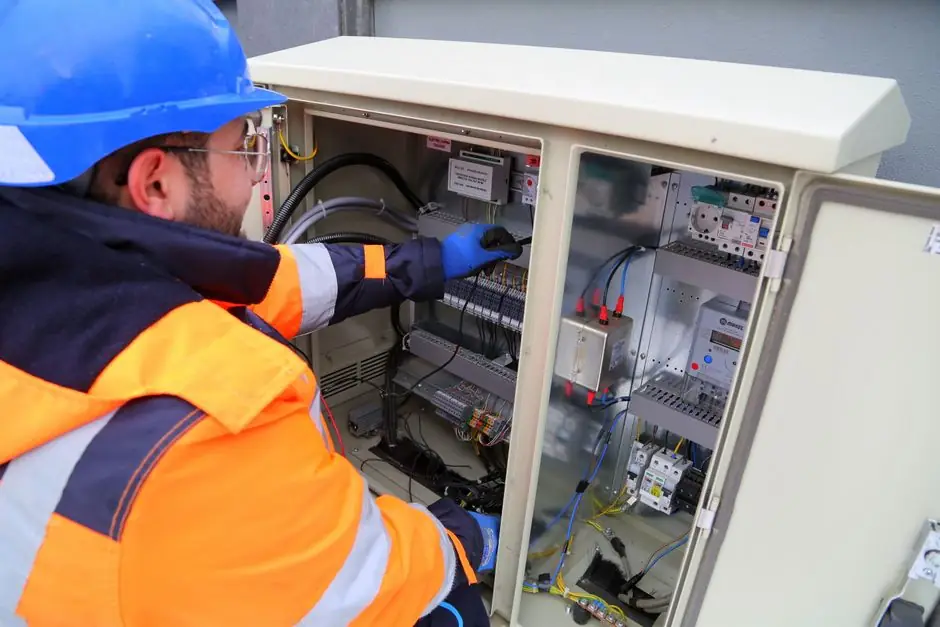
Selecting a perimeter alarm for an electrical work site is a detector-technology decision first, a vendor decision second, because live work zones impose terrain, weather, and integration constraints that no single product class satisfies across the board [S1][S2].
The four main detector families (buried seismic, fence-mounted vibration/cut, free-standing infrared or microwave beams, and camera-based video analytics) read different physical signals: ground vibration, fence movement, beam break, or video frame change [S1]. Choosing between them on a substation pad, a transmission-line laydown yard, or a temporary switchgear build determines false-alarm rate, defeat resistance, and how the alarm hands off to cameras or access control systems.
Detector Family Comparison: Seismic vs Fence-Mounted vs Beams vs Video
Underground seismic detection, fence-mounted sensors, IR beams, and video motion detection each carry a distinct performance profile on six decision criteria: visibility to the intruder, dependence on existing fence, weather resistance, dominant false-alarm sources, terrain adaptability, and defeat resistance [S1]. Buried seismic sensors are fully concealed and unaffected by wind, rain, or fog, but they require trenching and a defined geophone spacing; fence-mounted sensors need an existing fabric and are sensitive to wind-driven fence vibration; free-standing IR and microwave beams need a clear, straight line of sight and degrade in fog, heavy rain, or snow; video motion detectors need an unobstructed view of the whole perimeter and on their own produce the highest nuisance-alarm load [S1].
Cross-checking these technologies against the failure modes typical to an outdoor electrical work site (cable trenches, gravel pads, temporary fencing, vehicle movement, and weather exposure) shows that no single detector class wins on all criteria. A practical decision matrix for electrical work sites reads: (1) No existing fence and open ground: buried seismic or microwave beam; (2) Existing chain-link or temporary mesh fence: fence-mounted; (3) Narrow corridor such as a substation gate or transformer bay approach: IR or microwave beam; (4) Verification and forensic record of every breach: video analytics as a secondary layer cued by the primary sensor [S1][S2].
Electrical Work Site Constraints: Power, Zoning, and Cable Routing
Electrical work sites, especially substations and switchyard builds, often sit inside hazard-classified zones where detector housings, cable entries, and power supplies must meet the same ignition-risk rules as the work itself; for this reason, perimeter alarm specifiers should evaluate whether a chosen detector family offers suitable enclosure and cable-gland ratings for the adjacent zone, and route low-voltage signal cables away from HV equipment per the site's electrical-safety procedures [S2].
Power and cabling is the second hard constraint: buried seismic systems typically need a homerun cable back to a processor or gas alarm controller style head-end and benefit from a dedicated conduit; fence-mounted sensors are powered and queried along the fence line and are the simplest to deploy on a temporary mesh perimeter; free-standing beam pairs are point-to-point and need clean DC power at both ends; video analytics needs PoE or 24 V at each camera and bandwidth back to a recorder [S2]. On a short-duration outage job, battery-backed or solar-powered beam and fence-mounted kits are the lowest-friction options; on a multi-month substation build, the higher upfront trenching cost of a buried seismic system is offset by lower false-alarm load and zero visible hardware at the boundary [S1][S2].
False-Alarm Sources and Weather Behaviour by Detector Class
False-alarm load is the metric that decides whether a perimeter alarm is operationally usable on an electrical work site, because nuisance trips during hot-stick work or switching operations directly translate into lost productivity and operator alarm fatigue [S2]. Buried seismic detectors use adaptive ground-vibration algorithms and are largely immune to wind, rain, fog, and direct sunlight; their remaining nuisance sources are heavy vehicle passes close to the sensor run and large earthworks [S1]. Fence-mounted sensors remain sensitive to wind-driven fence vibration, debris striking the fabric, and animals climbing the mesh, so they need tensioned fabric and, on long runs, mid-span support posts to keep the false-alarm count manageable [S1].
Free-standing IR and microwave beams are degraded by fog, heavy rain, snow, and beam misalignment from thermal expansion of the mounting posts; their dominant nuisance sources are birds, blowing foliage, dust, and gradual post drift, which means quarterly alignment checks are a baseline maintenance line item rather than an option [S1]. Video motion analytics, run as a stand-alone detector, has the highest nuisance rate of the four families (shadow, headlight, wildlife, and weather-driven pixel change) and is most cost-effective when it is paired with a buried or fence-mounted sensor that hands the camera a small target zone at the moment of detection [S1][S2].
Integration with Cameras, Access Control, and Site Monitoring
Integration architecture is the dimension that separates a working perimeter alarm from a noisy one on an electrical work site: a sensor that triggers a camera, an access control event log, and a site-monitoring station in a defined sequence will be acted on, while a sensor that only drives a local siren will be ignored within a week [S2].
Specifiers should require documented integration paths from the chosen detector to: (1) PTZ camera preset call-up at the detection point; (2) access control or muster system event logging for personnel accountability; (3) the site fire alarm control panel style head-end or central monitoring station via dry contact, relay, or IP; (4) remote monitoring and control so the site security lead can arm, disarm, and review events off-site [S2]. Scalability and flexibility matter on multi-phase builds: a system that covers a 200 m laydown yard in phase 1 should be able to extend to 800 m in phase 3 without replacing the processor, and should accept new sensor technologies (for example, adding a buried seismic run to an existing fence-mounted perimeter) without parallel head-ends [S2].
Selection Checklist for Live Electrical Work
A pre-purchase checklist for live electrical work should force a decision on each of the following: terrain type (open ground, fenced compound, narrow corridor), fence status (existing permanent, existing temporary mesh, none), dominant weather exposure (fog-prone, high-wind, dust), false-alarm tolerance (zero tolerance for switching-day nuisance, or moderate), power and cabling route availability, integration targets (cameras, access control, central monitoring), and cybersecurity posture for any IP-connected head-end [S2].
A second pass on the same checklist should reject unsuitable options: do not specify free-standing IR beams across a fog-prone river crossing; do not specify fence-mounted sensors on temporary mesh that will be relocated mid-project; do not specify video analytics as a stand-alone detector on a site with wildlife traffic; do not specify any detector without a documented integration path to the site's existing monitoring head-end [S1][S2]. Where the use case is a short-duration outage job in a defined corridor, a battery-powered beam pair or fence-mounted kit on temporary mesh is the right-sized answer; for a multi-month substation build with permanent perimeter, buried seismic plus verification cameras is the lowest total-cost-of-ownership option over the project life [S1]. Specifiers handling the related access-control layer can compare structures in access control system selection for oil and gas facilities, and the heavier on-site equipment side (cranes, aerial work) is covered in aerial work platform selection criteria and aerial work truck matching reference pages.
Limitations, Failure Modes, and What Spec Sheets Don't Show
The failure modes that vendors under-weight in brochures are the ones that decide a perimeter alarm's real performance on an electrical work site: gradual fence fabric loosening (fence-mounted sensors), thermal post drift on summer afternoons (IR and microwave beams), trench subsidence over buried seismic cable, and cyber exposure on any IP-connected head-end [S2]. Reliability and durability claims should be backed by an installed track record in similar environments, not just an IP66 or IP67 enclosure rating, because IP rating covers water and dust ingress only and says nothing about vibration tolerance, UV ageing, or surge immunity on long cable runs near HV equipment [S2].
Cost analysis must include total cost of ownership, not just unit price: buried seismic systems have higher upfront trenching and homerun-cable cost but lower lifetime maintenance; fence-mounted systems are cheap to install but tie maintenance cost to fence condition; beam systems look inexpensive but carry a recurring alignment and cleaning burden; video analytics carries the highest cybersecurity and bandwidth cost and the lowest marginal hardware cost per added metre [S2]. For procurement teams comparing options, the practical rule is to require vendors to quote a 5-year total cost of ownership with explicit maintenance visit counts, and to penalise bids that omit cybersecurity features for IP-connected components, since perimeter alarms are increasingly part of the same network as access control and monitoring [S2].
Trackable signals to watch over the next planning cycle: regulatory tightening of cybersecurity requirements for IP-connected physical security devices, growing adoption of buried seismic plus video-verification architectures on utility and substation builds, and convergence of perimeter alarm head-ends with site fire alarm control panel style monitoring platforms as utilities standardise on fewer vendor stacks [S2].