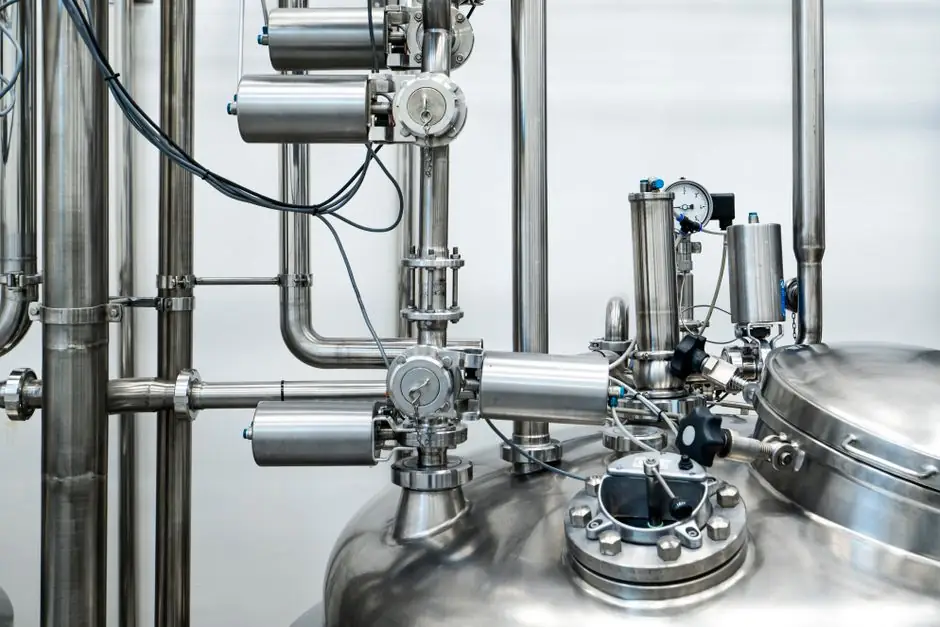
China-based B2B catalogs list 600+ active pharmaceutical equipment manufacturers as of mid-2026, spanning ampoule filling lines at US$80,000-150,000 per piece, visual inspection machines at US$100,000-300,000 per piece, and tablet hardness testers in the US$350-400 range per unit [S1][S3][S5].
Verified suppliers concentrate in three industrial clusters: Shanghai (Iven Pharmatech, trading-company + factory hybrid), Hunan (Zhengzhong Pharmaceutical Machinery, manufacturer/factory), and Jiangsu (Changzhou-based spray dryer and mixer exporters) [S1][S3][S4]. Alibaba, Made-in-China.com, and PharmaSources remain the three primary discovery channels for buyers building a 2026 shortlist.
Category Map: Where the 2026 Spend Actually Sits
Pharmaceutical equipment on China B2B catalogs resolves into five spend categories, each with its own price gate. Process skids (purified water, pure steam, RO + online TOC/conductivity) anchor at US$16,000-29,000 per set in 1-5 set MOQ brackets [S4]. Solid dosage machinery (granulators, coaters, grinders, spray dryers) clusters around the same US$16,000-29,000/set band when sourced from Changzhou-Jiangsu suppliers [S4].
Packaging and filling lines represent the high-capex tier: high-precision ampoule filling machines list at US$80,000-150,000 per piece with a 1-piece MOQ from Shanghai Iven Pharmatech [S1]. Liquid process skids (negative-pressure conveying with integrated dust control) sit at US$1,600-3,000 per piece, a 50x cost gap versus finished-dose lines that buyers must reconcile early in RFQ scoping [S2]. Powder mixing for food and pharma applications ranges from US$1,500-5,000 (fine powder blending) to US$1,800-8,000 (stainless steel double cone) and up to US$2,000-10,000 (double motion mixing) per piece [S2].
Audit Tier and Certification Markings: What Survives Buyer Vetting
Made-in-China.com and Alibaba both expose an Audited Supplier tier with on-site verification; Diamond and Gold member badges on individual listings (Iven Pharmatech Diamond, Zhengzhong Pharmaceutical Machinery Gold) signal paid verification rather than capability verification [S1][S3]. Buyers should treat the badge as a paperwork filter, not a performance filter.
CE marking appears on the tablet hardness tester (YD-1, OEM/ODM, CE) at US$350-400/piece, with tiered pricing at 5+ pieces, and a stated application list covering clinical diagnosis, food safety, and pharmaceutical industry [S5]. PharmaSources buyers see category-level CE/ISO 9001 declarations on supplier profiles, while the catalog itself organizes by Finished Dosage, API Equipment, Preparation Equipment, Pharmaceutical Packaging Machinery, and TCM Machinery [S7]. For broader plant-side context on how pharmaceutical skids interface with utility systems, see the upstream inputs and downstream spec map.
Tablet and Inspection Equipment: Hard Specs From 2026 Listings
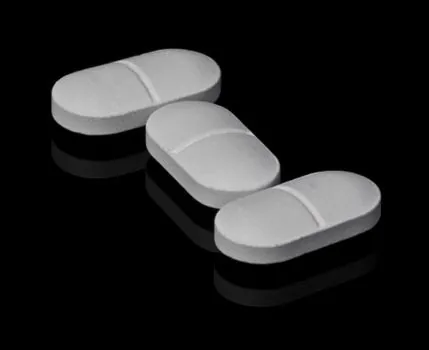
Tablet inspection machines show the widest price-to-capability spread in the catalog. Visual inspection high-voltage discharge leak detectors, light inspectors, and liquid detection machines for ampoule and vial lines cluster at US$100,000-300,000 per piece, with Hunan Zhengzhong as the auditable supplier and a 1-piece MOQ gate [S3]. The leakage detection step is mandatory for parenteral products and drives the line's overall qualification cost.
Tablet hardness testers (YD-1 class) sit at the opposite end of the capital scale: US$400 per piece for 1-4 piece orders, US$350 per piece at 5+ pieces, with customization available and online support plus video technical support as after-sales terms [S5]. Application scope on the listing explicitly names pharmaceutical industry, food safety, and clinical diagnosis, so the same SKU crosses QA/QC boundaries. Where tablet hardness instruments must integrate with cleanroom HVAC or environmental monitoring, buyers should align instrumentation with the same industrial valve change-control discipline used for process piping.
Mixing, Conveying, and Cream Processing: Mid-Tier Spend
Mid-tier process skids bridge powder handling and liquid dosing. Precision negative-pressure conveying equipment with integrated dust control lists at US$1,600-3,000 per piece, with the explicit dual-industry tag of pharmaceutical and food [S2]. Advanced cosmetics fine powder blending and mixing equipment for efficient production lists at US$1,500-5,000 per piece, with the same dual-industry framing common across Chinese OEM catalogs [S2].
Stainless steel double cone mix equipment for food powder sits at US$1,800-8,000 per piece, while high-grade pollution-free double motion mixing for the chemical industry lists at US$2,000-10,000 per piece [S2]. Pharmaceutical cream equipment on Alibaba shows 600+ products from global suppliers, with filling machines dominating the subcategory, and the trade assurance flow applies standard order protection [S6]. For plants considering complementary pneumatic conveying or actuator-driven valve skids, the pneumatic actuator selection guide covers torque and safety gates that interact with cream process lines.
Decision Filter: Audited Supplier vs Trading Company vs OEM/ODM

Three buyer profiles use three different filters. Direct end-user pharma manufacturers prioritize manufacturer/factory listings with on-site audit confirmation (Iven Pharmatech, Zhengzhong Pharmaceutical Machinery, Changzhou-based spray dryer exporter) because spares and FAT documentation need a factory trail [S1][S3][S4]. Contract manufacturers and CDMOs prioritize OEM/ODM capability, which the YD-1 tablet hardness tester explicitly exposes via a Customization Available field [S5]. Trading companies and project EPCs can absorb hybrid manufacturer/trading company badges (Iven Pharmatech, Zhengzhong) when consolidating multi-SKU RFQs into single POs [S1][S3].
Price-band gates also differ by profile: small-molecule generic plants commonly anchor at the US$1,500-10,000 per piece band for mixing and conveying skids, parenteral injectables manufacturers anchor at the US$80,000-300,000 per piece band for filling and inspection lines, and QA/QC labs anchor at the US$350-400 per piece band for tablet hardness instrumentation [S1][S2][S3][S5]. For plants that also need to specify cleanroom lighting and inline inspection optics, the lighting equipment and electric lamps reference covers illumination classes that visual inspection machines assume.
Standards and Compliance: What a 2026 RFQ Should Lock In
Three documentation items block most first-pass RFQ rejections. First, factory audit reports: ask for the date of the most recent on-site audit; Made-in-China.com, Alibaba, and PharmaSources each maintain their own audit trail and the audit date should be within 12 months of order placement [S1][S3][S7]. Second, material traceability on product-contact surfaces: stainless steel grade (304 vs 316L), surface finish (Ra value), and any ceramic component substitution must be declared per line item, because ceramic-case ampoule filling machines exist as a distinct subcategory in the catalog [S1]. Third, electrical and explosion-protection certification: parenteral and solvent-handling skids should carry CE marking at minimum, with ATEX or IECEx zone classification only where the line is sited in classified areas.
For QA/QC instruments, USP Chapter <905> uniformity of dosage units, USP <711> dissolution, and USP <701> disintegration are the governing test references for any tablet hardness, dissolution tester, or disintegration tester sourcing decision; PharmaSources organizes suppliers explicitly under the dissolution-tester category for this reason [S7]. Process water systems (purified water, water for injection, pure steam) should be specified against the current pharmacopoeia revision in force at the buyer's regulatory destination, with online TOC and conductivity detection exposed as standard options on skid-mounted RO systems from Jiangsu-based suppliers [S4]. For plants integrating pharmaceutical skids with broader instrumentation and flow meter lineups, the same audit discipline should apply across all wetted-service equipment.
Trackable signals over the next sourcing cycle: the publication of updated 2026 audit cycles on Made-in-China.com Diamond and Gold tier suppliers, new CE renewal cycles on the YD-1-class tablet hardness family, and any catalog reorganization on PharmaSources that adds or removes Finished Dosage versus Preparation Equipment subcategories. Watch also whether Hunan Zhengzhong and Shanghai Iven Pharmatech maintain their 1-piece MOQ on high-capex filling and inspection lines, because that MOQ floor is the single most leveraged negotiation term for small-volume parenteral projects [S1][S3].