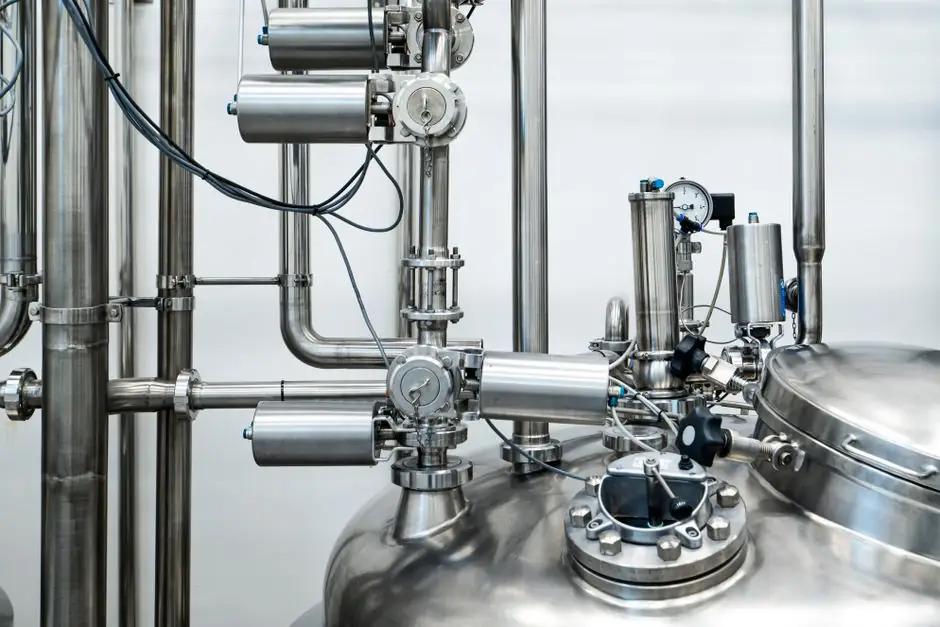
Stainless steel 316L remains the default material for product-contact surfaces in pharmaceutical equipment, with the GMP norm of surface roughness Ra ≤ 0.8 µm applied to wetted parts and documented during qualification [S2]. Plastics enter only in three controlled forms (soft films, hard valve bodies, elastomer membranes and O-rings), each tied to specific extractables and surface-finish testing because no pharma-specific roughness standard exists [S2].
Upstream the supply chain feeds steel mills, polymer compounders, and detergent formulators; downstream it terminates at the packaging-machinery-suppliers-2026-directory-map-and-sourcing-gates layer, where fill-finish and primary-pack skids must match the cleanability envelope of the upstream reactor or dryer.
Material Selection: 316L vs Plastic vs Elastomer
316L is treated as the pharmaceutical default because its corrosion profile in WFI and clean-steam service is well characterised, and material-incompatibility risk is treated as negligible compared with engineered plastics [S2]. Plastics, by contrast, trigger a four-axis review: leach-out, aging, surface finish, and mechanical compatibility; the absence of a "gold standard" means each part is qualified against the specific duty rather than a generic pharma rule [S2].
For plastics produced by injection moulding with highly polished tools, surface roughness comes out significantly better than the Ra ≤ 0.8 µm stainless benchmark, while machined plastic parts often need extra finishing to reach Ra < 1 µm [S2]. Where measurement is required, DIN ISO 4287 / 4288 govern stainless roughness, while the semiconductor-side SEMI F57 and SEMASPEC 92010950B are used as cross-industry references for plastic surface verification, since no equivalent pharma spec exists [S2].
Cleaning as a Process, not a Step: CIP, Manual, and Detergent Logic
Pharmaceutical cleaning is a multi-variable process: vessel volume, residue chemistry, equipment geometry, and detergent selection all have to be solved together, and an incorrect cleaning procedure is a common root cause of expensive extended shutdowns [S1]. Fluid bed dryers illustrate the geometry problem: vertical walls make it hard to keep detergent in contact, so consistent CIP spray coverage or manual action is normally required [S1].
Tablet coaters are simpler because the perforated pan can be filled, soaked, and rotated, but pigmented HPMC coatings (iron oxides, titanium dioxide) leave haze that alkaline detergents cannot strip, and strong corrosive acids plus manual scrubbing are sometimes the only practical fix [S1]. For ribbon and V-blenders, automated cleaning hits geometry limits and residual build-up is the recurring failure mode [S1]. Ribbon, V-blender, and fluid bed cleaning practice is consistent with the wider CIP/SIP gate logic applied to industrial valves on the same skid, where diaphragm and seat materials drive the same extractables question.
Auxiliary Equipment: Conveyors, Material Handling, and Process Support

Auxiliary equipment covers conveyor belts, material-handling skids, feeders, and transfer devices that keep the main reactor, dryer, or coater supplied without breaking the cleanability envelope [S4]. The auxiliary layer is where dust containment, washdown-rated motors, and stainless framing are usually decided, and it is frequently the cheapest place to retrofit segregation between upstream dispensing and downstream formulation.
On the wet side, flow meters and pressure transmitters on CIP loops see thermal cycling between ambient, hot-caustic (~80 °C typical), and final-rinse stages, so 316L wetted parts and hygienic Tri-Clamp connections dominate. The same hygienic-transmitter logic is referenced in the food processing equipment supply risk 2026 spec anchors and shock nodes article, where 3-A and EHEDG share most of the documentation load with pharma-side ASME BPE.
Comparison of Main Equipment Options by Decision Criteria
For a specifier choosing between a fluid bed, a tablet coater pan, and a ribbon/V-blender, the four criteria below map directly to published guidance. Fluid beds win on continuous high-throughput drying and coating but lose on cleanability of vertical walls; coater pans win on CIP access and small batch size but lose on pigmented-residue removal; ribbon/V-blenders win on gentle dry blending of APIs and excipients but lose on automated cleaning access [S1].
On materials, 316L wins on corrosion resistance and validated surface finish (Ra ≤ 0.8 µm), injection-moulded plastic wins on smoothness (better than stainless) but loses on extractables control, and elastomer (EPDM, PTFE, FKM) wins on sealing and membrane flexibility but loses on leachables and aging [S2]. For utilities, anti-static equipment is now standard on powder-handling conveyors because API/excipient dust clouds are a documented ignition source for ribbon and V-blender discharge.
Compliance Anchors: cGMP, ASME BPE, 3-A, and ISO 4287/4288

Compliance is layered: cGMP sets the high-level expectation that equipment must be cleanable and non-reactive, ASME BPE governs the dimensional and surface-finish detail of wetted stainless parts, and DIN ISO 4287 / 4288 specify how roughness is measured and reported on stainless [S2]. Plastic parts fall back to US 21 CFR 177 and the German BfR positive list as food-contact proxies, with the explicit caveat that these are not pharmaceutical "gold standards" [S2].
For inspection and NDT on stainless vessels, the same Ra and weld-discolouration rules pull in NDT equipment selection (boroscope, dye-pen, surface profile gauge) that any auditor will ask to see during qualification. In ATEX-classified solvent rooms, lighting equipment and electric lamps must be rated to IEC 60079-series zones, since halogen or incandescent fittings will fail inspection even if the upstream reactor is qualified.
Failure Modes and Limits Buyers Should Track
The most common failure modes are residual haze from pigmented coatings (acid cleaning plus manual scrub), detergent shadowing on vertical walls in fluid beds, and leachables or aging in plastic valve seats and elastomer diaphragms where steam sterilisation accelerates degradation [S1][S2]. Each of these is a known root cause of batch rejection or extended shutdown, which is why the cleaning protocol is written into the validation master plan, not the SOP [S1].
Spec ceilings buyers should pin in writing: stainless wetted surface Ra ≤ 0.8 µm with DIN ISO 4287/4288 measurement, plastic roughness verified per SEMI F57 or SEMASPEC 92010950B, 21 CFR 177 documentation for plastic wetted parts, and CIP coverage proven on every vertical wall above 1 m [S2].
Trackable signals into the next quarter: ASME BPE revisions on hygienic tubing and fittings, any tightening of 21 CFR 177 extractables limits, and 3-A / EHEDG updates that frequently cross-applied to pharma skids. The same upstream/downstream logic detailed in packaging machinery upstream and downstream spec map and sourcing signals applies here, and the food-grade benchmarks in food processing equipment upstream inputs downstream specs and 2026 vendor map are the practical proxy where pharma-specific test data is missing.