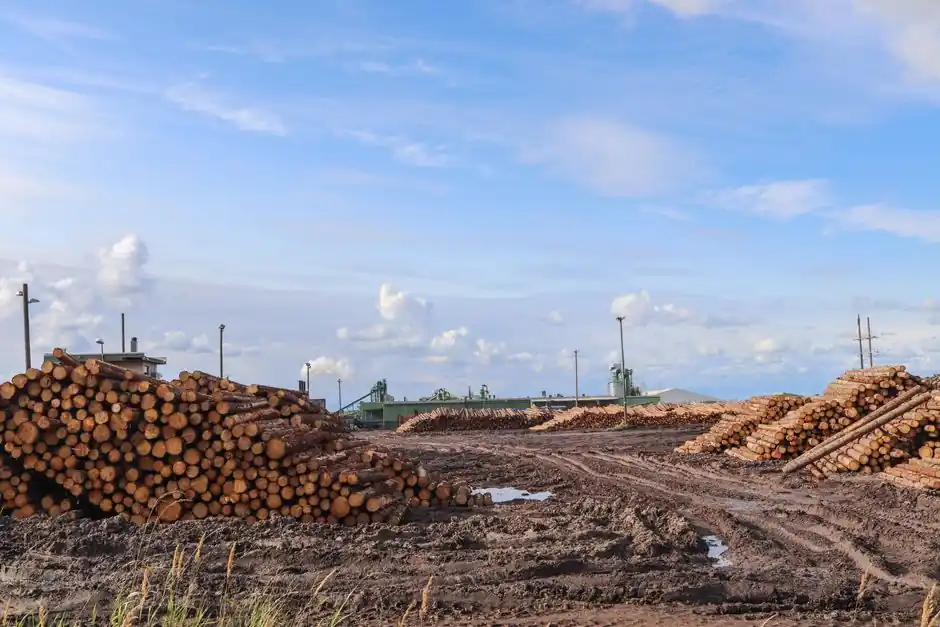
Forestry sites punish heavy iron. Soft, root-laden, often waterlogged ground rules out machines that work cleanly on a graded solar field, so the pile-driver segment that actually delivers in this environment is dominated by excavator-mounted hydraulic hammers, mini-digger post drivers in the 1-13 tonne carrier bracket, and skid-steer post-pounders running 1600-2000 PSI at 9.5-16 GPM [S3].
Listings from August 2026 show the active inventory skewing toward Dawson Emv300 sheet pilers fitting 12-30 tonne excavators, Malone and Protech P10/P18 mini-digger brackets, and 2026-build RAYTREE skid-steer post pounders, with used JCB JX Hammer piling rigs on JCB 220X-LC bases circulating at 2,927 hours [S3]. Forestry buyers should plan around that carrier envelope before looking at hammer energy.
Why forestry is not a solar pile-driving problem
Solar rigs are sized for open, graded fields where a 30+ tonne self-propelled tracked unit can drop 150-200 piles per day in clean rows, and the carrier weight is a productivity asset, not a liability [S1]. A typical European ground-mount PV build uses roughly 350 metal profile piles per megawatt, so machine utilisation on a single multi-MW site justifies the transport cost of a low-loader move [S1].
Forestry sites flip that calculus. Access tracks are narrow, soft-edge corridors through standing timber, and the work is rarely a single contiguous block: it is a chain of compound pads, deer-fence lines, haul-road culvert supports and bridge abutments. The same self-propelled rig that hits 200 piles/day on solar becomes undeployable the moment the carrier sinks past its tracks, and low-loader road moves between remote coupes are expensive in their own right. A pile driver selection for forestry therefore has to start with carrier class and ground pressure, not hammer energy or daily production rate.
Carrier class: 1-13 tonne mini-diggers and 12-30 tonne tracked excavators
The Protech P10 and P18 mini-digger post drivers in the August 2026 UK dealer inventory are explicitly designed to fit compact carriers in the 1-3 tonne operating weight class, with hydraulic top-link and side-tilt options on the Malone units for working on cross-slope fence lines [S3]. These machines install fence posts, gate anchors and small-diameter strainer posts at the access-track edge, where a full-sized piling rig cannot physically reach.
For heavier work, the Dawson Emv300 sheet piler fits 12-30 tonne excavators, and a typical 13-tonne carrier is the lower bound where a hydraulic post driver with serious impact energy becomes usable [S3]. The Autoguide Postmaster range, listed in 10-unit batches from an Enfield, County Meath dealer, is sold on the specific claim that a 2-person team can install posts faster, quieter and safer than conventional machines, which matters in working forests where chainsaw and forwarder crews are operating within earshot [S3]. Forestry buyers should match the carrier to the access corridor first, then size the hammer to the post, not the other way round.
Hammer and post-pounder spec envelope
Three live new-build pile hammers stocked in Anna, Ohio in August 2026 share a common operating envelope: 95-130 kg/cm² driving oil pressure, 30-45 L/min oil volume, and 460-760 bpm strike frequency [S3]. That window is the practical band for post-knocking on timber and light steel; below 460 bpm, productivity collapses on driven post work, and above 760 bpm the carrier hydraulics start to govern the cycle.
The 2026 RAYTREE skid-steer post pounder attachment runs at 1600-2000 PSI (roughly 112-140 kg/cm²) and 9.5-16 GPM (35.9-60.6 L/min), a hydraulic demand that a standard 60-80 HP forestry-rated skid steer can meet without auxiliary flow upgrades [S3]. Forestry contractors running a single skid steer for forwarding and brash handling get a post driver on the same platform, which is the actual economic argument for the segment: one carrier, two job functions, no low-loader move. Where the work needs serious sheet piling or bridge-abutment piles, the excavator-mounted Emv300 class and JCB JX Hammer rig take over, but those machines need purpose-hauled tracked carriers and are not the everyday forestry tool.
Productivity benchmark: do not import solar numbers
A self-propelled tracked pile driver can deliver 150+ piles per day on a clean solar site, and 200 piles per day is achievable with a single operator on a TURCHI 300F-class machine [S1]. That is the wrong reference for forestry. Excavator-mounted drivers typically deliver 60-80 piles per day even on a productive solar site, and on a forestry access-track job with stump clearing, side-loading and slope, realistic output drops to 30-50 posts per shift for a two-person mini-digger team [S1][S3].
The economic threshold for a self-propelled tracked unit, around 2,000 piles per project, is almost never reached on a single forestry contract [S1]. Truck-mounted post drivers are popular in guardrail and fencing work because of their road mobility, but on unprepared forest ground their limited manoeuvrability makes them a poor primary tool [S1]. For most forestry buyers, the right answer is a 1-13 tonne mini-digger bracket driver for the bulk of post work, a 12-30 tonne excavator hammer for the heavier piling jobs, and a skid-steer post pounder if the fleet already includes a compatible carrier.
Comparison: three forestry pile-driver classes on five criteria
Mini-digger post drivers (1-13 t) score high on ground-pressure sensitivity and access-corridor reach, moderate on hammer energy, low on single-shift productivity, and lowest on capital cost, with Malone and Protech units in current UK dealer stock [S3]. Excavator-mounted hydraulic hammers (12-30 t) score moderate on access, high on hammer energy and post diameter range, moderate on productivity, and moderate-to-high on cost, represented by the Dawson Emv300 and JCB JX Hammer rig listings [S3]. Skid-steer post-pounders score high on fleet commonality with existing forestry carriers, moderate on hammer reach (limited by skid-steer boom geometry), moderate on productivity, and low-to-moderate on cost, with 2026 RAYTREE units at 1600-2000 PSI and 9.5-16 GPM [S3].
The decision pivots on three numbers: the largest post or pile section to be driven, the worst ground-bearing pressure the site can support during the wet season, and whether the buyer already owns a compatible carrier. A fleet with a 13-tonne tracked excavator and a 75 HP skid steer covers most forestry pile-driving work without buying a dedicated self-propelled rig. A fleet that has neither is buying the carrier and the hammer together, and at that point a compact excavator with an integrated driver bracket is usually the lower-total-cost path than a skid steer plus post pounder plus a separate machine for heavier piling.
Limitations and failure modes specific to forestry
Hydraulic pile drivers in the 95-130 kg/cm² pressure band are tuned for mineral soil and decayed-stump ground; fresh hardwood stumps and live root mats deflect posts and stall hammers, so a forestry pre-clearing pass with a stump grinder or excavator-mounted rake is almost always required [S3]. Skid-steer post-pounders at 9.5-16 GPM lack the hydraulic reserve to drive larger strainer posts into compacted forestry track surfaces, and operators commonly over-cycle the auxiliary hydraulics, which shortens pump life.
Used JCB JX Hammer piling rigs on JCB 220X-LC bases in current dealer stock show 2,927 hours, a useful data point: high-hour used piling hammers have usually been worked on abrasive mineral soil, and forestry buyers should budget for hammer bush and seal inspection before deployment [S3]. The 2-person Autoguide Postmaster workflow is sold on a quieter, safer installation than conventional machines, and that is not marketing fluff in a forestry setting where crews work within hearing distance of chainsaws and forwarders [S3]. For heavier foundation work such as bridge abutments and large culvert headwalls, the segment does not self-source: forestry pile-driver inventories do not include the heavy crawler cranes and hydraulic impact hammers used on civil bridge jobs, and that work is normally subcontracted to a civil piling contractor with road-mobilised equipment.
Trackable signals to watch over the next quarter: dealer inventory turnover on the Dawson Emv300 and JCB JX Hammer lines, new Protech and Malone mini-digger bracket driver listings in the UK and Ireland, and any RAYTREE or comparable skid-steer post pounder with forestry-rated guarding entering the European market. Hydraulic flow demand on the skid-steer class, currently 9.5-16 GPM, is the spec to watch: a sub-10 GPM unit that delivers usable driving energy would materially change the carrier-choice maths for small forestry contractors [S3].
Spec-level background on the components involved: pressure transmitter, and flow meter.
Background reading: Safety Mat Selection for Oil and Gas Facilities: A Spec Map.