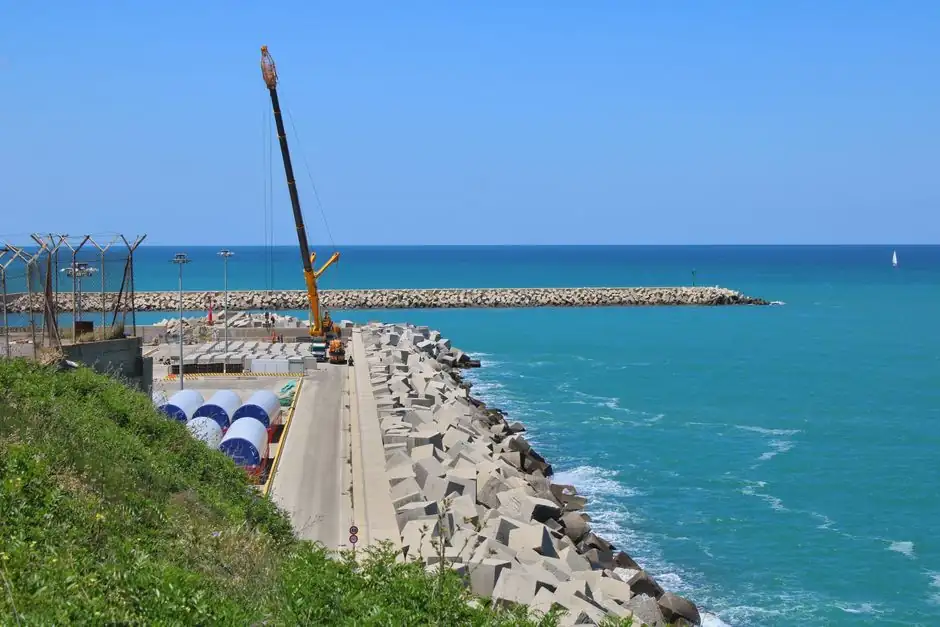
Desalination systems combine high chloride exposure, pressure swings, abrasion, and chemical treatment, so valve selection must be assigned to the intake, pretreatment, high-pressure RO, or brine-discharge service rather than treated as one generic valve selection [S3][S5].
Where pinch valves fit in the desalination train
Pinch valves are a practical fit for seawater RO control and brine-discharge duties, where solids-bearing flow, corrosion resistance, and low leakage matter more than a compact metal-trimmed control valve [S5]. Their operating envelope is not interchangeable with every valve type: RO high-pressure isolation may favor ball or severe-service valves, while large intake isolation may use butterfly, gate, or knife-gate equipment [S5].
RF Valve lists manual, pneumatic, electric, and hydraulic pinch valves for desalination, alongside air-release and knife-gate products [S2]. Bray identifies pinch valves among its products for desalination processes [S4].
The correct comparison is functional, not brand-based. A pinch valve provides throttling with an elastomeric flow path and can isolate dirty or abrasive service; a ball valve provides tight shut-off and is commonly selected for high-pressure RO; a butterfly valve is practical for large intake lines; and a knife gate handles solids in discharge service [S5]. For comparable slurry and solids-control applications, see Pinch Valve Selection for Mining Slurry Service.
Pressure, temperature, and flow-control criteria
Seawater reverse-osmosis valves are commonly required to handle 60–80 bar, equivalent to 870–1160 psi, while multi-stage flash systems may reach 120°C, or 248°F [S5]. These figures define the screening envelope, not a universal rating: every pinch valve still needs a specified design pressure, design temperature, and allowable pressure differential at its actual opening condition.
That makes stable sizing important. For control duty, use the required minimum and maximum flow coefficients, not the pipe nominal diameter alone.
Check seat leakage, allowable pressure drop, actuator stroke, and cycle frequency in the final data sheet. Do not accept a generic Cv label when the required operating point lies outside the published curve.
Material and liner compatibility
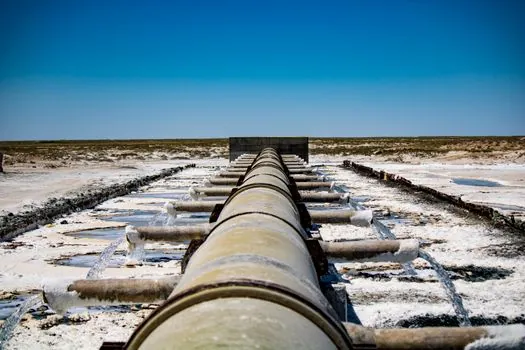
External pinch valves use one wetted sleeve material, while internal pinch valves add a body or liner that must also contact the process fluid [S6]. In seawater, the selection must cover general corrosion, pitting, crevice corrosion, and erosion from suspended solids; the cited desalination guidance identifies pitting and crevice corrosion as common stainless-steel failure modes in chlorides [S5].
For metallic bodies, UNS S32205 Duplex and UNS S32750 Super Duplex stainless steels provide a defined route for chloride-exposed duty, while Titanium Grade 2 or Grade 5 is reserved where higher corrosion resistance justifies its cost. Nickel-Aluminum Bronze is identified for seawater intake and low-pressure service, and PTFE, PFA, and EPDM liners are used for chemical dosing and corrosive-fluid handling [S5].
The elastomer is not a detail to be left to the installer. Chloride, temperature, oxidants, chemicals, and abrasion can attack or age a sleeve differently from the metal body. Validate the sleeve and liner against the complete chemical inventory and temperature range. An external sleeve simplifies the wetted-material count, but it does not eliminate the need to confirm body corrosion allowance, reinforcement geometry, and end-connection compatibility [S6].
Type comparison for seawater and brine duty
Compare the main options on pressure capability, corrosion protection, solids tolerance, and control range. Pinch valves are distinguished by a replaceable elastomer flow path [S6]. Ball valves are suited to high-pressure RO shut-off, butterfly valves to large-diameter intake lines, diaphragm valves to chemical dosing, and knife gates or pinch valves to abrasive brine discharge [S5].
This comparison excludes a universal pressure class for every row. The desalination screen of 60–80 bar applies to RO systems, and 120°C applies to multi-stage flash conditions, but the selected valve must have its own certified rating for the relevant service [S5].
Actuation, control, and operating constraints
Pinch-valve options include manual, pneumatic, electric, and hydraulic actuation, so selection should begin with the required fail position and available power source rather than the actuator brand [S2]. Electric and pneumatic systems are commonly used for remote operation in large plants, while hydraulic actuation is an alternative where large operating forces are required [S5].
Control performance depends on more than opening percentage. The sleeve profile, trim configuration, Cv curve, actuator speed, positioner resolution, and maximum allowable pressure differential determine whether the valve can hold a stable flow near the lower throttling range [S1]. Type A pinch valves for wastewater service are described as requiring no actuator and closing drop-tight on solids, but that description does not transfer automatically to a controlled desalination process [S7].
Verify cycle life against expected starts, travel time, minimum opening, and operating differential pressure. A full-port dual-pinching pinch valve has been reported with a full-open Cv of 9,713, more than twice that of a full-port plug valve, showing that geometry can materially change flow capacity [S8]. Do not use that figure as a generic selection value; calculate the required Cv for the installed line and compare it with the manufacturer curve.
Specification, standards, and failure prevention
A desalination purchase specification should state nominal size, actual flow, minimum and maximum Cv, design pressure, design temperature, allowable pressure differential, fluid composition, chloride concentration, fluid temperature, chemicals, solids content, actuation, fail action, seat-leakage class, and applicable material grades [S1][S6][S10]. These fields determine whether the sleeve, body, seat, actuator, and controls belong in the same operating envelope.
Valve procurement documents commonly reference API 600 or API 6D for steel valves, ISO 15848 for fugitive emissions, and AWWA C516 for large-diameter butterfly valves [S5]. NACE MR0175 is listed in that guidance, but it addresses metallic materials for H2S-containing oil-and-gas production environments rather than seawater service as a general seawater qualification. Confirm the exact governing clause and material applicability with the project specification owner.
Stainless-steel valves must resist pitting, crevice corrosion, and Stress Corrosion Cracking, while brine service adds abrasion from concentrated saltwater [S5][S9]. Ask the manufacturer to document the selected alloy grade, corrosion allowance, elastomer compound, liner arrangement, and test scope. Avoid substituting standard 316 stainless steel in high-chloride duty when the specified design depends on Duplex, Super Duplex, titanium, bronze, or a qualified polymer lining [S5].
Application-specific selection logic
For high-pressure RO throttling, shortlist a control-rated pinch valve with a verified Cv range, chloride-compatible wetted parts, and a pressure rating above the maximum operating pressure [S1][S5]. For brine discharge containing solids, prioritize abrasion resistance, a replaceable sleeve, full-bore passage, and reduced solids trapping, then confirm whether knife-gate isolation is needed upstream [S5].
Do not use the mainstream pinch-valve option where precision control requires a Cv curve outside the 10–95% effective range, where the fluid attacks the selected elastomer, or where frequent cycling makes sleeve replacement uneconomic. Likewise, a brine discharge line may need a knife gate for isolation and a pinch valve for control, rather than expecting one component to perform both duties [S5].
The shortlist logic is straightforward: define the process stage and fluid, calculate minimum and maximum Cv, set the maximum pressure and temperature, select the liner and body materials, then choose actuation by fail action and control requirements. The detailed solids-control comparison in Pinch Valve Selection for Mining Slurry Service is useful when abrasion and sleeve wear dominate the duty.
Next, obtain manufacturer curve and material data for the three shortlisted sizes, verify that one size contains the required operating point from CVMIN to CVMAX, and record sleeve, liner, body, actuator, and pressure-test requirements in the purchase specification [S1][S6][S10].