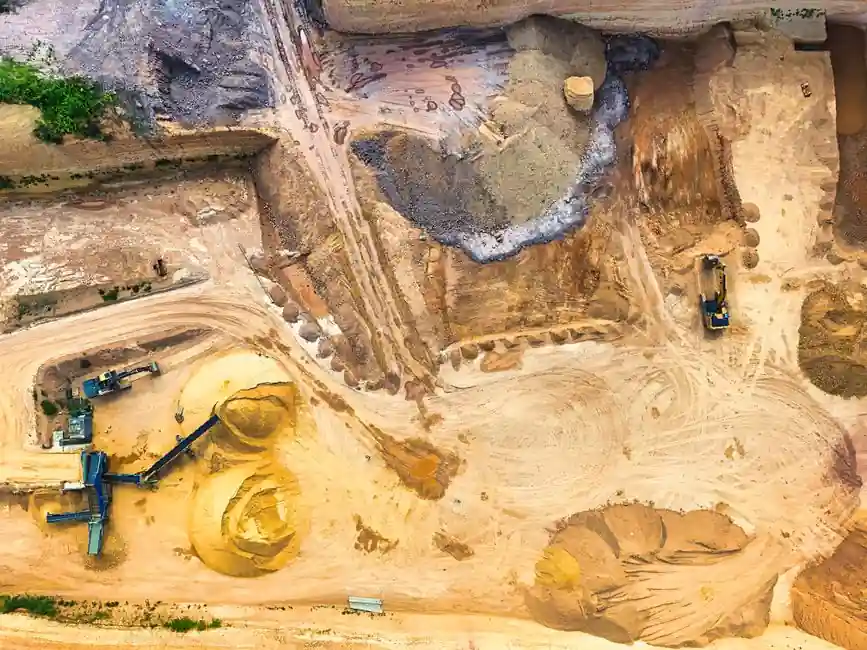
Pinch valves suit abrasive mining slurries because the flexible sleeve is the only wetted flow component, eliminating internal metal seats and reducing clogging risk.
The correct choice depends on differential pressure, slurry temperature, particle behavior, chemistry, actuation, throttling duty, and the required end connections.
Pinch Valve Fit for Mining Duty
Mining slurry commonly carries sharp rock, sand, ash, lime, ore, or chemical precipitates through pump discharge, tailings, backfill, and reagent lines. A pinch valve closes by compressing an elastomer sleeve around the pipe centerline, so the open bore is straight and there are no internal seats or disc cavities to erode or trap solids [S2][S3].
That geometry is particularly valuable at low flow velocity, where settled debris can impair metal-seated valves. The pinch valve closes on a smooth venturi and is self-cleaning, providing superior performance with fluids at low velocity [S3]. For broader control-valve selection, compare process variables and actuator requirements with control valves for abrasive mining service.
The main qualification is important: a pinch valve is not automatically the correct choice for every mining line. The sleeve must match pressure, temperature, chemistry, abrasion, and duty frequency, and the valve must be properly sized for the complete operating range.
Compare Pinch, Knife Gate, and Ceramic-Lined Valves
A pneumatic pinch valve offers a full-bore, solids-resistant path and reliable isolation, while a knife gate valve provides push-through isolation for on/off service. A ceramic-lined gate or ball valve can suit selected abrasive duties where ceramic erosion resistance is required, but the ceramic element, body geometry, and end connections must be checked for the actual slurry [S3][S4].
For a typical mining purchase comparison, the decision criteria are solids handling, throttling capability, cavity risk, and maintenance exposure. Pinch valves are strongest where solids, scale, or corrosion make exposed metal seats undesirable; knife gates are strongest for straight-through shutoff in suitable on/off service; ceramic-lined valves are strongest where the medium and geometry are compatible with the selected ceramic and liner system [S4][S10].
Pinch valves should not be selected as the default for every high-pressure, high-temperature line. Severe throttling increases sleeve wear, and the available sleeve compounds, reinforcement, actuator arrangement, and pressure rating must be checked before approval [S2][S9].
Size the Valve for Pressure and Flow
Pinch-valve selection must begin with the actual process medium, differential pressure, temperature, solids behavior, materials, and connection requirements rather than nominal pipe size alone [S9]. These are product-specific limits, not universal mining requirements.
For throttling applications, valve size and actuator travel must provide stable control across minimum, normal, and maximum flow. Sleeve material becomes critical for severe throttling because repeated compression and partial opening concentrate wear [S2]. A mining pinch valve also requires verification of shutoff pressure, operating pressure, maximum sleeve temperature, actuator air supply, control signal, cycle rate, and the maximum permitted solids size [S9].
The body should match the line rating and mechanical arrangement, while the sleeve carries the fluid-facing wear duty. Inspect whether the proposed bore is unrestricted when open and whether the actuator closes the sleeve progressively around the centerline rather than imposing a damaging offset load [S2][S3].
Select the Sleeve for Abrasion and Chemistry
Elastomer selection must address more than bulk fluid compatibility. The pinch valve’s simple design is especially useful for the slurries and abrasive and corrosive liquids found in mining applications [S3]. The sleeve compound must be checked against the complete aqueous chemistry, temperature, and abrasion level rather than against a generic chemical compatibility chart.
Reinforcement is part of the sleeve system, not an optional detail. Mining-service pinch-valve sleeves use flexible rubber reinforced with high-strength fabric, and the sleeve is the primary wetted component exposed to the process [S3]. The reinforcement, cover layers, bonding, and overall cross-section determine resistance to compression fatigue, abrasion, and pressure loading.
For severe throttling, define an inspection interval and sleeve-replacement criterion before procurement. The sleeve is the principal replacement item, while seats, packing, seals, and glands do not require routine replacement in the cited mining design [S3].
Choose Actuation for Control and Isolation
Manual pinch valves suit local isolation and occasional operation, pneumatic pinch valves suit automated on/off service, and control pinch valves suit throttling or variable-orifice duties [S1][S3]. Mining applications include slurry handling, tailings, processing equipment, mining chemicals, mixing, and remote sites, where pneumatic actuation can support remote operation when the required air supply is available [S5].
Do not treat pneumatic actuation as a complete fail-safe selection. Specify fail-open, fail-close, or fail-last action from the process requirement, then confirm the actuator mechanism, travel stop, air pressure range, spring arrangement, position feedback, and enclosure requirements. The cited product family includes air-operated and control pinch valves, but its operating ranges must be checked for the selected size and model [S2].
For control duty, coordinate actuator response with the slurry’s solids loading and the control valve’s permissible travel. Severe throttling can shorten sleeve life, so sleeve selection, valve sizing, and control tuning form one engineering decision rather than separate procurement choices [S2].
Evaluate Installation, Maintenance, and Failure Modes
Pinch valves avoid the seats, stuffing boxes, packing glands, and internal metal flow parts that create recurring wear and maintenance exposure in mining service [S3]. The open flow path is straight, and the centerline pinch action can help dislodge deposits, reducing the likelihood of a hard blockage compared with a cavity-forming gate or ball valve [S2][S3].
The main failure mode is sleeve wear, especially from severe throttling, high abrasive solids, unsuitable temperature, or chemical attack. A sleeve that is merely replaced without identifying the cause can reproduce the same failure rate. Record solids composition, particle size, velocity, temperature, pH, duty cycle, pressure, and throttling travel during commissioning, then use that operating record to refine the sleeve compound and maintenance interval.
Another common error is confusing nominal valve size with installed flow capacity. Confirm line diameter, bore, pressure class, flow direction, flange or weld preparation, actuator orientation, and available installation clearance. A pinch valve should be specified as a complete valve, sleeve, actuator, and end-connection package rather than as a body alone.
Apply the RFQ and Acceptance Checklist
A mining pinch-valve RFQ should identify the nominal size, minimum and maximum flow, operating and design differential pressure, fluid and solids description, maximum particle size, temperature range, chemistry, throttling requirement, actuator action, available instrument air, cycle frequency, end connections, and applicable project specification [S9]. Request the sleeve compound, reinforcement details, body material, pressure-temperature basis, actuator operating range, and available spare sleeve under the exact model proposed.
Factory and site acceptance should verify full opening, complete closure, leak-tight shutoff where required, smooth reversible operation, actuator stroke, local position indication, and removal of the sleeve for inspection. For control service, include a controlled travel test using the intended instrument air range and a method for recording opening percentage [S2][S3].
Standards should be selected by the governing project and service, not inserted generically into the data sheet. Confirm pressure ratings, flange interfaces, materials, and testing through the applicable specification; no universal mining pinch-valve standard is established by the cited sources. The engineering shortlist is: use a pinch valve for solids-laden, corrosive, or fouling service where isolation and throttling are required, use a knife gate for suitable push-through on/off duty, and use ceramic-lined construction only after confirming liner compatibility and geometry [S3][S4][S10].
The next procurement action is to issue the operating envelope with the RFQ, then require each bidder to identify the sleeve compound, pressure-temperature limit, actuator size, and service-life assumptions for that exact duty.