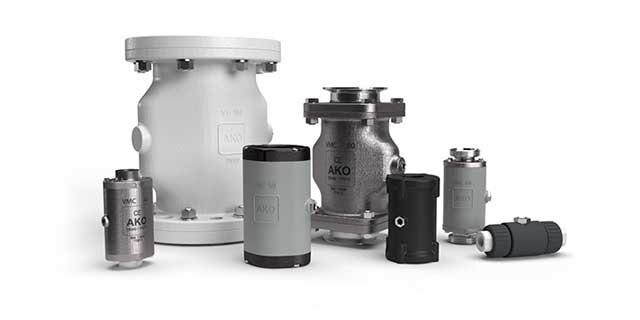
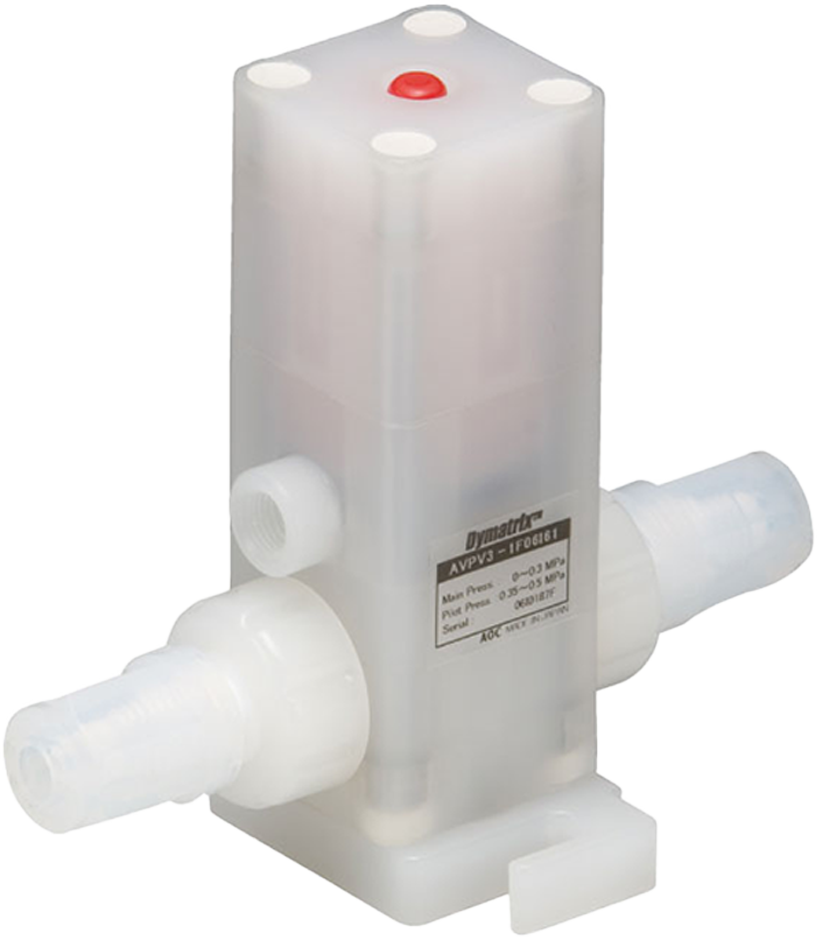
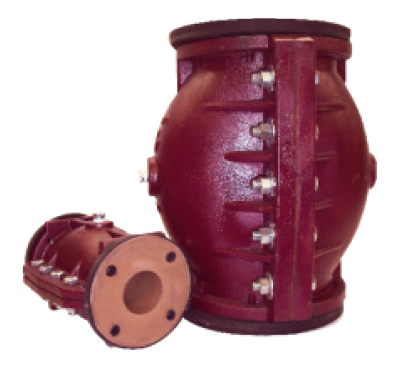
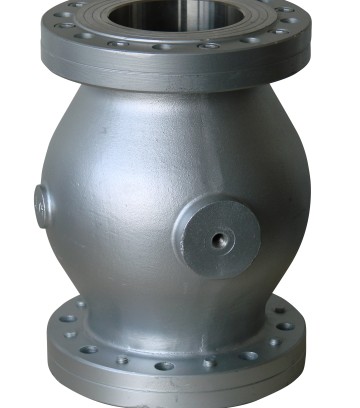
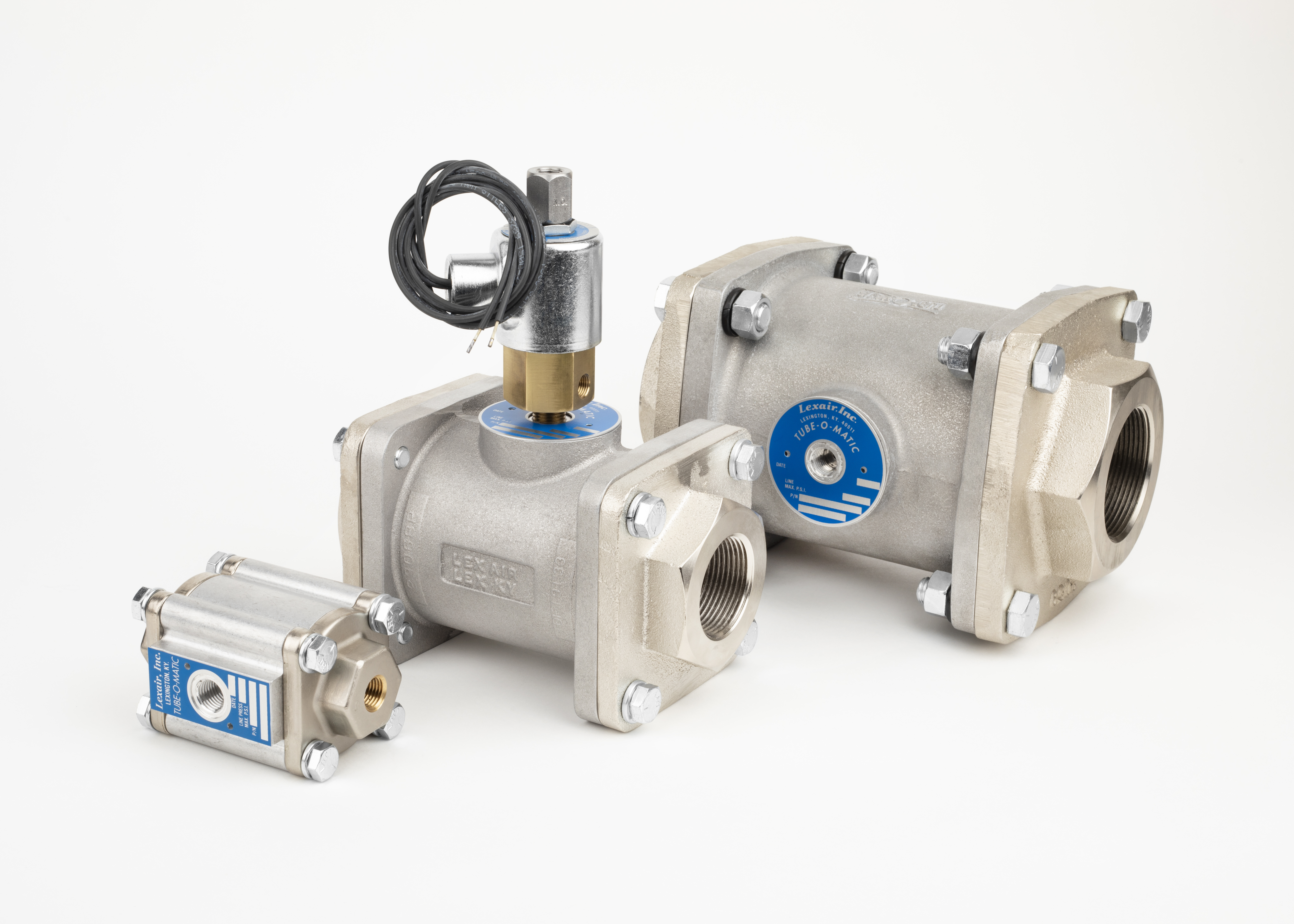
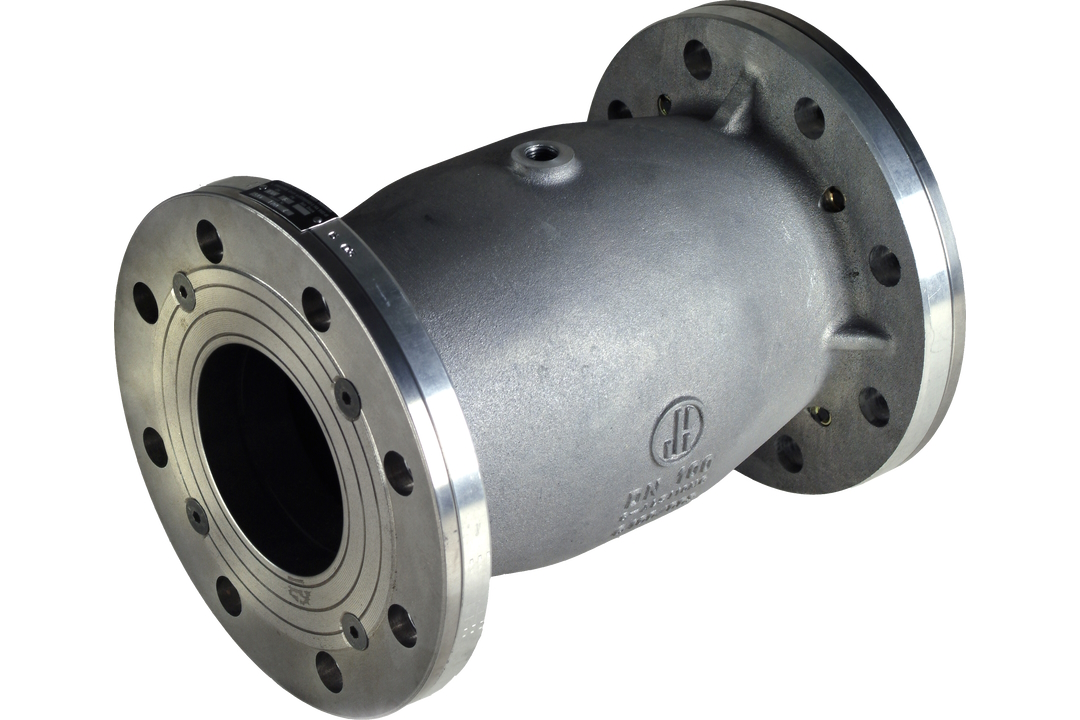
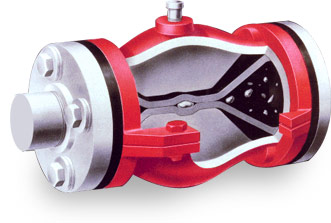
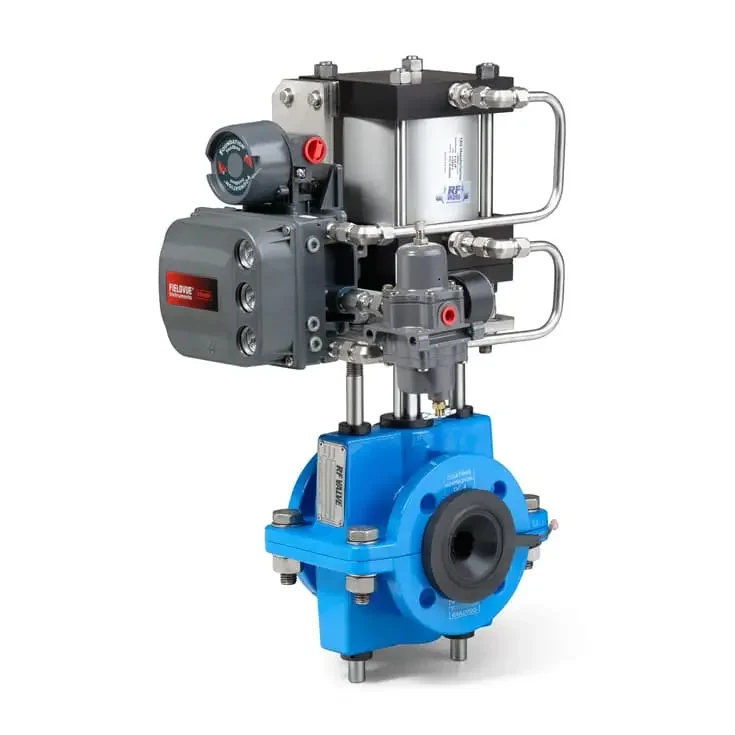
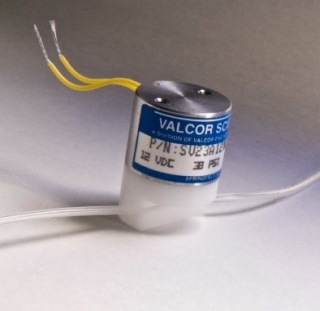
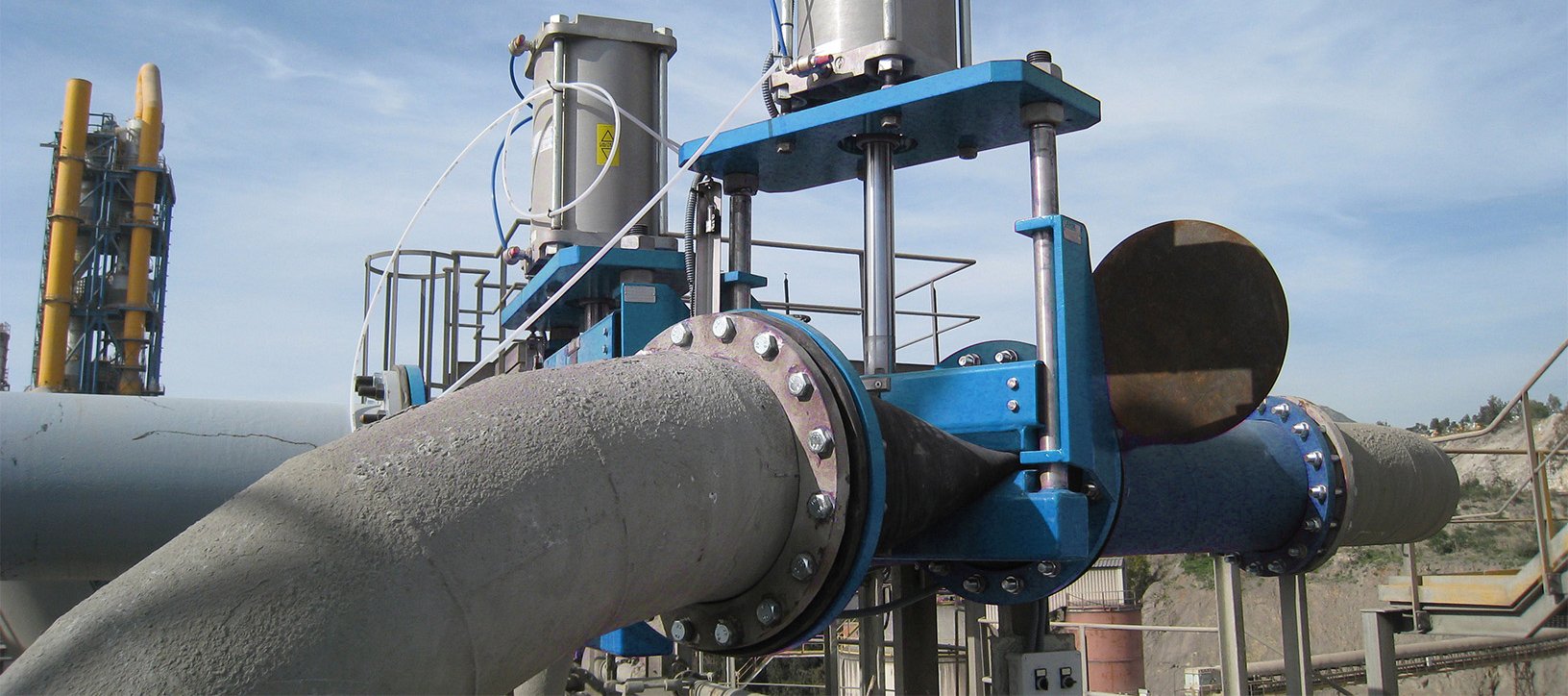
A pinch valve is a full-bore isolation valve that controls flow by squeezing a flexible elastomer sleeve, the only part that ever touches the process media. Because nothing protrudes into the bore, the open valve presents a straight, unobstructed flow path with no weir, seat, pocket, or dead leg. This makes the pinch valve the reference choice for abrasive slurries, fibrous suspensions, dry bulk powders, and media carrying large solids that would jam or erode a gate, ball, or butterfly valve.
The sleeve can be closed mechanically by a handwheel and pinch bar, or pneumatically by admitting compressed air into the jacket around the sleeve. The valve body, made of aluminium, cast or ductile iron, or stainless steel, carries no internal trim, so corrosion and abrasion resistance are decided almost entirely by the choice of sleeve elastomer.
Photo: Hess BSH, CC BY-SA 4.0, via Wikimedia Commons
This guide is written for industrial purchasing and design engineers selecting valves for slurry, powder, and corrosive-media service. It covers 6 chapters from working principle, actuation and body types, sleeve elastomer grades, materials and standards, spec-sheet decoding, to selection decisions, with 7 selection FAQs and manufacturer comparisons. Dimensional and material references draw on public standards including ISO 5752 face-to-face lengths, EN 1092 and ASME B16.5 flange drilling, and ASTM D2000 elastomer classification, alongside published manufacturer datasheets.
Chapter 1 / 06
What is a Pinch Valve
A pinch valve is a linear-motion shut-off valve in which flow is started, stopped, or throttled by pinching a flexible elastomer tube, called the sleeve, until its opposite walls touch and form a drop-tight seal across the entire bore. It is functionally a 2/2-way valve: fully open or fully closed, with a limited throttling band in between. The defining feature is that the resilient sleeve is the only wetted component. The metal body, the closing mechanism, and the actuator never contact the process fluid, so the valve handles aggressive, abrasive, and solids-laden media that would destroy the seat and trim of a conventional valve.
Three operating states describe the valve. In the open state the sleeve is fully relaxed and the bore is round and unobstructed, giving a near-zero pressure loss and a flow area equal to the connecting pipe. In the throttling state the sleeve is partially compressed, reducing the cross-section and raising the local velocity. In the closed state the sleeve walls collapse against each other, and because rubber conforms around any trapped particle, the valve seals positively even when solids are present, a condition that holds a metal ball or gate valve open.
Structurally a pinch valve has four elements. The sleeve is a reinforced rubber tube, typically built in three layers: an inner liner chosen for chemical and abrasion resistance, a reinforcement layer of one to three plies of nylon or aramid fabric that carries the line pressure without ballooning, and an outer cover. Sleeve wall thickness is commonly in the range of 6 to 12 mm depending on bore and pressure class. The body or housing surrounds the sleeve and provides the pressure boundary for the closing air in pneumatic designs. The end connections are flanged to EN 1092 or ASME B16.5, threaded, or sanitary tri-clamp. The actuator is either a manual handwheel with pinch bars or a pneumatic jacket.
The pinch valve traces its lineage to the rubber-tube clamps used in laboratory and medical fluid handling, scaled up and reinforced for industrial pressures. Its industrial breakthrough came with the development of fabric-reinforced moulded sleeves that could hold several bar of line pressure while still flexing to a drop-tight close. Today the pinch valve is a category of its own within the on-off and slurry valve families, sitting alongside knife-gate, diaphragm, and full-bore ball valves, and it is the default isolation device on mineral processing, dredging, fly-ash, and pneumatic-conveying lines.
The engineering value of a pinch valve is concentrated in four properties: the abrasion resistance of the elastomer sleeve, the unobstructed full-bore flow path, the positive seal around trapped solids, and the single low-cost replaceable wear part. These properties decide the total cost of ownership on difficult media. A pinch valve costs more than a basic gate valve up front, but where slurry abrasion would scrap a metal-seated valve in weeks, the pinch valve runs for months or years on a sleeve that costs a fraction of the body.
It is worth stating clearly what a pinch valve is not. It is not a precise modulating control valve: its inherent flow characteristic is non-linear, and outside a contoured-sleeve control variant it gives little usable resolution near the closed position. It is not a high-pressure valve in the way a forged ball or gate valve is, because the line pressure is held by a reinforced rubber tube rather than a metal pressure boundary, capping practical line pressures at the low single-digit-bar range for most bores. And it is not a fire-safe or high-temperature device, since the sleeve elastomer sets a ceiling that rarely exceeds about 130 degrees Celsius. Recognising these boundaries early prevents the common error of specifying a pinch valve into a duty where a different valve family is the correct answer.
Chapter 2 / 06
Actuation and Body Types
Pinch valves are classified two ways: by how the sleeve is closed (actuation) and by how the sleeve is held in the body (body construction). Getting both right is the first selection step, because they determine pressure capability, control-air requirements, and serviceability. The table below summarises the main actuation types.
Mechanical pinch valves use a rising or non-rising stem that drives two pinch bars against the mid-section of the sleeve. Because closure is multi-turn, typically more than one full handwheel rotation, the operator can hold any intermediate position, which makes mechanical pinch valves usable for coarse manual throttling as well as isolation. They need no compressed air or electrical supply, so they suit remote installations and simple manual lines. The trade-off is speed: a mechanical valve cannot cycle quickly and is not suited to automated batching.
Pneumatic, or air-operated, pinch valves are the workhorse of automated slurry and powder handling. Compressed air is admitted into the jacket surrounding the sleeve; the air pressure collapses the sleeve walls drop-tight, and venting the jacket lets the sleeve spring back open under line pressure and its own elasticity. The closing air pressure must exceed the line pressure: manufacturers such as AKO require a minimum differential on the order of 2 bar above the line pressure for reliable shut-off. Air-operated valves cycle fast, fail-safe to a defined state, and integrate directly with solenoid pilots and DCS or PLC outputs.
By body construction there are two families. In an open-body (open-frame) design the sleeve is exposed between two end flanges and is closed by external pinch bars; this is the classic mechanical configuration and gives easy sleeve inspection and replacement. In an enclosed-body (closed-body) design the sleeve is sealed inside a pressure-tight housing, and the cavity between the housing and the sleeve is pressurised with control air or hydraulic fluid to close it. The enclosed body protects the sleeve from external damage, allows pneumatic or hydraulic actuation, and is standard for higher line pressures. The table below contrasts the two.
Body construction
Closure source
Pressure capability
Sleeve access
Open body (open frame)
External pinch bars
Low to medium
Excellent; sleeve visible
Enclosed body (closed)
Jacket air or hydraulic pressure
Medium to high
Unbolt body to access
A further distinction is fail-safe behaviour. Air-operated pinch valves are commonly specified fail-closed (air-to-open) so that loss of control air shuts the line, or fail-open (air-to-close) where a process must keep flowing on air failure. Because the sleeve has its own spring-back elasticity, the fail position must be engineered with the actuator and pilot logic, not assumed from the sleeve alone.
Chapter 3 / 06
Sleeve Elastomer Grades
The sleeve is the only wetted part, so its elastomer single-handedly decides chemical compatibility, abrasion resistance, temperature limit, and service life. Choosing the wrong compound is the most common and most expensive pinch-valve mistake. The table below compares the mainstream sleeve elastomers with their approximate maximum continuous temperature and characteristic strengths. Always confirm against the manufacturer corrosion chart for the exact media, concentration, and temperature.
Elastomer
Max continuous temp
Strengths
Avoid
Natural rubber (NR)
approx. 80 degrees C
Excellent abrasion and resilience; standard slurry sleeve
Oils, fuels, oxidizers, ozone
EPDM
approx. 110 to 120 degrees C
Hot water, dilute acids/bases, steam, ozone, weathering
Natural rubber (NR) is the default sleeve for abrasive, non-aggressive media: tailings, sand, gravel, fly ash, cement slurry, and dredging spoil. Its mechanical toughness and high resilience let it absorb and rebound particle impact rather than eroding, which is why it outlasts metal-seated valves on slurry by a wide margin. NR is limited to roughly 80 degrees Celsius and to media without significant oil, oxidizer, or ozone content. For severe abrasion, polyurethane-lined or special abrasion-grade compounds extend life further.
EPDM is the choice for hot water, steam condensate, dilute acids and alkalis, and outdoor or ozone-exposed service, with a continuous limit around 110 to 120 degrees Celsius. Its weakness is hydrocarbons: EPDM swells badly in mineral oils, fuels, and greases, so any oil-bearing process rules it out. NBR (nitrile) is the complementary grade, excellent in oils, fuels, fats, and aliphatic hydrocarbons but poor against ozone and strong oxidizers.
CSM (Hypalon) and FKM (Viton) are the chemical-duty grades. CSM resists strong acids, bases, and oxidizers and tolerates roughly 130 to 150 degrees Celsius. FKM (Viton) handles aggressive chemicals, oils, and higher temperatures to about 130 degrees Celsius but should not be used in hot water, steam, ketones, or amines. Silicone (VMQ) offers the widest temperature span and is available in FDA and EHEDG-compliant food and pharmaceutical grades, but its low tear strength makes it unsuitable for abrasive slurry. For potable, food, and pharmaceutical lines, specify the certified grade explicitly, since the base polymer alone does not guarantee compliance.
Two construction points matter alongside the polymer. The reinforcement layer, one to three plies of nylon or aramid fabric, sets the pressure rating: more plies allow higher line pressure but stiffen the sleeve and raise the closing force needed. And conductive (anti-static) compounds are required for ATEX or dust-explosion zones, so that the sleeve does not accumulate a static charge in dry powder conveying. Specify the conductivity requirement up front when the media is a flammable dust or solvent.
Chapter 4 / 06
Body Materials and Standards
Because the sleeve isolates the media, the pinch valve body is chosen for mechanical strength, weight, and the closing-pressure boundary rather than for corrosion resistance. The common body materials are aluminium, cast iron and ductile iron, coated or cast steel, and stainless steel. The table below sets out where each fits.
Body material
Typical use
Notes
Aluminium
Compact and small-bore air-operated valves
Light, low cost; limited pressure
Cast iron / ductile iron
General slurry, water, wastewater
Strong, economical; needs external coating
Cast / coated steel
Higher pressure slurry and mining duty
Powder-coated or rubber-lined exterior
Stainless steel (304 / 316)
Food, pharma, corrosive ambient, washdown
Required where the housing itself is exposed
Thermoplastic (POM / PVC)
Compact lab, dosing, OEM valves
Small DN, low pressure only
For enclosed-body valves the housing is also the pressure vessel for the closing air or hydraulic fluid, so its rating must cover both the line pressure and the actuation pressure with margin. Where the valve is installed in a corrosive atmosphere, in washdown areas, or where the housing could be splashed by the process, stainless steel or a fully coated body is specified even though the media never contacts it.
Pinch valves are not governed by a single dedicated product standard the way thermoplastic ball valves are by ISO 16135. Instead they are built to the general valve dimensional and material standards. Face-to-face length commonly follows ISO 5752 or the manufacturer series. Flange drilling and rating follow EN 1092-1 (PN 6, PN 10, PN 16) in Europe or ASME B16.5 (Class 150) in North America, with the equivalent cast-iron drilling under ASME B16.1 (Class 125), so the valve bolts directly into standard piping. Sleeve elastomers are classified and specified by ASTM D2000, which codes a rubber by type and class against heat and oil resistance, and food or pharmaceutical sleeves additionally carry FDA 21 CFR 177.2600, EC 1935/2004, or EHEDG compliance. Hazardous-area installations reference ATEX 2014/34/EU and the IEC 60079 series, which is why conductive sleeves and earthed bodies are mandated in dust and gas zones.
The table below maps the typical standard reference to each part of a pinch valve specification, so a purchase order can cite the right document for each interface rather than relying on a single product code.
Specification area
Typical standard reference
Face-to-face length
ISO 5752 / manufacturer series
Flange drilling and rating
EN 1092-1 (PN) / ASME B16.5 (Class)
Sanitary connections
Tri-Clamp ISO 2852 / DIN 32676
Sleeve elastomer classification
ASTM D2000
Food / pharma contact
FDA 21 CFR 177.2600 / EC 1935/2004 / EHEDG
Hazardous area
ATEX 2014/34/EU / IEC 60079 series
Chapter 5 / 06
Key Specification Parameters
A pinch valve datasheet reads differently from a metal valve datasheet because the sleeve dominates. Seven parameters drive most selection decisions: nominal size, line pressure rating, control or closing pressure, temperature limit, flow coefficient, sleeve elastomer, and end connection. Each is decoded below.
Nominal size (DN / NPS) equals the bore, since pinch valves are full-bore. Industrial pinch valves span roughly DN10 to DN300 and larger, with small-bore solenoid and compact air-operated units starting around DN10 and slurry valves running to DN300 or more. As an example of the range, the AKO VF flanged series covers DN40 to DN300, the flanged VMC series covers DN25 to DN150, and the compact threaded VMP series starts at DN10. The full bore means the valve adds no extra restriction beyond the connecting pipe when fully open.
Line pressure rating is the maximum process pressure the sleeve and reinforcement can hold. For air-operated valves it is size-dependent and typically falls in the low single-digit-bar range for larger bores, rising for smaller bores; published manufacturer data shows, for instance, maximum line pressures on the order of 6 bar for the smallest sizes (DN10 to DN25) and lower for larger sizes. Reinforcement ply count and sleeve wall thickness set this rating, so a higher-pressure sleeve in the same body is a defined option.
Control (closing) pressure applies only to air-operated and hydraulic valves. The jacket pressure must exceed the line pressure to collapse the sleeve drop-tight. Manufacturers specify a minimum differential, commonly about 2 bar above the maximum line pressure, with recommended differentials in the region of 2 to 3.5 bar. A practical rule is a control pressure of 1.5 to 2 times the line pressure plus a sleeve allowance: too little and the valve leaks, too much and the sleeve fatigues prematurely.
Temperature limit is set by the sleeve elastomer, not the body, and follows the grades in Chapter 3: roughly 80 degrees Celsius for natural rubber, 110 to 120 degrees Celsius for EPDM, and up to about 130 degrees Celsius for FKM, silicone, and CSM. The control-air or hydraulic side and the ambient rating of the actuator must also cover the installed environment.
Flow coefficient (Kv / Cv) describes throughput. A fully open pinch valve has a high coefficient close to that of the bare pipe because the bore is unobstructed. For control duty, a reduced-bore or contoured (conical) sleeve deliberately lowers and linearises the coefficient to give usable throttling resolution. The remaining two parameters round out the order:
Sleeve elastomer: NR, EPDM, NBR, CSM, FKM, silicone, or a food/conductive grade per the media and temperature.
End connection: flanged to EN 1092-1 or ASME B16.5, threaded, or sanitary tri-clamp, matched to the existing pipe class.
Actuation and fail position: manual, air-operated fail-closed, or fail-open, with the pilot and limit switches specified.
Body material and protection: aluminium, ductile iron, coated steel, or stainless, with external coating where the housing is exposed.
Two derived figures matter for operating budget. Compressed-air consumption per cycle scales with bore and jacket volume, on the order of one to two litres of free air per cycle for a mid-size valve, which adds up on high-cycle batching lines. And sleeve life, discussed next, sets the spare-parts and downtime cost that usually dominates the lifecycle economics of a slurry valve.
Chapter 6 / 06
Selection Decision Factors
To turn the preceding chapters into a specific model, work through the ordered decision sequence below. Most selection errors come not from one wrong parameter but from deciding the sleeve or actuator before the media and pressure are pinned down. These eight steps form a reusable RFQ template.
Media and duty: Define the fluid, solids content, particle size, abrasiveness, and whether the duty is on-off isolation or throttling. This decides whether a pinch valve is the right family at all versus a diaphragm, knife-gate, or control valve.
Sleeve elastomer: Match the compound to media chemistry and temperature using Chapter 3: NR for abrasive non-aggressive slurry, EPDM for hot water and dilute acids/bases, NBR for oils, CSM or FKM for aggressive chemicals, a certified grade for food and pharma, a conductive grade for ATEX dust.
Size and line pressure: Set DN to the pipe bore (the valve is full-bore) and confirm the sleeve and reinforcement hold the maximum line pressure with margin, including surge and water-hammer peaks.
Actuation and fail position: Manual for simple isolation, air-operated for automation. For air-operated, confirm the control-air supply can deliver at least about 2 bar above line pressure and choose fail-closed or fail-open per process safety.
Body construction and material: Open-body for easy sleeve access at lower pressure, enclosed-body for pneumatic or hydraulic closure and higher pressure. Pick aluminium, ductile iron, coated steel, or stainless per pressure and ambient exposure.
End connection and dimensions: Flanged to EN 1092-1 or ASME B16.5, threaded, or tri-clamp, with face-to-face per ISO 5752 or the series so the valve fits the existing spool.
Control and instrumentation: Solenoid pilot, positioner for throttling sleeves, limit or proximity switches for position feedback, and a contoured sleeve where a defined Kv or Cv is required.
Total cost of ownership: Add purchase price, installation, compressed-air consumption, and above all sleeve replacement frequency and the downtime it implies. On abrasive slurry the sleeve, not the valve body, dominates the lifecycle cost.
One dimension that is easy to overlook at the purchasing stage but decisive over a valve's life is serviceability and spare-sleeve supply. Because the sleeve is a consumable wear part, the practical questions are how fast a replacement sleeve in the right elastomer can be sourced, whether the sleeve can be changed without removing the body from the line, and whether a wear-detection or stroke-trend method is available to plan the change before a rupture spills media. Established makers such as AKO Armaturen, Red Valve, and Valmet (formerly Flowrox and Larox) keep sleeve inventories and field service in major markets; for slurry and tailings, Weir Minerals and regional Chinese suppliers such as Lianke and Teko provide lower-cost natural-rubber and EPDM sleeves. Confirm spare-sleeve lead time and proven references in your specific media before committing to a series, because a valve with no available sleeve is a stopped process line.
FAQ
What is the difference between a pinch valve and a diaphragm valve?
Both isolate the process fluid from the metal body with a flexible elastomer, but the geometry differs. A pinch valve uses a full-bore tubular sleeve that is squeezed shut from outside the flow path, so the open valve presents a straight, unobstructed bore with no weir, pocket, or dead leg. A diaphragm valve presses a flat membrane down onto a weir or a flat seat inside the body, leaving a flow path that turns over a saddle. The pinch valve handles abrasive slurries, fibrous media, and large solids far better because nothing protrudes into the stream, while the diaphragm valve gives finer throttling control and is the sanitary standard for clean low-solids liquids. Pinch valves also seal positively around trapped solids that would hold a diaphragm or a ball valve open.
How much higher must the control pressure be than the line pressure?
For an air-operated pinch valve, the closing air pressure in the jacket must exceed the maximum upstream line pressure so the sleeve walls collapse drop-tight. Manufacturers such as AKO specify a minimum differential of about 2 bar above the line pressure for reliable shut-off, and a practical working rule is a control pressure of roughly 1.5 to 2 times the line pressure plus a sleeve-elasticity allowance. Below about 1.3 times the line pressure the sleeve can leak; well above 2.5 times accelerates sleeve fatigue and shortens service life. Mechanical pinch valves do not use this ratio because a handwheel and pinch bar mechanically close the sleeve regardless of line pressure.
How do I choose the sleeve elastomer for my media?
The sleeve is the only wetted part, so its elastomer governs both chemical compatibility and service life. Natural rubber (NR) is the standard for abrasive, non-aggressive slurries up to about 80 degrees Celsius because of its mechanical toughness and resilience. EPDM suits hot water, dilute acids and bases, and ozone exposure up to roughly 110 to 120 degrees Celsius but fails in oils and fuels. NBR (nitrile) handles oils, fuels, and aliphatic hydrocarbons. CSM (Hypalon) and FKM (Viton) cover strong acids and oxidizers, with FKM and silicone tolerating about 130 degrees Celsius. Always cross-check the manufacturer corrosion chart against the actual media concentration, temperature, and abrasive load before ordering.
Why are pinch valves preferred for abrasive slurry service?
In a pinch valve the abrasive media contacts only the resilient rubber sleeve, never a metal seat or trim. When abrasive particles strike the rubber, the elastic sleeve absorbs and deflects the impact energy rather than eroding like a hard metal surface, so wear is slow and even. The full-bore straight-through path also avoids the cavities, seats, and stem pockets where slurry packs and abrades in gate, ball, and butterfly valves. The result is far longer service life on mining tailings, cement slurry, fly ash, and dredging duty, with the sleeve being a single low-cost replaceable wear part. Cycle life on abrasive duty can reach the order of one to several million cycles versus tens of thousands for ball or knife-gate valves.
Can pinch valves be used for flow control, or only on-off?
Pinch valves are primarily on-off (2/2-way) shut-off devices, but they can throttle within limits. The closing characteristic is strongly non-linear, so the controllable band is roughly the middle of travel; the valve is twitchy near the closed position and offers little resolution in the last part of the stroke. For modulating duty, manufacturers offer conical or contoured sleeves that linearize the flow characteristic and provide a defined Kv or Cv, and positioners with proportional air supply improve repeatability. For precise continuous control, a dedicated control valve or a contoured-sleeve control pinch valve is the better choice; for isolation and coarse throttling of difficult media, a standard pinch valve is ideal.
What is the typical sleeve service life and how is it replaced?
Sleeve life ranges from a few months to several years depending on the elastomer, slurry composition, temperature, pressure, valve size, and cycling frequency. On heavy abrasive slurry duty, replacement every 6 to 24 months is common. The sleeve is a single, low-cost spare: on flanged open-body and enclosed-body designs the valve is unbolted from the line, the worn sleeve is pulled out, and a new one is fitted, often without removing the body. Tracking pressure drop and actuator stroke trends, or using a wear-detection sleeve, lets maintenance plan the change before a sleeve ruptures. Always stock at least one spare sleeve per critical valve.
Which manufacturers and series are common for industrial pinch valves?
AKO Armaturen (VF flanged and VMP/VMC compact series), Red Valve (Series 75 and Type A air-operated), and Valmet (formerly Flowrox and Larox, with PV pinch and PVE/PVG slurry knife-gate-style sleeves) are the established names in mining, cement, and wastewater. Other recognized suppliers include Onyx Valve, ABACO, and Saunders for sanitary and chemical duty. For slurry and tailings, also evaluate Weir Minerals and regional Chinese makers such as Lianke and Teko that supply natural-rubber and EPDM slurry sleeves at lower cost. Select on sleeve elastomer range, body rating, spare-sleeve availability, and proven service references in your specific media before committing.
Pinch Valve Manufacturers
Source-backed product routes. Open a company dossier for procurement scope and cited evidence.