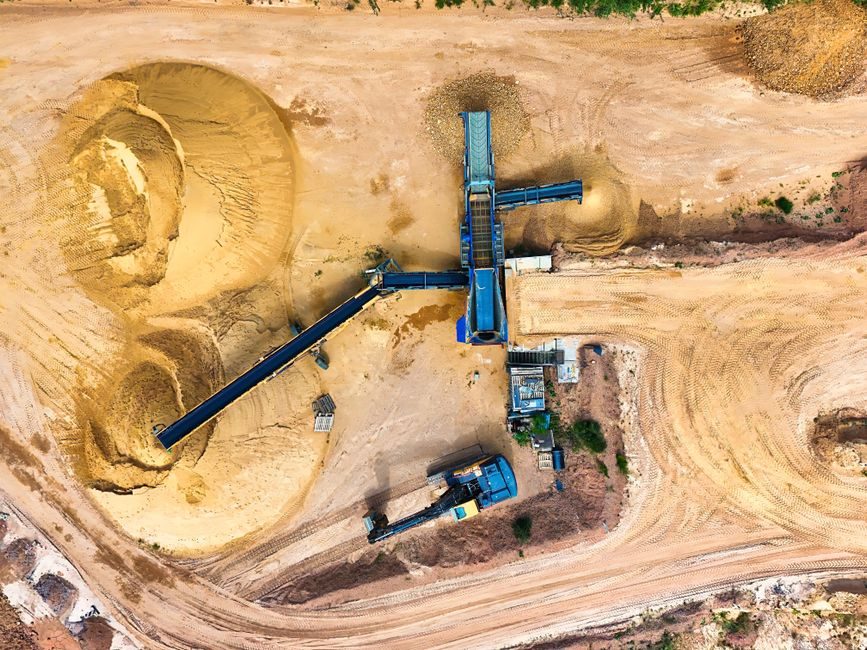
A mining-spec wheel loader is selected first by haul-truck payload class, then by bucket density, and only finally by engine horsepower and operating weight, because the loading-and-haulage cycle consumes 50–60% of total surface-mine production cost and any mismatch between loader pass count and truck box capacity propagates directly into cost per tonne [S2].
The envelope that defines whether a machine is fit for any mining duty is the combination of SAE J732/J818 tipping load at full turn, SAE breakout force, hinge-pin height, and operating weight; mid-size production loaders typically weigh 18–50 t with 2.5–6 m³ buckets, while ultra-class surface mining units exceed 200 t and 20 m³ [S3][S5].
Truck-Class Payload Match: The 50–85% Rule
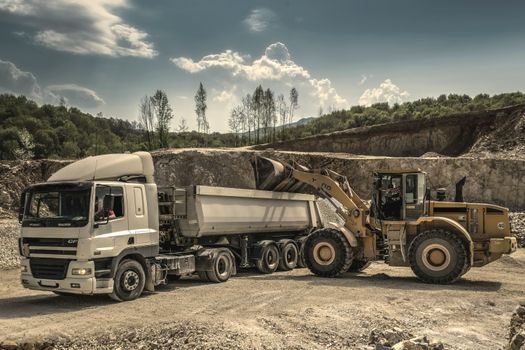
Procurement guidance for open-pit loading equipment states that wheel-loader bucket payload should be sized at 50–85% of the rigid-frame haul-truck's rated payload, because a 4–6 pass match keeps the truck at the loader's optimal loading arc and minimises queue time at the face [S2]. The same source notes that correct load distribution during the loading cycle has been measured to improve average cycle speed by 5.2% per pass, a gain that compounds across thousands of daily cycles [S2].
For an 80–100 t class truck (Cat 777, Komatsu HD785), a 4-pass match falls in the 20–25 t per pass range, which lines up with the Komatsu WA1200 at 20 m³ / 216 t operating weight when handling broken rock at ~1.6 t/m³ [S3]. Mid-sized 54–60 t trucks pair with the WA800 (12 m³, 102 t) or WA900 (13 m³, 107 t), while sub-54 t utility trucks are typically loaded with 3–6 m³ machines such as the WA380-8 or Cat 972-class units [S3][S5].
Structural Limits: Tipping Load, Breakout Force, Hinge Pin
SAE-rated full-turn tipping load at 40° articulation is the structural ceiling that defines a mining loader's maximum allowable payload, and procurement specs typically require both straight and full-turn tipping values to be quoted to SAE J732 to prevent under-specification at the bank [S6]. One published municipal mining-fleet specification sets the minimum envelope at 23,300 lb straight tipping load, 18,050 lb full-turn (40°) tipping load, and 26,500 lb breakout force, paired with 150 in hinge-pin height and 114 in dump clearance at 45° for truck-loading geometry [S6].
Bucket breakout force governs the ability to dig into a compacted muck pile or shot-rock face, and values above 200 kN are typical of mid-size 3–5 m³ mining-class machines; below this range, cycle time degrades rapidly in hard digging [S6]. Operating weight and static tipping load scale together — roughly a 2.5:1 ratio of operating weight to full-turn tipping load is normal for a wheel loader in production configuration, and deviations from this ratio usually indicate an undersized rear-frame or counterweight package for the duty claimed [S2][S6].
Size Class Comparison: Compact, Mid, Large, Ultra-Class
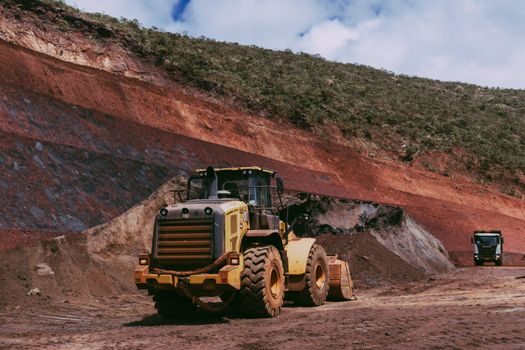
The market segments mining wheel loaders into four discrete size classes, and the procurement decision is almost always which class fits the truck fleet, not which model within a class: [S2]
1.5–5 t / 0.6–1.5 m³ (compact, e.g. MCLLROY 918, 1.5–2.5 t class) — yard, stockpile reclaim, secondary support; not rated for primary face loading in hard rock [S1].
18–50 t / 2.5–6 m³ (mid-size, e.g. WA380-8, WA470-6A, WA480-6A, Cat 972/980 class) — primary loading for 40–60 t articulated and small rigid trucks, quarry face work, shot-rock handling [S5][S7].
80–110 t / 9–13 m³ (large, e.g. WA800 12 m³ / 102 t, WA900 13 m³ / 107 t) — primary loading for 54–100 st (short tons) rigid trucks, oil-sand, large aggregate quarry [S3].
200+ t / 20–40 m³ (ultra-class surface mining, e.g. WA1200 20 m³ / 216 t, WE2350 40.5 m³ / 266 t) — primary loading for 144–250 st rigid-frame trucks in iron-ore, copper, and oil-sand operations [S3][S4].
The WE2350 is the current ultra-class benchmark at 1,715 kW (2,300 HP) gross, 40.52 m³ (53 yd³) bucket, and 266,259 kg (587,000 lb) operating weight, sized to load Cat 793/795 and Komatsu 930E-class trucks in 4–5 passes [S4]. Mid-size diesel-electric drive loaders such as the WA470-6A and WA480-6A have an established reputation in mining for sustained production in high-altitude and high-ambient-temperature operations, where diesel-electric drive removes the cooling penalty of a mechanical powershift at continuous high load [S5].
Selection Criteria Beyond Bucket Size
For any size class, the four non-bucket parameters that drive the buy decision are powertrain type, hydraulic response, ground-engaging tool (GOT) package, and noise/emissions compliance, each of which is site-specific. A mining procurement spec should require documentation of: (a) powertrain type (mechanical, hydrostatic, or diesel-electric), (b) bucket GET consumption rate in mt of material per set of teeth, (c) operator sound pressure per ISO 6396:2008 (target ≤72 dB(A) for enclosed cabs in confined-pit work), and (d) emissions tier — Tier 4 Final / EU Stage V for any operation in a regulated jurisdiction, EU Stage II for export-only secondary markets [S9][S1].
For steel-mill and slag-handling specialty applications, factory-engineered arrangements such as the Cat 972 steel-mill package add elevated cooling packages, heat-resistant hydraulic seals, and slag-bucket wear packages that materially change the spec sheet versus a quarry-base machine of the same model [S9].
When a Wheel Loader Is the Wrong Tool
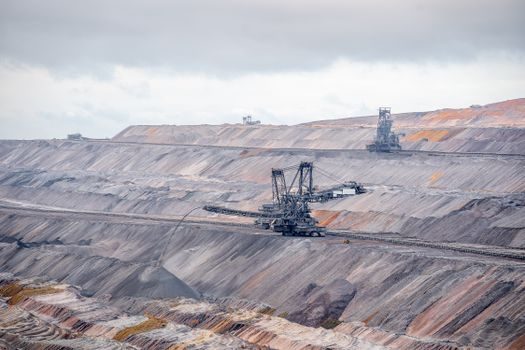
A wheel loader is a poor selection when the dig face is consistently above-grade, the material requires a long reach, or the loading geometry favours a face shovel; in those cases, a hydraulic mining shovel or a mining dump truck-matched hydraulic excavator in face-shovel configuration delivers better truck-loading geometry and higher fill factors on broken rock [S3]. Electric mining shovels with AC drives are also typically preferred over ultra-class diesel loaders for hard-rock copper and iron-ore operations at the 250 t truck class, where the higher installed cost of an electric shovel is amortised by lower fuel burn and higher availability in continuous 24/7 duty [S3].
Within the broader loading fleet, a backhoe loader handles utility trenching, drainage, and small-dig work, while a skid-steer loader is restricted to clean-up, stockpile, and confined-area work — neither belongs on a primary mining face [S1].
Application-Specific Configurations and Sourcing
Steel-mill and slag-handling configurations extend the wheel-loader envelope into a non-mining but adjacent heavy industry, with elevated cooling packages and purpose-built buckets [S9]. In oil-sand and large coal operations, diesel-electric drive units in the WA470-6A through WA1200 range dominate because the drive system handles the high-inertia load swings of a 12–20 m³ bucket with less thermal stress than a mechanical transmission [S5].
Export-market Chinese-built units in the 1.5–5 t class (MCLLROY, SDLG, Liugong) are widely used in secondary and support roles at African and Southeast-Asian mines, where factory options include EU Stage II diesel for non-regulated regions and EU Stage V for European export; the 5-tonne class is the upper limit of this compact segment, and any payload above 8 t in primary face duty requires moving into the OEM mid-size class [S1].
Limitations and Failure Modes to Spec Against
Three failure modes dominate mining-loader downtime and should be specified against during procurement: (1) frame cracking at the articulating hitch, driven by under-rated full-turn tipping load versus actual cycle loading; (2) final-drive and axle failures caused by sustained high-torque operation outside the rated gross machine weight envelope; and (3) hydraulic-cylinder seal failures at elevated ambient, which can be mitigated by high-temperature seal packages and synthetic ester fluids [S2][S6]. The published 22–56% range for maintenance and repair as a share of total mine operating expenditure reflects precisely this gap between correctly specified and incorrectly specified machines [S2].
For excavator-based comparison points on the same fleet (truck-loading, pipeline right-of-way, forestry), the spec-maps for excavator selection for pipeline construction and forestry excavator spec map cover adjacent loading-tool decisions; for the upstream equipment side of the same procurement, the ready-mix concrete selection map addresses the haul-road and pad concrete specification that loader traffic will run on during the first 12 months of mine life.
Verify any candidate unit's SAE J732 tipping-load certificate, ISO 6396:2008 operator-noise certificate, and Tier 4 Final / EU Stage V emissions declaration at the RFQ stage, and confirm that the supplier's recommended GET consumption rate (in m³ per tooth set) is supported by field data from a mine of comparable rock hardness (UCS) — the spec sheet will not catch these on its own, and they are the largest single source of cost-per-tonne variance in mining loading fleets [S2][S6][S9].