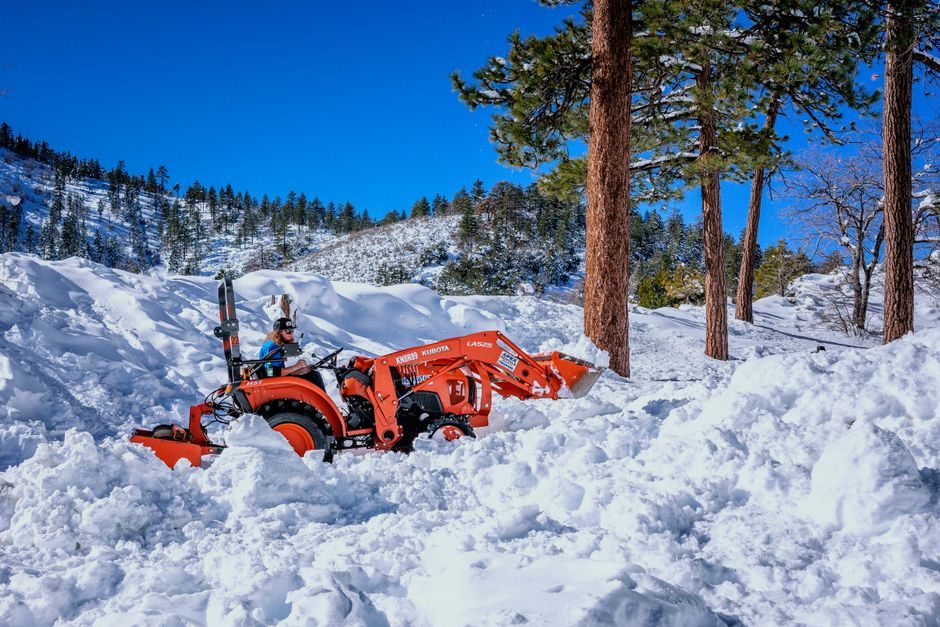
A compact-to-mid tracked excavator in the 8–14 tonne operating weight class is the workhorse that snow contractors in Tahoe City and the Spokane region repeatedly spec for combined plowing, loading, and hauling duty [S1][S2].
Junior's Snow Removal & Excavation Inc., operating as a general engineering contractor in North Lake Tahoe since 2000, runs a mixed heavy-equipment spread that pairs a 12–14 t class excavator with skid-steers and haul trucks to clear commercial lots and move plowed snow offsite [S2]. Dundee's Spokane fleet, in service since 2006, uses snow plows, snow blowers, snow throwers, skid-steers, bobcats, sand and salt dispensers, and snow shovels across residential and commercial contracts [S1]. The two fleets illustrate a clear 2026 pattern: a single mid-class excavator anchors the heavy work, and lighter compact machines cover the sidewalk and detail tasks.
Operating Class and Why 8–14 t Dominates Snow Work
Snow contractors in mountain regions such as Truckee and Olympic Valley run 12–14 t class tracked excavators because the machine has the bucket capacity to load a tri-axle dump in four to five passes while still fitting on a 40 t lowboy for relocation between sites [S2]. Lighter compact excavators in the 5–8 t class are kept on the yard for tight access, sidewalk cuts, and back-blading curb lines where a full-size machine cannot reach [S1]. The wheeled and tracked split matters: tracked undercarriage with steel or rubber pads delivers the low ground pressure needed to work on frozen ground and packed snow without breaking through asphalt that has been weakened by freeze-thaw cycles.
Two operating realities push owners away from machines smaller than 8 t. First, bucket breakout force below roughly 50 kN cannot pop a frozen snow pile that has compacted to 400–500 kg/m³ under its own weight over a week. Second, lift capacity at full reach drops below 2 t on most 5 t class machines, which is below the threshold needed to swing a 1.5 m³ bucket of wet snow at 5 m radius without tipping the machine. A 12 t class excavator typically delivers 90–110 kN bucket breakout and 4–6 t lift at full reach, both of which keep a single operator productive through a 12-hour storm shift.
For procurement teams cross-shopping chassis configurations against other severe-service applications, the urban excavator spec map on class, mobility, and tail-swing breaks down the same operating-weight bands against street-legal transport envelopes.
Engine, Hydraulics, and Cold-Weather Package
A 2026-spec snow excavator should carry a diesel engine in the 75–110 kW band with a factory cold-weather package: block heater, heavy-duty batteries rated to –30 °C, low-viscosity hydraulic oil (ISO VG 32), and an ether-start aid for cold-soak starts below –20 °C [S1]. Hydraulic flow in the 220–280 L/min range at 280–350 bar working pressure is the working envelope for running a high-capacity snow bucket, a tilting ditch-cleaning bucket for curb work, and a hydraulic thumb for log or debris handling after a windstorm.
Two auxiliary circuits are now standard on most contractor-grade machines. A proportional joystick-controlled second function is needed for tilt buckets; a third function is needed for hydraulic thumbs and for powered snow-blower attachments that can move 250–400 t of snow per hour on a 2 m blower head. Quick-coupler hydraulic lines should be flat-faced and color-coded toISO 16028 interfaces to keep cold-weather disconnection losses under 5 mL per cycle.
For a deeper cut on chassis, cab, and powertrain options that overlap with severe-service forestry work, the forestry excavator spec map walks through the same hydraulic-flow and arm-reach tradeoffs against guard options.
Attachment Matrix: Bucket, Blower, Thumb, and Plow

Contractors running year-round snow and excavation businesses typically own four core attachments for the host excavator. A 1.0–1.5 m³ general-purpose bucket handles the bulk of loading wet snow into haul trucks and cleaning up after plows. A 1.8–2.0 m hydraulic snow blower, fed by a 220 L/min auxiliary circuit, is the workhorse for the 1.0–1.2 m overnight accumulations that close parking decks. A hydraulic thumb converts the host machine into a debris handler for fallen limbs and compacted ice blocks. A rear-mounted or attachment-side dozer blade lets a single machine push piles back from building lines without a support loader. [S3]
The comparison below lines the four attachments against the four decision factors a snow-operations manager weights most heavily:
<b>Bucket (1.0–1.5 m³):</b> low purchase cost, highest loading rate into haul trucks, no hydraulic complexity, limited to dry-to-moist snow below roughly 350 kg/m³. <b>Hydraulic snow blower (1.8–2.0 m):</b> handles 250–400 t/h, throws 15–25 m, requires 220+ L/min auxiliary, adds 600–900 kg to the working envelope. <b>Hydraulic thumb:</b> smallest capex, multiplies the host machine's utility for debris and ice blocks, no measurable cycle-time penalty. <b>Dozer/wing blade:</b> mid-cost, extends reach 1.5–2.5 m past the tracks, ideal for backing piles off curbs and building lines.
For sites where the host excavator is feeding a 1.5–2.0 m³ hopper, a pressure transmitter on the auxiliary circuit pressure line is the cheapest way to detect a blocked intake before the relief valve opens and the operator hears the telltale chatter.
Supporting Fleet: Skid-Steers, Loaders, and Rooftop Scrapers
No snow contractor in 2026 runs a single machine class. The pattern repeated across both reference operators is a 12–14 t class excavator as the heavy anchor, one or more 2.5–4.5 t skid-steers or compact track loaders for sidewalks and back-of-curb work, and a haul truck in the 15–30 t GVW bracket for offsite snow relocation [S1][S2]. Dundee's Spokane fleet lists skid-steers and bobcats explicitly alongside the snow plows, snow blowers, and snow throwers used for stairways, walkways, and tight lot access [S1].
For vehicle-yard operations such as bus depots, delivery hubs, and long-haul trucking terminals, a rooftop snow scraper is the only attachment that scales to the throughput required. The Scraper Systems fleet plow clears a single trailer or bus roof in under 30 seconds, with documented throughput of up to 60 vehicles per hour, and has been in continuous North American production since 1998 [S3].
Two operational figures define when a rooftop scraper pays back versus a manual crew. Second, several U.S. states fine operators up to $1,500 per incident for transit with snow on the roof, a figure that recurs in fleet-safety bulletins and that recoups the capital cost of a rooftop scraper inside one to two winter seasons for fleets above 25 vehicles [S3].
Inside the depot, the hydraulic pressure line feeding the scraper head is monitored by the same kind of pressure sensor used on excavator auxiliaries, and a flow meter on the chassis-mounted hydraulic unit gives the maintenance crew a direct read on circuit health.
Site Selection, Operating Limits, and Failure Modes

Two operating limits define the 8–14 t envelope. The first is ground-bearing pressure: a 12 t tracked excavator with 600 mm steel shoes delivers roughly 35–40 kPa to the ground, low enough to work on a frozen gravel lot but high enough to crack a 75 mm asphalt cap that has been undermined by a spring thaw. The second is hydraulics: cold-soak oil above ISO VG 46 raises working-pressure loss by 8–12 % and slows cycle times, which is why contractors in Tahoe and Spokane spec low-viscosity ISO VG 32 hydraulic oil for winter and switch back to VG 46 for the shoulder season [S1][S2].
Three failure modes recur every winter. Hydraulic hose rupture at the quick coupler when a frozen fitting is disconnected under load — solved by flat-faced ISO 16028 couplers and a no-disconnect-under-pressure policy. Track tensioner seizure when slush infiltrates the idler seal — solved by daily greasing and a winter track inspection every 250 operating hours. Engine cold-soak no-start below –25 °C when the ether aid is empty — solved by an end-of-shift block-heater checklist and a fuel-water separator with a heated bowl.
For yard operators that also need to weigh loaded haul trucks before they leave the gate, an industrial valve manifold on the scale pit and a PLC head-end that ties axle weight, gate position, and ticket printing into one sequence cuts the per-truck cycle to under 90 seconds, a throughput target that matches the rooftop-scraper rate of up to 60 vehicles per hour for combined yard operations [S3].
Procurement, Standards, and Trackable Signals
Three procurement benchmarks separate a contractor-grade snow excavator from a general-purpose machine. First, a factory-installed cold-weather package rated to –30 °C ambient with documented cold-start tests at –25 °C. Second, a quick-coupler rated toISO 16028 with a powered hydraulic locking pin, not a manual wedge. Third, an engine and aftertreatment system that meets EPA Tier 4 Final / EU Stage V for off-road diesel, since most U.S. states and Canadian provinces enforce those emissions tiers on contractor-purchased new equipment regardless of seasonal use. [S2]
Trackable signals for 2026 include the rollout of factory telematics that expose hydraulic-circuit pressure and temperature on the operator display, the growing number of Tier 4 Final / Stage V rebuild kits for the 75–110 kW engine band, and the steady migration of rooftop scraper systems from bus-only depots into long-haul trucking yards as more states adopt the $1,500-per-incident snow-on-roof fine [S3]. For context on landfill and waste-handling sites, where winter uptime and abrasion-resistant buckets overlap with snow-spec needs, the 2026 landfill excavator spec map covers the same undercarriage and bucket-liner decisions in a higher-impact service environment.