
Plasma cutting delivers 500-2,500 mm/min travel on 0.5-2.0 mm kerf, beating oxy-fuel on speed and heat input for typical landscape metalwork [S6].
For landscape projects (gate frames, planter boxes, fire-pit rings, rebar cages, edging profiles) a 30-50 A inverter plasma on 110V/220V with 14-16 mm clean-cut capacity is the working envelope most crews standardize on [S1][S7].
Why a Plasma Cutter Fits Landscape Metalwork
Plasma cutting handles steel, stainless, copper, and aluminum by ionizing compressed air into a conductive arc, so one machine covers mild-steel gate frames, stainless planters, and copper downspout brackets without swapping torches [S4]. Compared to an abrasive cutoff wheel, a 40-50 A plasma delivers cleaner edges, far less heat distortion, and lower consumable cost on the 1/8-1/4 in stock that dominates landscape work [S3]. Compared to oxy-fuel on plate above 6 mm, plasma wins on travel speed (500-2,500 mm/min vs 250-600 mm/min) and kerf width (0.5-2.0 mm vs 2.0-6.0 mm), which matters when cutting decorative silhouettes and rebar cages for raised beds [S6]. A plasma cutter is therefore the right tool category for the typical landscape fabricator; the only landscape sub-tasks where oxy-fuel still wins are thick ferrous plate above 25 mm and purely outdoor rusted-steel demolition.
Four Spec Gates That Decide the Build Sheet
Amperage, input voltage, duty cycle, and air consumption are the four parameters that determine whether a cutter actually clears a landscape workday without overheating or tripping breakers [S1][S4]. The table below lines them up against the three operating profiles common in landscaping: light residential (one crew, weekend work, gates and planters under 1/4 in), production nursery/agritourism (daily cutting of planters, edging, fire-pit rings up to 1/2 in), and mobile service (driving a truck to job sites, cutting 1/4-3/8 in miscellaneous steel).
For a 20-amp portable 110V build, expect roughly 6-8 mm clean cut on mild steel and a 35-40% duty cycle, which suits light residential and trimming tasks [S1]. For a 50-amp dual-voltage machine on a 220V 30-amp breaker, expect 14-16 mm clean cut and 60% duty cycle, which is the production nursery baseline [S1][S7]. For an 80-amp 220V machine on a 50-amp breaker, expect 25 mm clean cut and up to 1 in severing, which is only required when landscape jobs run into structural plate or heavy fire-pit rings [S1][S3]. Across all three profiles the working envelope is narrower than the spec sheet suggests: more amps than your typical stock thickness leads to slag, dross, and harder control on thin decorative steel [S1].
Decision Comparison: Entry Inverter vs Mid-Range Dual-Voltage vs 80 A Industrial
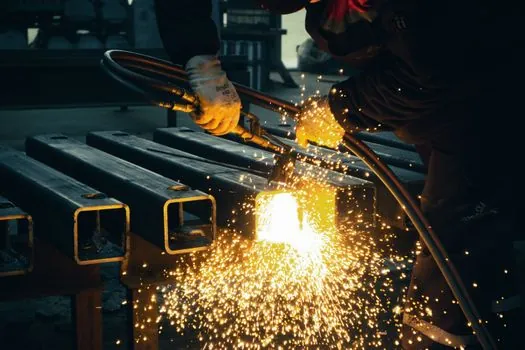
Three machine classes cover the landscape trade, and the right one is set by the thickest plate you sever in a normal week, not the thickest plate you have ever seen [S1][S3]. A 30 A 110V-only inverter handles 6-8 mm clean cut on 1/4 in and thinner, weighs under 25 lb, and runs on a 20-amp household circuit, but its 35-40% duty cycle and limited severance make it a one-job-at-a-time tool [S1]. A 50 A 110V/220V dual-voltage inverter is the landscape fabricator's workhorse: 14-16 mm clean cut, 60% duty cycle at rated output, 4-6 CFM airflow at 60-90 PSI, and the same machine cuts thin on 110V in the shop and full-thickness on 220V in the field [S1][S7]. An 80 A 220V industrial cutter delivers 25 mm clean cut and 1 in severing but needs a 50-amp breaker, a 6-8 CFM compressor, and usually a wheeled cart, which is overkill unless the shop also does structural fabrication [S3].
The cost delta is meaningful: a 30 A single-voltage machine typically lists around 400-600 USD, a 50 A dual-voltage machine around 700-1,200 USD, and an 80 A industrial machine around 1,500-3,000 USD, before factoring in the 220V circuit install cost (often 500-1,500 USD) for the 50 A and 80 A classes [S1][S7]. For most landscape crews the 50 A dual-voltage tier is the breakeven point: 14-16 mm covers 90% of gate, planter, and fire-pit work, and the same unit moves to job sites on 110V [S7].
Air Supply, Compressed Air, and the Hidden Constraint
Plasma cutting requires 4-6 CFM of clean, dry compressed air at 60-90 PSI; a small 6-gallon pancake compressor that delivers 2-3 CFM is the most common reason a 50 A cutter "underperforms" on site [S3][S7]. A moisture separator or refrigerated air dryer is not optional for landscape crews that cut outdoors, because humid air kills consumables fast and roughs up cut edges [S4]. Air consumption scales with amperage: a 30 A cut typically needs 3.5-4.5 CFM, while a 50 A cut needs 5-6 CFM, so the compressor decision has to be made alongside the cutter decision, not after [S3]. Pilot-arc reliability on painted or rusty metal matters for landscape work because gate frames and fire-pit rings are often stored outside and arrive at the cut with mill scale, primer, or surface rust; non-HF pilot arc designs are preferred when working near electronics or battery tools [S3].
Consumables, Duty Cycle, and Total Cost of Ownership
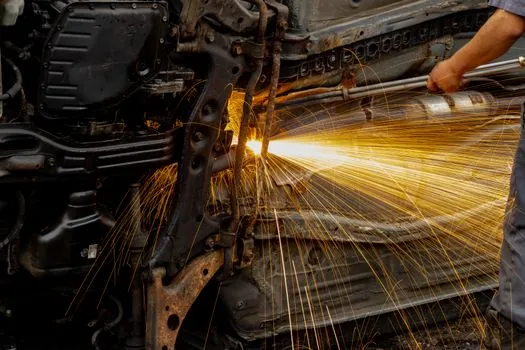
Consumable life (electrode + nozzle + swirl ring + shield) and 10-minute duty cycle together drive the per-foot cost of cutting, which on landscape jobs is the difference between profitable and break-even work [S1][S2]. A 60 percent duty cycle is a common spec on plasma cutter listings [S1], and real-world cutting rarely happens continuously anyway because setup time, material repositioning, and measurement breaks naturally create cooling periods, but production work and repetitive cutting jobs demand higher duty cycles to maintain efficient workflow [S7]. On the consumable side, expect 80-150 USD per electrode/nozzle set on 30-50 A machines, and typical electrode life of 100-300 pierces depending on thickness and operator technique [S2][S3]. A CNC-ready pilot arc upgrade (Everlast PowerPlasma 52i class machines) is only worth it if the landscape shop is also running a small CNC tube-and-plate table for batch brackets [S3].
Who Should Buy Which Class: A For/Against Map
Choose a 30 A 110V inverter if the work is weekend gate repairs, 1/8 in planter brackets, and the existing garage only has 15-20A circuits; do not choose it if you regularly cut 3/8 in plate or run production [S1]. Choose a 50 A 110V/220V dual-voltage inverter if the work spans residential gates, commercial planters, and on-site fire-pit rings up to 1/2 in, and you can install or access a 30A 220V outlet; do not choose it if the shop has no 220V and no plan to add one [S1][S7]. Choose an 80 A 220V industrial machine only if the landscape work has grown into structural steel, thick fire-pit sculpture, or fence post-on-plate fabrication; do not choose it for decorative cutting because high amperage on thin stock produces dross and warpage [S1][S3]. For crews that also handle rebar cages for raised beds and marble/stone cutter work for hardscape, the 50 A plasma remains the most versatile single-machine investment [S1][S3].
Safety, Standards, and Sourcing Notes for 2026
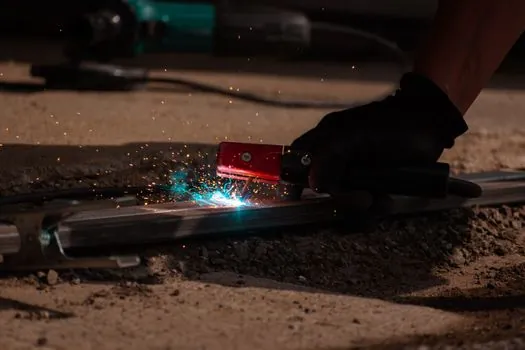
Modern inverter plasma cutters carry over-current, overheat, and pilot-arc fault protections as standard, and dual-voltage 110V/220V designs from brands such as Hypertherm, Hobart, Miller, Lotos, bestarc, ARCCAPTAIN, YESWELDER, SILATU, and Reboot are widely stocked in 2026 [S3]. A 2025 market analysis cited by RS Mobile Welding noted a 15% year-over-year increase in North American sales of portable and mid-range plasma cutting systems, reflecting demand for shop-floor-ready equipment among professionals and serious hobbyists [S5]. The landscape-specific signal to track through late 2026 is the rollout of more 50-55 A dual-voltage units with non-HF pilot arc, app-controlled amperage presets, and lower no-load power draw, all of which are now listed in the plasma cutter reference guide and in third-party test roundups [S3][S7]. For crews scaling into demolition or batch production, the plasma cutter spec gates for demolition work cover the air, duty cycle, and PPE deltas that landscape demolition sub-contractors should fold into their own SOPs.