Selecting a plastic container in 2026 is a four-axis decision: resin family, capacity class, regulatory rating, and load geometry — the 1000 L HDPE IBC at roughly 1200 mm × 1000 mm footprint and 1160–1335 mm height remains the workhorse of bulk liquid storage, with manufacturers such as IPL Schoeller, WERIT, and FACH-PAK offering UN31H2/Y-rated variants for ADR/IMDG/RID transport of dangerous goods [S1].
Below the IBC tier, the market splits sharply: 13.5–115 L PP and HDPE stackable bins dominate parts handling, IML (in-mold labeling) PP containers and PET clamshells dominate food and cosmetic packaging, and FDA-cleared flexible plastic containers dominate sterile irrigation solutions — each segment governed by a different resin and regulatory logic [S1][S2][S3][S6].
Resin Family and Operating Envelope
HDPE is the default resin for chemical and food IBCs because it balances impact strength, chemical resistance, and weldability, and the 1000 L IBC 1000 K series from IPL Schoeller uses HDPE with an optional UN authorisation for transport of dangerous goods, a 120 cm length and 116 cm height [S1]. PP (polypropylene) is favoured where higher temperature resistance is required, and IPL Schoeller's ComboLife® 285 PP IBC at 1132 mm height and 1155 mm length is positioned as a rigid-returnable alternative to disposable systems, combining a 1000 L capacity with simplified cleaning [S1].
For cosmetic and personal-care packaging, PET and PE dominate because of clarity and extrusion-blow-moulding economics, and Partnerplus Packaging's 101–200-person facility in Hanzhoung, Shaanxi, lists PE cosmetic bottles, PET cosmetic bottles, and airless plastic bottles with MOQ 10000 pieces and decoration services including hot-stamping, silkscreen and UV coating [S2]. The choice between PET and PE is driven by clarity demand (PET) versus chemical-resistance squeeze (PE) — both are detailed in our engineering plastic reference.
Capacity Class and Footprint Logic
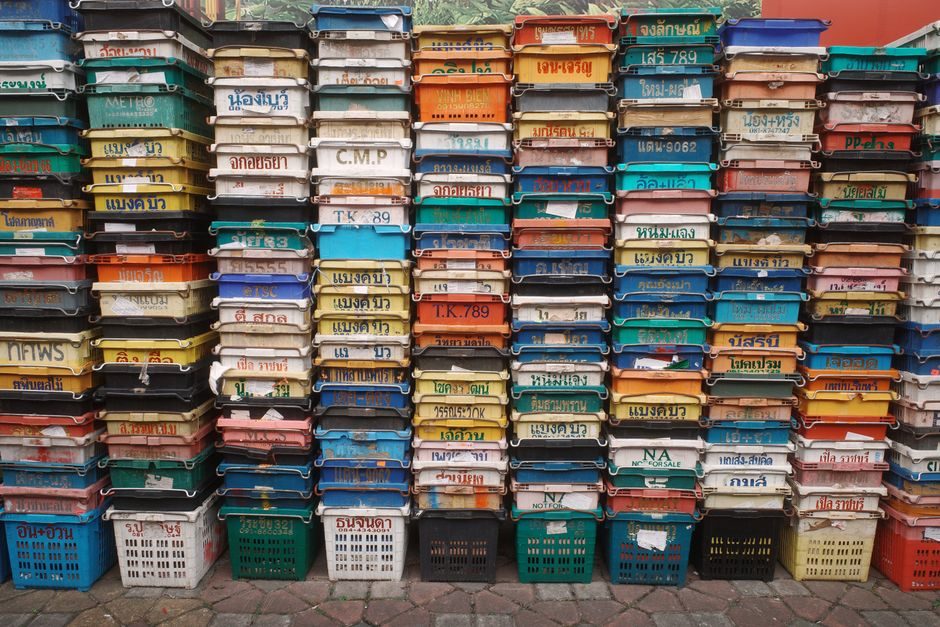
Capacity class dictates handling equipment: 13.5–115 L PP and HDPE bins fit standard shelving and cart workflows, 1000 L IBCs require a forklift and pallet jack, and intermediate 200–300 L drums straddle the two — the 54 L heavy-duty stackable storage bin listed on Alibaba 2026-06-10 sits in the lower tier and is rated for warehouse shelf loads rather than forklift handling [S1][S5]. Within the 1000 L IBC class, height varies from 1160 mm to 1335 mm depending on frame style and bottom geometry, with WERIT's Top Line HDPE IBC at 970–1178 mm height and 120 cm × 80/100 cm footprint representing the compact end of the range [S1].
For high-density storage bins, Quantum Storage's plastic-bin.com catalog illustrates the height-stratified logic: 24", 30", 36", and 42" HULK stack bins, MAGNUM stack containers, and dividable grid bins are organised by shelf depth and pick-face rather than by resin, since polypropylene is the near-universal default in this segment [S4]. This is a different selection logic from liquid IBCs — pick ergonomics and stack ratio override chemical compatibility.
Regulatory Ratings: UN, FDA, and Food Contact
Three regulatory tracks govern plastic container specification: UN performance packaging for dangerous goods (UN31H2/Y for rigid plastics), FDA Drug Listing for sterile medical fluids, and food-contact migration testing. The IPL Schoeller IBC 1000 K and FACH-PAK FP HC1 (1135 mm length, 1335 mm height) both carry UN31H2 ADR/IMDG/RID approval for sea and road transport of liquids, with the FP HC1 also available in a food-grade version [S1]. WERIT's Top Line IBC is similarly approved for hazardous goods transport, with the safety case built around accident prevention for humans, materials and environment [S1].
On the medical side, FDA Drug Database entry NDC 018904-001 (UROLOGIC G IN PLASTIC CONTAINER, Hospira) records a sterile irrigation solution of citric acid 3.24 g/100 mL, magnesium oxide 380 mg/100 mL, and sodium carbonate 430 mg/100 mL, approved 1983-05-27 and now discontinued, illustrating the long tail of plastic-container drug approvals carried in the FDA database [S6]. For food-contact IML containers, Caixin Plastic runs high-speed fully-automatic in-mould labelling machines imported from Japan for IML food containers, IML plastic cups, IML bottles and IML lids — a process where the label becomes part of the moulded PP surface and eliminates secondary labelling [S3].
Selection by Use Case: Liquid Bulk, Dry Storage, Food, Cosmetics
Liquid bulk (chemicals, food liquids, wine): select 1000 L HDPE IBC with UN31H2/Y if the contents are hazardous, 200 mm top lid for ease of cleaning, and pallet base for forklift engagement — see our tank container reference for the steel-cage variant used where higher pressure or temperature ratings apply. Dry parts and order picking: select 24"–42" PP stack bins with dividable grid options, prioritising pick-face depth over resin; QUANTUM's stack-and-hang bins and dividable grid lines are typical spec targets [S4].
Food packaging: select IML PP containers with food-contact certification when brand decoration and freezer-to-microwave service are required, and PET clamshells (e.g. recycled-PET apple clamshells) for fresh-produce visibility. Cosmetic and personal care: select PE or PET bottles and jars with airless pump options for oxidation-sensitive creams, with MOQ 10000 pieces the typical Asian-supplier baseline [S2][S3]. For inter-plant transfer of moulded parts between injection moulding cells and assembly, automated handling often pairs stack bins with a conveyor spec map — the bin footprint and conveyor roller pitch must match.
Comparison Matrix: HDPE IBC vs PP IBC vs PET Packaging vs PP Bin
Across the four dominant plastic-container archetypes, the decision criteria diverge sharply. On regulatory rating, HDPE and PP IBCs both reach UN31H2/Y for dangerous goods, while PP bins typically carry no UN rating and PET packaging is governed by FDA food-contact rather than transport performance [S1][S3]. On temperature ceiling, PP leads at roughly 100–120 °C continuous versus HDPE's 80–95 °C window, and PET sits lower still at 60–70 °C before distortion — a critical limit for hot-fill or autoclave-sterilised applications [S1].
On capacity range, HDPE/PP IBCs cluster tightly at 1000 L (with sub-1000 L variants from 25 L for the SORB®XT Quick absorbent container to 13.5–115 L PP ion-exchange containers from Schäfer) [S1]. PP storage bins span 5 L to 200 L, and PET packaging spans 50 mL to 5 L for cosmetics. On cost-per-litre, HDPE IBCs win at the 1000 L scale (typically a single-digit USD figure per litre shipped), PET cosmetic jars sit at the high end per unit due to decoration and MOQ economics, and PP bins sit in the middle for material-handling reuse cycles [S1][S2][S4]. This four-criteria matrix — rating, temperature, capacity, cost — is the minimum an engineer should walk before issuing a spec.
Limitations, Failure Modes, and Sourcing Pitfalls
Plastic containers fail along four predictable modes: stress cracking from chemical exposure (especially with surfactants and citrus oils on HDPE), UV embrittlement in outdoor storage without carbon-black additive, top-load buckling in high-stack warehouse scenarios, and lid-seal failure on repeated IBC reconditioning cycles. The FACH-PAK FP HC1 mitigates some of these by offering a food-grade HDPE variant, but cross-contamination between food and non-food IBC fleets is a recurring audit finding in 2026 third-party logistics audits [S1].
Sourcing pitfalls include MOQ lock-in (Partnerplus Packaging's 10000-piece MOQ on cosmetic containers is the Asian-supplier baseline and locks out low-volume buyers) [S2], UN-rating confusion (UN31H2 covers rigid plastics for liquids, while UN1H1 covers jerricans — specifying the wrong code voids dangerous-goods compliance) [S1], and IML-versus-self-adhesive labelling confusion where the IML process moulds the label into the PP wall, eliminating delamination but requiring higher mould-tooling investment [S3]. Engineers specifying IBCs for hazardous liquids should cross-check the tank container standards map for the steel-caged ISO 1496-3 equivalent when multimodal intermodal use is in scope.
For component-level specifications, see linear guide.