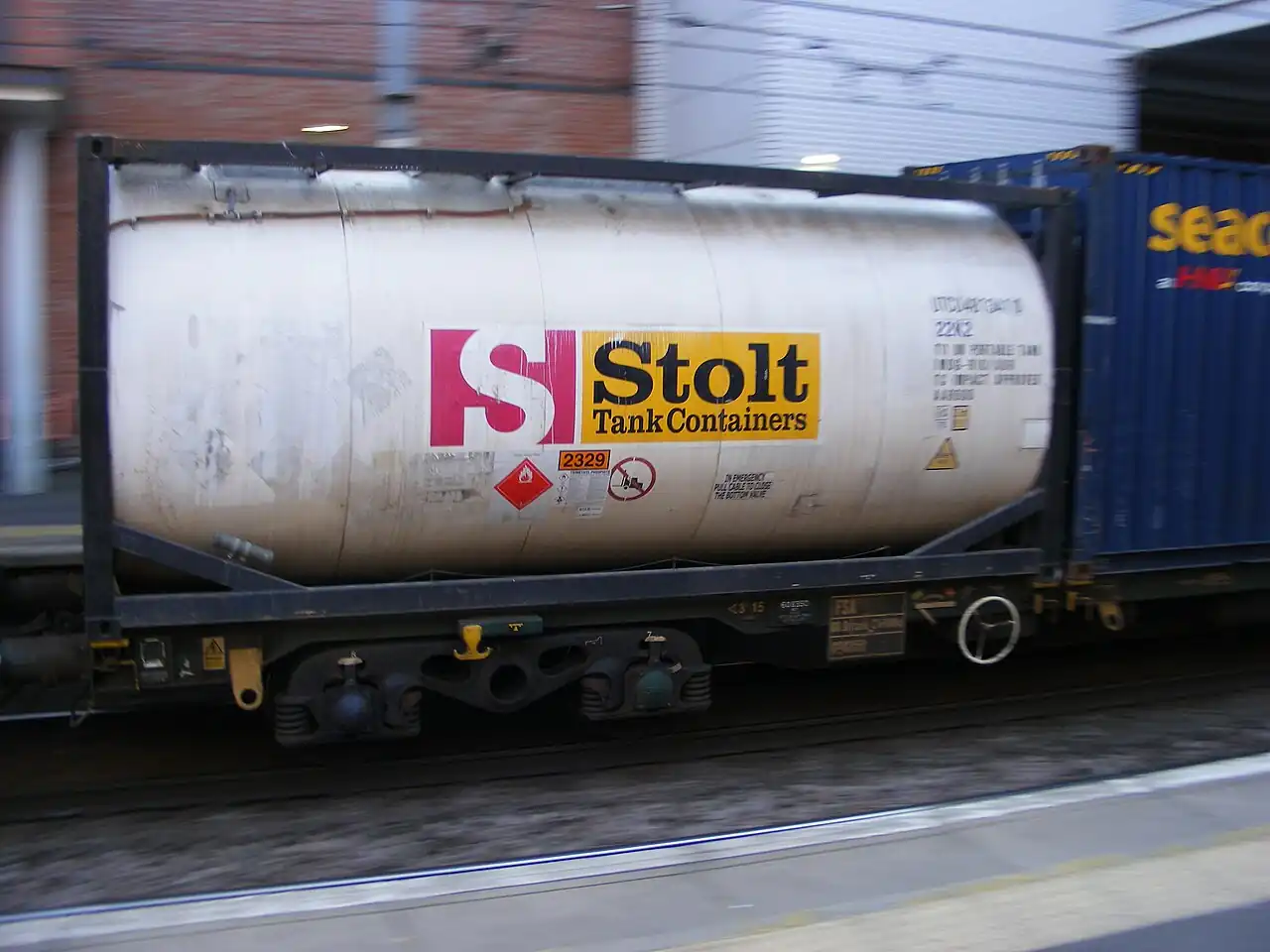
A tank container is a cylindrical pressure vessel, almost always built from 316L stainless steel, mounted inside a standard ISO 668 freight-container frame so it can carry bulk liquids, gases, and powders by ship, rail, and road without transferring the cargo. The vessel and frame together comply with ISO 1496-3, and in dangerous-goods transport the same unit is regulated as a UN portable tank under the IMDG Code, with its construction class fixed by a T-code such as T11, T14, or T50.
For a procurement engineer the central decisions are the T-code (which media class and pressure the tank may legally carry), the capacity and weight rating that fit the cargo density and road limits, and the wetted material and fittings that survive the specific media. This guide walks through all three.
This guide is aimed at industrial purchasing engineers and logistics engineers. It covers 6 chapters from what a tank container is, through T-code portable tank instructions, capacity and weight ratings, wetted materials, key spec parameters, to selection decisions, with 7 FAQs and supplier orientation. All parameters reference the ISO 1496-3 and ISO 668 freight-container standards, the IMDG Code Chapter 4.2 portable tank instructions, and the ASME Boiler and Pressure Vessel Code Section VIII pressure-vessel rules.
Chapter 1 / 06
What is a Tank Container
A tank container, often called an ISO tank or tanktainer, is an intermodal container built to carry liquids, liquefied gases, and pressurised dry powders as bulk cargo. It consists of two basic elements defined by ISO 1496-3: the tank (the cylindrical pressure vessel that holds the cargo) and the framework (the rectangular steel structure that gives the unit standard ISO 668 external dimensions and eight corner castings). Because the corner castings match every container ship cell, rail wagon, and road chassis in the global fleet, the same tank moves seamlessly across sea, rail, and road without ever decanting the cargo, which is the core economic advantage over drums, IBCs, and road tankers.
The same physical equipment carries three names depending on context. Logistics and shipping call it an ISO tank because the frame conforms to ISO standards. Engineering documents call it a tank container, the formal ISO 1496-3 term. Dangerous-goods regulation calls it a UN portable tank or IMO portable tank, because for hazardous cargo the vessel must satisfy the design, test, and marking rules in Chapter 6.7 of the UN Model Regulations and the IMDG Code. A buyer reading a datasheet should treat all three as synonyms describing one unit.
The industrial history of tank containers runs from the 1950s, when American elliptical container tanks on frames first appeared, to 1964, when Bob Fossey at Williams Fairclough in London built the first swap-body tank for combined truck and rail transport. Commercial production began in 1966, the first ISO-dimensioned tank container followed in 1967, and the ISOTANK trademark was registered in 1969 by Andrews of Aintree, whose tanks were the first to carry Lloyd's Register and UK Department of Transport approvals. The equipment reached its current cylindrical 316L form in the early 1970s, and from around 2010 manufacturing shifted primarily to China and South Africa.
In terms of scale, the International Tank Container Organisation (ITCO) estimated the global fleet at roughly 848,400 units as of January 2024, growing steadily as chemical and food shippers move bulk liquids out of drums and into reusable tanks. A tank container is a capital asset that is built once, certified to a 2.5-year and 5-year inspection cycle under the Convention for Safe Containers (CSC) and the dangerous-goods periodic test schedule, and kept in service for 20 years or more, so its total cost is dominated not by purchase price but by utilisation, cleaning, and repositioning.
Four engineering attributes determine whether a given tank fits a job: the T-code, which legally binds the tank to a class of cargo and a minimum test pressure; the capacity and weight rating, which must match cargo density against road and ship limits; the wetted material and lining, which must survive the specific media chemically; and the fittings (valves, manlid, heating, baffles), which control loading, discharge, and surge behaviour. The rest of this guide decodes each in turn.
Chapter 2 / 06
Types and T-Code Classification
Tank containers are classified two ways at once: by physical configuration (standard liquid, gas, reefer, swap-body) and by the regulatory T-code that fixes what dangerous goods the tank may carry. The T-code is the more important number for procurement, because it is a legal constraint, not a marketing label. The IMDG Code Chapter 4.2 defines portable tank instructions T1 through T22 for liquids and solids of classes 3 to 9, plus T50 for non-refrigerated liquefied gases and T75 for refrigerated (cryogenic) liquefied gases. Each instruction fixes a minimum test pressure, a minimum shell thickness in millimetres of reference steel, and the pressure-relief and bottom-opening provisions. The table below summarises the codes a buyer meets most often.
T-code
Min. test pressure
Bottom opening
Typical cargo
T1
1.5 bar
Permitted
Wine, light non-hazardous liquids
T4
2.65 bar
Permitted
Edible and non-edible oils
T11
6 bar
Permitted (triple closure)
Most non-hazardous and mild hazardous chemicals
T14
6 bar
Not permitted
Aggressive acids, toxic chemicals
T50
Per gas (e.g. 25 bar)
Not permitted
LPG, ammonia, propylene, butadiene
T75
Per design
Not permitted
Cryogenic liquefied gases
The standard liquid tank in T11 or T14 configuration is the workhorse of the fleet, carrying chemicals, food-grade liquids, and oils. T11, with a 6 bar minimum test pressure, a 4 bar working pressure, and a permitted bottom outlet (a triple closure of internal foot valve, external valve, and blank flange), is the single most common dangerous-goods construction because it covers the broad band of non-hazardous and mildly hazardous chemicals while remaining easy to load and drain. T14 shares the same 6 bar test pressure but adds stricter provisions, with no bottom opening permitted and a bursting disc fitted to the relief valve, so it steps up for strong acids, toxic substances, and other aggressive media. The correct T-code for any specific substance is read from column 13 of the IMDG Dangerous Goods List, not chosen by the shipper.
The gas tank in T50 configuration is a high-pressure vessel for non-refrigerated liquefied gases such as LPG, propane, butane, anhydrous ammonia, propylene, and butadiene. A T50 has no bottom opening, carries a dedicated relief system and sunshield, and is built to a maximum allowable working pressure that depends on the gas vapour pressure: common ratings include roughly 18 bar for LPG service (with a test pressure of about 25 bar), rising to 27.5 bar and higher for more volatile gases. Capacity is governed by the gas, since the tank must never be liquid-full at the reference temperature.
The reefer or insulated tank adds a refrigeration unit or heavy insulation to hold temperature-sensitive cargo such as latex, chocolate, or pharmaceutical intermediates within a band, while the swap-body tank extends the vessel beyond the standard frame footprint to reach 29,000 to 35,000 litres for European road and rail networks where higher gross weights are permitted. The T75 cryogenic tank is a vacuum-insulated double-wall vessel for refrigerated liquefied gases such as liquid nitrogen, oxygen, argon, and LNG, a specialist category distinct from the ambient-temperature fleet.
Chapter 3 / 06
Construction and Design Codes
A tank container's certification stack is layered, and each layer answers a different question. Understanding which standard governs which feature prevents the common procurement error of accepting a tank that meets one code while violating another. The four governing layers are the frame standard, the pressure-vessel design code, the portable tank instruction, and the safe-container convention. The table below maps each layer to what it controls and the typical designation a buyer sees on the data plate.
Standard / code
Controls
Typical designation
ISO 668
External frame dimensions and classification
1CC (20 ft)
ISO 1496-3
Tank container specification and testing
Series 1 tank container
ASME VIII Div. 1 / 2
Pressure-vessel shell design and stamping
U / U2 stamp
EN 14025
Metallic pressure tank design (Europe)
EN 14025
IMDG / UN Ch. 6.7
Dangerous-goods portable tank rules
UN portable tank Tnn
CSC 1972
Structural safety and inspection cycle
CSC plate
The frame is governed by ISO 668, which fixes the external envelope, and ISO 1496-3, which specifies how a series 1 tank container is built and tested (stacking, racking, lifting, restraint, and end-wall loads). A 20-foot tank frame carries the ISO 668 classification 1CC and presents the same 6,058 by 2,438 by 2,591 mm envelope and corner-casting geometry as a dry box, which is why it stows in any standard cell guide.
The pressure vessel is designed to a recognised pressure-vessel code, most commonly ASME Boiler and Pressure Vessel Code Section VIII, Division 1 or Division 2, which sets the allowable stresses, weld details, and inspection that earn the U or U2 stamp on the data plate. In Europe the equivalent metallic-tank design standard is EN 14025, applied under the Transportable Pressure Equipment Directive. The vessel is hydrostatically tested to the T-code test pressure, and the shell thickness is verified against the minimum reference-steel thickness the T-code demands.
The dangerous-goods layer comes from Chapter 6.7 of the UN Model Regulations, transposed into the IMDG Code for sea, ADR for European road, and RID for rail. This layer assigns the T-code, mandates the periodic 2.5-year and 5-year inspections, and requires the marking of the tank with its test pressure, design temperature range, and permitted substances. The structural-safety layer is the 1972 Convention for Safe Containers (CSC), whose plate certifies that the unit can be stacked and handled safely in the container system and sets the Approved Continuous Examination Programme (ACEP) inspection regime.
For a buyer, the practical consequence is that a compliant tank must satisfy all four layers simultaneously. A vessel that passes ASME VIII but lacks a valid CSC plate cannot move in the container system; a tank with a perfect frame but an expired 2.5-year dangerous-goods inspection cannot legally load hazardous cargo. The data plate, which collects the frame class, the design code stamp, the T-code, the test pressure, and the inspection dates in one place, is the first document to read on any tank offered for sale or lease.
Chapter 4 / 06
Capacity, Weight, and Materials
Once the T-code is settled, the next decision is matching capacity and weight to the cargo. A tank container is a fixed-volume box that must respect two simultaneous limits: the volume the vessel holds, and the gross weight the frame, the road, and the ship will accept. Dense liquids hit the weight limit long before the tank is volumetrically full, while light liquids fill the volume long before the weight limit, so the right tank size depends on cargo density. The table below gives the representative capacity and weight ratings for the standard 20-foot liquid tank.
Parameter
Standard liquid (T11)
Gas (T50, LPG)
Nominal capacity
21,000 to 26,000 L
~24,600 L
Tare weight
3,500 to 4,200 kg
6,000 to 7,000 kg
Max gross weight
30,480 / 36,000 kg
36,000 kg
Max payload
~26,000 to 32,000 kg
~29,500 kg
Working pressure (MAWP)
4 bar
~18 bar
Test pressure
6 bar
~25 bar
Relief valve set
~4.4 bar
Per design
Capacity for standard liquid service runs 21,000 to 26,000 litres, with swap-body designs extending to 29,000 to 35,000 litres for European networks that allow higher gross weights. Larger volume means lower tare-per-litre efficiency only up to the point where the loaded tank exceeds the gross-weight limit, so a high-density cargo such as concentrated acid is shipped in a smaller-capacity, heavier-walled tank that fills the weight budget without overflowing the volume.
Weight is expressed as three linked numbers: tare (empty equipment weight), maximum gross (the rated ceiling), and payload (gross minus tare). The baseline ISO 1CC gross rating is 30,480 kg, but heavy-tested frames rated to 36,000 kg are standard across Europe, where road regulations permit the higher mass. A buyer must confirm that the gross rating, the ship's stowage limit, and the destination road network's axle limits all agree, because the lowest of the three governs how much cargo can actually be loaded.
The wetted material for the vast majority of liquid tanks is austenitic 316L stainless steel, chosen for its balance of corrosion resistance, weldability, and hygiene. The 16 to 18 percent chromium, 10 to 14 percent nickel, and 2 to 3 percent molybdenum resist organic acids, solvents, and dilute mineral acids, while the low 0.03 percent maximum carbon prevents weld-zone sensitisation in a fully welded vessel. The electropolished interior, finished to a low surface roughness, cleans easily between cargoes, which matters because one tank may carry dozens of different products over its service life.
Where 316L is not enough, the build steps up. Chloride-rich or strongly oxidising media call for duplex 2205 stainless or higher alloys. Hydrofluoric acid, sodium hypochlorite, and similarly aggressive cargoes ride in rubber-, PTFE-, or polyethylene-lined tanks. Gas tanks reverse the logic: because liquefied gases are chemically benign but demand a thick pressure shell, T50 vessels use normalised carbon-steel plate such as ASME SA-612 or SA-516 rather than stainless, which is both cheaper and stronger for pure pressure duty. Insulation, when fitted, is typically 50 mm of rock wool at about 40 kg per cubic metre, clad in GRP or aluminium, and heating is provided by external steam channels giving roughly 10 to 10.5 square metres of heating area at about 4 bar steam pressure, or by electric pads.
Chapter 5 / 06
Key Specification Parameters
Reading a tank-container data plate and specification sheet is a core skill for logistics and procurement engineers. A single tank lists 20 or more parameters, but eight truly drive the buy-or-reject decision: T-code, capacity, gross and tare weight, test pressure, wetted material, baffle configuration, fittings (manlid and valves), and the degree-of-filling rule. Each is explained below.
T-code and test pressure are inseparable. The T-code (T11, T14, T50) fixes the minimum test pressure, the minimum shell thickness, and the bottom-opening provisions, and it legally constrains which cargoes the tank may carry. A tank built to a higher T-code can carry lower-code cargo, but never the reverse. The test pressure stamped on the plate (for example 6 bar on a typical T11 or T14 liquid tank, 25 bar on a T50 gas tank) is the hydrostatic pressure the vessel was proven against, and it must equal or exceed the value the assigned T-code demands.
Capacity, gross, and tare together determine usable payload. The important discipline is to test the three numbers against cargo density: multiply nominal capacity by cargo specific gravity and the permitted degree of filling, then check the result against the payload (gross minus tare). If the calculated cargo mass exceeds payload, the tank is volume-limited the wrong way for that cargo and a smaller, heavier-rated tank is needed.
Baffle configuration decides how the tank may be loaded. A non-baffled tank has a single open shell, drains and cleans easily, and is standard for full single-product chemical loads, but it must obey the degree-of-filling rule. A baffled tank carries internal surge plates that damp liquid movement, so it can legally travel part-loaded for food, beverage, and multi-drop service, at the cost of harder cleaning and slightly higher tare.
The degree-of-filling rule is the surge-safety constraint set by the IMDG Code. For a non-baffled tank over 7,500 litres carrying a low-viscosity liquid (under 2,680 square millimetres per second at 20 degrees Celsius), the load must be under 20 percent or over 80 percent of capacity, because an intermediate fill lets the liquid slosh and slam the shell heads with destabilising hydraulic forces. Separately, every liquid load must retain a vapour ullage so the tank is never 100 percent liquid-full at the reference temperature, leaving room for thermal expansion.
Fittings are the loading and discharge interface. The five items to confirm are listed below:
Manlid: a top manhole, commonly 500 mm diameter, for inspection, internal cleaning, and (with the right gasket) compatibility with the cargo.
Top discharge / vapour valves: air-line and vapour-return connections plus a top outlet on tanks loaded or discharged from the top.
Bottom outlet valve: typically a 3-inch foot valve and external valve on liquid tanks, governed by the T-code bottom-opening provisions (absent on gas tanks).
Pressure-relief device: a relief valve, often set around 4.4 bar on a 4 bar liquid tank, plus bursting discs on higher-pressure service.
Gaskets and seals: the elastomer (EPDM, FKM, FFKM, or PTFE) must be chemically compatible with the specific cargo, a frequent overlooked failure point.
Wetted material and lining close the list. Confirm the shell grade (316L, duplex 2205, or a lined carbon steel) and, for sensitive cargo, the interior surface finish and any cladding against the manufacturer's corrosion chart for the exact concentration, temperature, and chloride content of the media.
Chapter 6 / 06
Selection Decision Factors
To turn the preceding five chapters into a specific tank order or lease, follow the decision sequence below. Most selection mistakes come not from a single wrong number, but from settling a downstream choice (capacity, fittings) before an upstream constraint (T-code, density) has been fixed. These eight steps work as a fixed procurement checklist.
Cargo and T-code: identify the exact substance and its UN number, then read the assigned portable tank instruction (T-code) from the IMDG Dangerous Goods List. The T-code is a legal floor, not a preference. For non-regulated cargo, choose the configuration (T11-equivalent liquid, food-grade) that suits the media.
Density and capacity: compute cargo mass as capacity times specific gravity times the permitted fill, and pick a capacity (21,000 to 26,000 litres standard, up to 35,000 for swap-body) so the loaded mass lands within payload without wasting volume.
Weight rating and route: confirm the gross rating (30,480 kg baseline or 36,000 kg heavy) against the ship stowage limit and the destination road axle limits. The lowest of the three governs the legal payload.
Wetted material and lining: match the shell grade (316L, duplex 2205, or lined carbon steel) to the media using the manufacturer's corrosion chart for the actual concentration, temperature, and chloride level, not a generic compatibility table.
Baffle and fittings: choose baffled (part-load, multi-drop, food) or non-baffled (full single-product chemical), then specify manlid size, valve count and sizes, relief setting, and gasket elastomer compatible with the cargo.
Temperature handling: decide whether steam or electric heating, insulation, or refrigeration is needed for the cargo's viscosity and stability, and confirm the design temperature range covers the route's ambient extremes.
Certification and inspection status: verify the data plate carries a valid CSC plate, an in-date 2.5-year and 5-year dangerous-goods inspection, the correct T-code marking, and the design-code stamp (ASME U or EN 14025) before the unit can load.
Buy versus lease and total cost: compare outright purchase against operating lease, factoring utilisation, repositioning, cleaning cost per changeover, and inspection upkeep. Because a tank serves 20 years, the lifetime logistics cost dwarfs the purchase price difference.
One last commonly overlooked dimension is serviceability and cleaning logistics: access to certified tank-cleaning stations on the trade lane, availability of EFTCO or ENFIT cleaning certificates documenting the last cargo, spare-part supply for valves and gaskets, and the repositioning cost of returning an empty tank. These seem secondary at the order stage but dominate operating economics over the equipment's life. For fleet supply, builders such as CIMC Enric, Welfit Oddy, Nantong Tank, and Chengli fabricate and certify the vessels, while operators and lessors such as Stolt Tank Containers, Hoyer, Bertschi, Den Hartogh, EXSIF Worldwide, Seaco, and Eurotainer own and dispatch the fleets that most shippers lease from rather than buy outright.
FAQ
What is the difference between a tank container and an ISO tank?
They are the same equipment. Tank container is the formal term in ISO 1496-3, while ISO tank is the trade name in everyday logistics. In dangerous-goods regulation the same unit is called a UN portable tank or IMO portable tank. All three names describe a cylindrical pressure vessel, almost always 316L stainless steel, mounted inside a standard ISO 668 freight-container frame with eight corner castings, so it can move by ship, rail, and road without transferring the cargo. The word ISO in ISO tank refers to the frame conforming to ISO 668 and ISO 1496-3, not to the vessel being a specific size.
What do the T-codes T11, T14, and T50 mean?
T-codes are portable tank instructions from IMDG Code Chapter 4.2, numbered T1 to T22 for liquids and solids of classes 3 to 9, plus T50 for non-refrigerated liquefied gases and T75 for refrigerated (cryogenic) liquefied gases. Each code fixes a minimum test pressure, a minimum shell thickness in millimetres of reference steel, and the pressure-relief and bottom-opening provisions. T11 (6 bar test pressure, 4 bar working pressure, bottom opening permitted) suits most non-hazardous and mild hazardous chemicals. T14 (also 6 bar test pressure, but no bottom opening and a bursting disc on the relief valve) covers aggressive acids and toxic chemicals. T50 covers pressurised gases such as LPG and ammonia. The UN Portable Tank T-code assigned to a substance is listed in the Dangerous Goods List column 13.
What is the capacity and weight of a 20-foot tank container?
A standard 20-foot tank container sits in a 6,058 by 2,438 by 2,591 mm ISO frame. Nominal capacity for liquid chemical and food service is typically 21,000 to 26,000 litres, with swap-body variants reaching 29,000 to 35,000 litres. Tare weight runs about 3,500 to 4,200 kg for liquid tanks and 6,000 to 7,000 kg for high-pressure gas tanks. Maximum gross weight is rated at 30,480 kg under the baseline ISO 1CC class, or 36,000 kg for heavy-tested frames widely used in Europe. Payload is gross minus tare, so a 36,000 kg frame with a 4,000 kg tare carries up to about 32,000 kg of cargo, subject to road-legal axle limits.
Why must a tank container be filled below 20 percent or above 80 percent?
This is the IMDG Code degree-of-filling rule for surge control. For a non-baffled tank over 7,500 litres carrying a low-viscosity liquid (under 2,680 square millimetres per second at 20 degrees Celsius), a partial load between 20 and 80 percent lets the liquid slosh and slam the shell heads with large hydraulic forces during braking and cornering, threatening vehicle stability. The mitigation is to load under 20 percent or over 80 percent, or to use a baffled tank with internal surge plates. Separately, every liquid load must keep a vapour ullage so the tank is never 100 percent liquid-full at the reference temperature, because thermal expansion would otherwise overpressure the shell.
What is the difference between a baffled and a non-baffled tank container?
A baffled tank carries internal surge plates (transverse partial bulkheads) that break up liquid movement, so it can legally travel part-loaded and is preferred for food, beverage, and multi-drop chemical deliveries. A non-baffled tank has a single open shell, gives easier interior cleaning and full drainage, and is standard for full single-product chemical loads moved port to port. The trade-off is that a non-baffled tank must obey the under-20 or over-80 percent fill rule, while a baffled tank can run at intermediate fill levels but is harder to clean for product changeover and slightly heavier in tare.
Why are most tank containers built from 316L stainless steel?
316L offers the best balance of corrosion resistance, weldability, hygiene, and cost for multi-product chemical and food service. The 2 to 3 percent molybdenum content resists many organic acids, solvents, and dilute mineral acids, while the low carbon (0.03 percent maximum) prevents weld-zone sensitisation in a vessel that is welded all over. The smooth electropolished interior cleans easily between products, which matters because a single tank may carry dozens of different cargoes over its life. For chloride-heavy or strongly oxidising media, operators step up to duplex 2205, or apply rubber, PTFE, or polyethylene linings. High-pressure gas tanks instead use normalised carbon steel plate such as ASME SA-612 or SA-516 because gases are non-corrosive and the thicker carbon-steel shell is cheaper for pressure duty.
How are tank containers heated, insulated, and cleaned?
Many cargoes (sulphur, bitumen, fats, certain resins) ship as solids or high-viscosity liquids and must be warmed before discharge. The common method is external steam channels welded to the shell, with a typical heating area of 10 to 10.5 square metres and a steam working pressure around 4 bar; electric heating pads are an alternative where no steam is available. Insulation is usually 50 mm of rock wool at about 40 kg per cubic metre, clad in glass-reinforced plastic (GRP) or aluminium, to hold temperature and protect personnel. Cleaning is done at certified tank-cleaning stations using hot caustic, solvent, or steam cycles, with the ENFIT or EFTCO cleaning certificate documenting the last cargo and the cleaning method for the next loading.