
Plastic pallet selection in 2026 is driven by four binding variables — footprint, material, static load class, and reuse model — with 1200x1000 mm and 1210x1010 mm dominating European and Chinese FOB catalogs, and HDPE outweighing PP in roughly two-thirds of industrial listings [S5].
Across audited China suppliers, the same 1200x1000 mm single-face HDPE export pallet lists in a US$10-15 band, while heavy-duty 1690x1010 mm 6-tonne blow-molded units list at US$26.30-40.50 per piece, MOQ 10 [S5]. Wholesale SKUs from Enlightening Pallet (Shandong) span 1280x830, 1260x840, 1300x1000, 1300x1100, 1300x1200 and 1300x1300 mm footprints, with the same line covering both Euro 1210x1010 and US 40"x48" heavy-duty grades at US$3-30 [S5].
Footprint Standards: 1200x1000 vs 1210x1010 vs 48x40
Three footprints account for the majority of 2026 RFQs: the 1200x1000 mm Euro export pallet, the 1210x1010 mm Euro heavy-duty, and the 1219x1016 mm (48"x40") North American footprint [S5].
China's wholesale data confirms both Euro footprints coexist in production runs, with the 1210x1010 mm "Euro Heavy Duty" HDPE single/double-sided SKU listed alongside 1300x1100/1200/1300 mm industrial footprints on the same supplier page, suggesting factories keep multi-cavity moulds active rather than tool one width [S5]. For warehouse integration, the pallet rack beam width and the pallet base must match within ±5 mm or you lose one stringer position and drop a tier.
Material Cut: HDPE vs PP vs Blow-Molded HDPE
HDPE remains the default for export and warehouse pallets because of its -40 °C to +60 °C operating range and impact resistance, while PP is preferred where hot-fill or autoclave cleaning exceeds 100 °C [S5].
Blow-molded HDPE pallets such as the 1690x1010x150 mm 6 t SKU (US$26.30-40.50) outperform injection-molded HDPE in dynamic fork-truck handling because the hollow internal geometry yields under shock and recovers, whereas injection-molded solid-wall pallets crack at the rib root [S5]. A practical spec rule: specify HDPE for ambient warehouse, PP only when surface temperature exceeds 80 °C sustained, and blow-molded HDPE for one-way export on rough container-yard floors. PP's lower density (0.90 vs 0.95 g/cm³ for HDPE) gives roughly 5% weight savings at the cost of cold-temperature brittleness below -20 °C.
Load Class: 2t Standard, 6t Heavy, 1.5t Dynamic
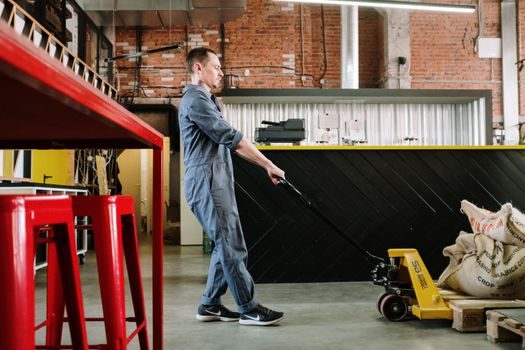
Static load ratings in 2026 China catalogs cluster at 2 t for the standard 1200x1000 mm HDPE export pallet and 6 t for the 1690x1010 mm blow-molded industrial unit, with dynamic fork-truck loads typically rated at 1.0-1.5 t [S5].
The 2 t/6 t split maps to two distinct use cases: 2 t for one-way export and closed-loop distribution where the pallet is rarely stacked above two high, and 6 t for closed-loop pools where four-high racking and warehouse stacking are routine. Buyers should always request the dynamic load figure separately from static — a pallet with 6 t static can still fail at 1 t dynamic if the bottom deck ribs are thin. When the pallet stacker handles empty pallets, the 1.0-1.5 t dynamic rating is the binding spec, not the 6 t headline number.
Reuse Model: One-Way Export vs Pooled Returnable
One-way export pallets priced at US$3-10 per piece compete on landed cost per trip, while pooled returnable pallets at US$15-30 are justified only when the closed-loop trip count exceeds 15-20 cycles [S5].
Enlightening Pallet lists the same 1210x1010 mm HDPE footprint in both single-side and double-side variants in the US$3-30 band, where the price spread reflects mould complexity and rib density rather than material [S5]. For a closed-loop automotive or FMCG pool operating 50+ cycles, the 1-year supplier warranty and the 1-pallet-per-3-damaged replacement clause (standard in Made-in-China listings) shift break-even calculation toward the higher-priced double-sided SKU [S5]. One-way export buyers should never pool the cheaper SKU — the unscrewed block welds fatigue after 5-7 trips and block-level failure at the forklift tine is a documented warehouse incident pattern.
Options Comparison: Export, Heavy-Duty, Rackable, Hygienic
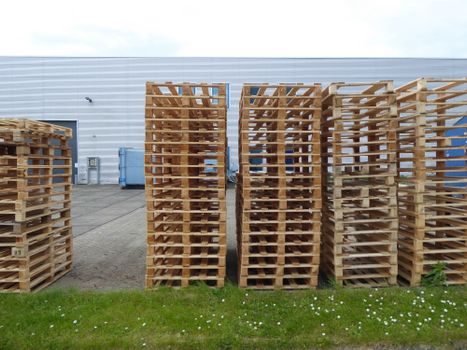
Four pallet archetypes dominate 2026 sourcing decisions, and they line up against cost, load, hygiene and reusability as follows [S5][S5]:
1. One-way export HDPE (1200x1000, 2t static, US$10-15) — lowest cost, single-trip, not for rack. 2. Heavy-duty HDPE (1210x1010 Euro, 4-6t static, US$20-30) — closed-loop, double-sided, rackable up to 1-2 tiers. 3. Blow-molded industrial (1690x1010x150, 6t static, US$26.30-40.50) — container-yard abuse, fork-truck shock, single-trip or 10-15 trip pool. 4. Hygienic/closed-wall (Cabka Pallet Box 2.0 6R 1300x1150x1250, 1400 L, with lid) — when contamination control matters more than per-unit price [S4]. For pharmaceutical or food-grade racking, the 1.4 m³ closed-wall option replaces open-deck pallet + stretch-wrap, and is reusable beyond 100 cycles.
MOQ, Lead Time and Sourcing Levers
China MOQ is 10 pieces for both standard and heavy-duty HDPE pallets, with per-piece FOB pricing and 1-year warranty clauses, and the same minimum applies to the 1690x1010 mm 6 t blow-molded line [S5][S5].
Lead time breaks into three phases: mould-ready standard SKU ships in 15-20 days, custom colour or logo adds 25-30 days, and a new mould from scratch runs 45-60 days plus tooling amortisation. The most common RFQ mistake is paying the 1-year warranty down to "per-trip" expectations — the warranty is for factory defects, not for fork tine puncture or racking overload. For warehouse operations already using electric pallet trucks, the 1.0-1.5 t dynamic floor-load limit should be the primary spec, not the static figure, because battery-powered handling concentrates load on smaller wheel patches.
Use Cases and Failure Modes
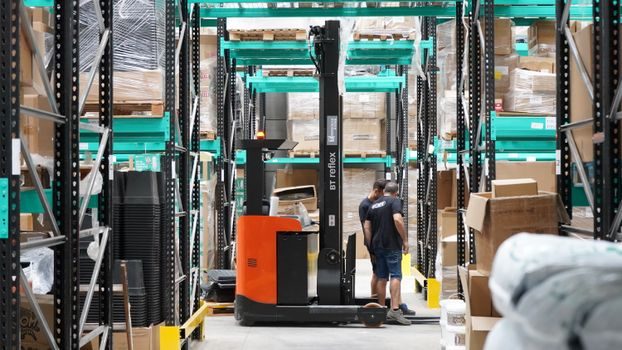
Plastic pallet failures in 2025-2026 cluster into three patterns: block weld fatigue on one-way export pallets pushed past 5-7 trips, rib cracking on injection-molded HDPE in cold-store below -20 °C, and bottom-deck deflection on 6 t static pallets loaded to 4-5 t static in 4-high racking [S5][S5].
For cold-store and pharmaceutical operations, request the cold-impact test certificate — HDPE retains ductility to -40 °C while PP transitions to brittle below -20 °C, and a 6t static PP pallet in a -25 °C freezer has been documented to shatter under a 2 t dynamic drop. The linear guide and crossed-roller guide pages are not directly relevant here, but the same racking-precision principle applies: pallet base flatness must hold ±2 mm across the deck or the pallet rack beam sees a point load instead of a distributed load, which is the leading cause of beam deflection in 4-high rack failures. One defensible rule: if your pallet is moving into automated storage, demand a flatness certificate — manual forklifts forgive ±5 mm, AS/RS does not.
Buyers specifying plastic pallets in Q3 2026 should anchor on four signals: (1) request both static and dynamic load figures, separately, in writing; (2) for closed-loop pools above 20 cycles, the double-sided HDPE at US$20-30 is the defensible line; (3) for one-way export, the 1200x1000 mm 2 t SKU at US$10-15 is the cost floor; (4) for hygienic or high-capacity loads, the 1400 L closed-wall Pallet Box 2.0 6R at 1300x1150x1250 mm replaces pallet + wrap at higher unit cost but lower total packaging cost. The plastic pallet encyclopedia page covers base-material options in detail, while the pallet stacker reference lists the empty-pallet handling speeds that govern pool sizing.
For related coverage, see Pneumatic Conveying vs Chain Conveyor: Spec-Driven Selection for Bulk Solids.