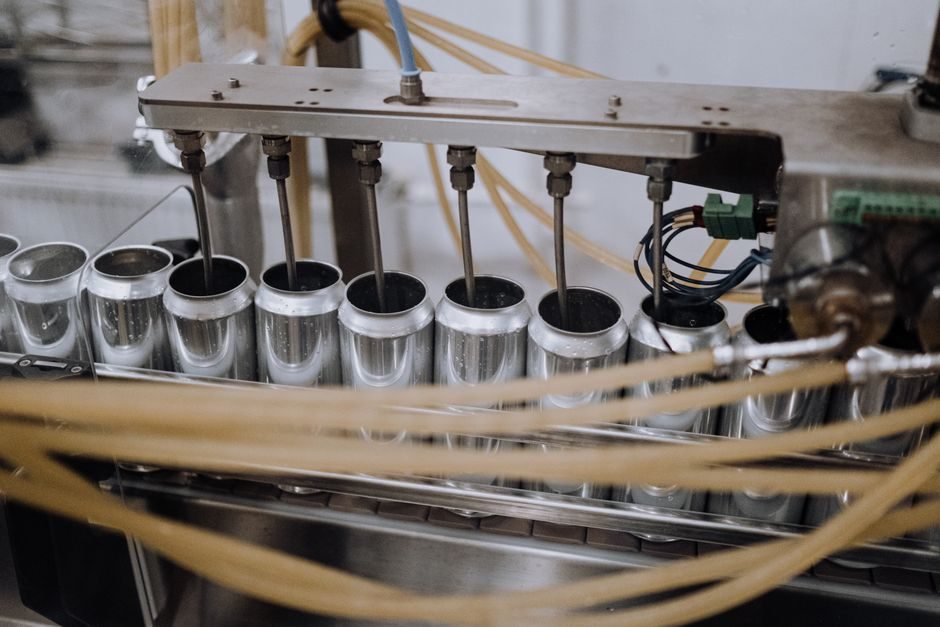
For fine dry powders, granules and pellets in the food, chemical, plastics and pharma trades, a positive-pressure pneumatic conveying line typically operates between 2 and 30 t/h on a single dilute-phase or dense-phase run, driven by a roots-type blower or a screw compressor at 0.2–0.8 MPa gauge [S1][S6].
For coarse, lumpy, hot or wet bulk — clinker, slag, wood chips, bagasse, foundry sand, hot-ash below ~300 °C, and palletised or agglomerated rejects — engineers default to a chain conveyor, since mechanical pull is largely indifferent to particle size, moisture and stickiness, and an industrial chain conveyor line commonly reaches 50–500 t/h per strand at chain speeds of 0.1–0.6 m/s [S2][S3].
Operating Principle and Power Path
Pneumatic conveying uses a gas-solid two-phase flow: air (or nitrogen for inert duty) is the motive fluid, the bulk is the dispersed phase, and energy is delivered by a positive-displacement blower, a screw compressor or a vacuum pump; the carrier line is a sealed pipe, usually 50–300 mm NB in mild steel or aluminium with a bend radius ≥ 10×D for dilute-phase service [S1][S6].
A chain conveyor uses an endless conveyor chain as the traction element, with flights, slats, push bars or a pinned-on en-masse body that drags the material through an enclosed trough or a pan; drive power is mechanical through a shaft-mounted or coupling-mounted gearmotor at the head shaft, with a take-up tensioning the chain on the return run [S2].
Bulk-Solids Compatibility Map
Material fit is the single most decisive axis: pneumatic systems need dry, free-flowing product with a top size typically under ~6 mm and a moisture content low enough to stay fluidised; a chain conveyor will carry anything that does not break a flight, including 200 mm clinker, hot sand at 250 °C, wet filter cake, and stringy or fibrous scrap [S1][S6].
For mildly cohesive or temperature-sensitive powders (PVC, sugar, flour, bentonite), dense-phase pneumatic conveying with a pulse feeder or blow tank pushes the product in slugs at solids-to-air loading ratios above 25, which keeps line velocity down near 4–8 m/s and limits degradation [S1]. For abrasive ores, foundry sand or cement raw mix, the lower pipe velocities of dense-phase cut elbow wear dramatically versus dilute-phase dilute flow at 18–25 m/s [S6].
For hot, lumpy or sticky bulk — clinker cooler discharge, sinter cooler, biomass boiler ash, recycling shredder output — no air stream is going to move it: a roller chain-driven en-masse conveyor, a cable drag chain for sludge, or a drag-chain cooler is the working answer [S2][S3].
Capacity, Distance and Footprint
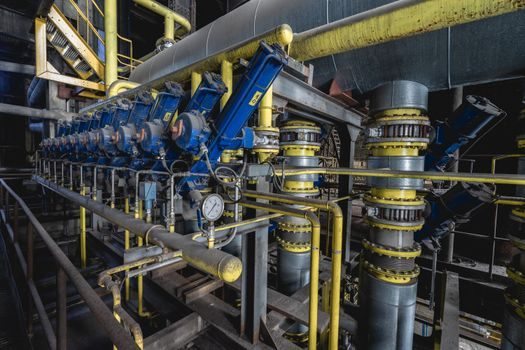
Pneumatic systems lose specific energy fast with distance: a single dilute-phase line is practical to roughly 300–500 m horizontal equivalent length, and beyond that the compressor power climbs non-linearly; vertical lifts inside a pneumatic run are typically capped near 30–40 m for dilute-phase and 50+ m for dense-phase [S1][S6].
Chain conveyors carry comfortably over 50–150 m horizontal on a single drive, with intermediate booster drives every 80–120 m on heavy-duty en-masse units; vertical configurations are limited to flight elevators rather than true en-masse, so steep lifts usually switch to a bucket elevator instead [S2].
Pneumatic systems win on routing: a single small-bore pipe can climb, turn and enter an enclosed vessel, eliminating dust pickup points and trenching; a chain conveyor needs a straight, level or gently sloped casing, a maintenance aisle along its full length, and a dedicated support structure [S1][S2].
Hygiene, Containment and Cross-Contamination
For food, pharma and additive-feed applications the pneumatic line is a closed pipe with only filter-vents, rotary-airlocks and a few flanged joints, so clean-in-place and dust exposure are intrinsically lower; a chain conveyor needs a fully enclosed casing plus a skirt at the inlet to stay inside the same hygiene envelope [S1][S6].
Where explosion protection is in scope — ATEX 2014/34/EU zone 20/21 inside, zone 22 outside — pneumatic systems can be specified with nitrogen inerting, explosion-isolation pinch valves and burst panels on the receiver; chain conveyors are mitigated by venting panels on the casing and upstream rotary feeders, but ignition sources on the chain drive (hot bearings, tramp metal) are harder to fully eliminate [S1][S6].
Operating Cost and Maintenance
Energy per tonne-metre is heavily tilted toward chain: a 100 t/h en-masse conveyor typically runs at 1–3 kW per 10 m of casing, while a pneumatic line of comparable capacity lands closer to 8–15 kW per 10 m equivalent length once blower and filter losses are included [S1][S2].
Maintenance patterns differ: pneumatic consumables are filter socks/bags, blower rotors and elbow patches, with mean-time-between-overhaul dominated by the rotary-airlock rotor; chain conveyor consumables are the conveyor chain and flights themselves, with chain elongation monitored by a take-up travel gauge, and bolt-on flights re-welded every 6–18 months in abrasive service [S2][S3].
For engineering design throughput, PneuCalc version 8 (released as of 2025) lets an engineer model dilute- and dense-phase routes, saltation velocity, pressure drop and material degradation in one workflow, which de-risks pneumatic sizing on new lines [S5].
Comparison on Decision Criteria
Side-by-side at the spec level: pneumatic systems win on routing flexibility, sealed containment and fine-powder handling, but lose on energy per tonne-metre, abrasive wear on bends, and capacity ceiling per line; chain conveyors win on capacity, energy efficiency with coarse or heavy bulk, and tolerance for heat/moisture, but lose on footprint, hygiene accessibility and steep vertical lifts [S1][S2][S6].
As a rule of thumb, switching from pneumatic to chain is justified above ~25–30 t/h on a coarse or hot bulk, or below ~50 m horizontal where the blower capex cannot be amortised; switching from chain to pneumatic is justified where a single enclosed pipe through a process building is needed, or where multiple pickup points feed one central dust filter [S2][S6].
Selection Logic and Common Failure Modes
Specify pneumatic only after confirming the product is fluidisable: a Deitcher-type fluidisation test, a bulk density under ~1.6 t/m³ and a particle size envelope of 0.05–6 mm; otherwise the line will salt out, plug elbows and over-pressurise the filter [S5][S6].
Specify chain only after confirming flight metallurgy suits the load: 304/316 stainless for food and pharma, 400 HB hardened flights for abrasive slag, manganese-steel pins for shock loading, and a silent chain or sealed-for-life bearing head shaft where dust ingress would otherwise trash the bearings within 12 months [S2][S3].
For a related warehouse-side spec cut on pallet boxes, the same heat-tolerant and impact-tolerant logic carries over, as covered in Storage Cage vs Plastic Pallet Box: 2026 Spec Cut for Warehouse Specifiers. For vertical lifts up to 30 m, the cross-over from a chain conveyor to a centrifugal or continuous bucket elevator is the standard answer, mapped in Bucket Elevator Buying Guide 2026: Capacity, Lift, Casing and Centrifugal vs Continuous.
Sourcing, Standards and Vendor Map
DirectIndustry indexes roughly 70 pneumatic-conveyor manufacturers offering 85 distinct units, and a further 61 manufacturers listing 150 pneumatic-conveying system variants including dense-phase, vacuum and positive-pressure families; major European names include Scheuch, AZO, AirMasters, Baker Perkins and Vetter, with new pneumatic conveyor entries refreshed on the index in the 2026-05 to 2026-06 window [S2][S3].
For chain conveyors, the index points to the same number of suppliers (70 listed manufacturers, 85 products), with product families grouped by en-masse, apron, drag and roller chain pan conveyors; the buying guide pairs the catalogue with a side-by-side filter, which is the working starting point for a 2026 RFQ [S2].
Engineering reference: the ScienceDirect Topics chapter on pneumatic conveying (last updated 2025-10) is the most current aggregated source on dilute-phase vs dense-phase design, saltation velocity correlations and filter sizing [S6]. For size-aware supply-chain context that affects lead time on the chain side, see Bearing Supply Chain 2026: Lead Times, Steel Cost and Sourcing Reality — the same chrome-steel and heat-treatment bottleneck applies to conveyor-chain pins and to rolling-element bearings.