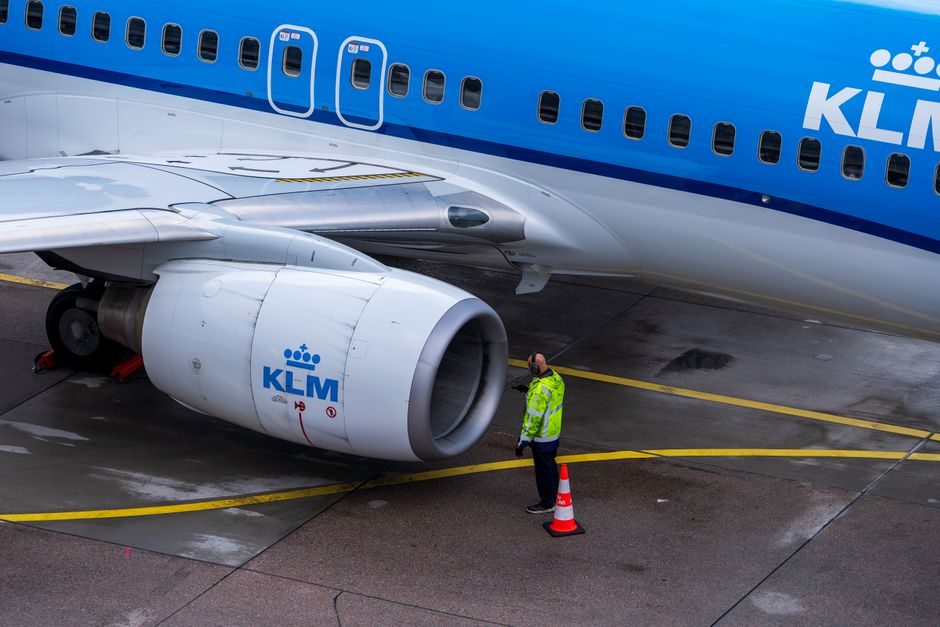
Air-cargo terminal throughput is dominated by ULDs, container dollies and belt loaders — screw conveyors show up only on the periphery, and most procurement calls for them are mis-scoped. Where a duty genuinely exists (de-icing fluid recovery dry-out, lost-bulk ballast sand, in-flight catering loading, ground-power dust extraction), the conveyor is a short, inclined (≤30°) tubular stainless unit sized to the bulk density and tonne-per-hour target, not a long-run port installation [S1][S4].
U.S. carrier filings and European hub tariff pages updated in July 2026 confirm that air-cargo flows are now tracked by IATA e-AWB and live ULD telemetry, with no published specification of bulk-handling screw conveyors inside the terminal envelope [S3][S6]. That absence is itself the answer: any vendor claiming a "standard air-cargo screw" is selling port- or cement-spec hardware relabelled. Engineers should treat the air-cargo use case as a derivative of port-logistics screw conveyor selection, with three changes — lighter frame, full 304/316 stainless contact parts, and ATEX Cat 2 or Cat 3 zone-2 rating only where de-icing glycol vapour is present [S1].
Duty cases that actually exist in air cargo
Three use cases recur in OEM inquiry logs: reclaimed Type I/IV de-icing fluid solids (typically ≤2 t/h at hub ramps, dry-out stage 80–120 °C), ULD ballast sand reclamation from cargo position centres (0.5–1.5 t/h, fine 0.2–0.8 mm silica), and in-flight catering bulk-loader flour or sugar auger feeds (0.3–1.0 t/h, food-grade 316L) [S1][S2]. Anything above ~5 t/h in a free-flowing chemical or fuel-additive dust points to pneumatic conveying, not a screw, because flight-line ignition risk and ATEX zoning make an open trough unworkable [S1]. The chemical-shipping screw conveyor map covers the higher-tonnage, higher-hazard case and should be read alongside this one when glycol recovery, aviation fuel additives, or dry ice handling is in scope. CableConveyors explicitly offers ATEX- and Pressure Equipment Directive-compliant builds, so specifying one of those frames on a de-icing line is a low-risk move [S1].
Geometry, angle and material of construction
Standard horizontal or inclined-to-30° flights cover roughly 90% of the listed air-cargo duties; a properly designed flight and pitch can push inclines to 45°, but above 30° volumetric capacity drops and a screw elevator is the honest answer [S1]. Shafted vs shaftless is the second fork: shaftless helicoid flights handle wet, sticky, or stringy reclaim (frozen de-icing slush, catering dough residue) without the central pipe that traps contamination, but they need a higher-torque gearbox and a liner trough rated for the abrasive load. Shafted units remain the default for dry sand, sugar and flour reclaim because the centre pipe gives positive drive and lets end-shaft seals reach IP65 [S4]. Material splits cleanly — carbon steel with industrial coating for non-contact frames, 304 stainless for general food/dust, 316L for catering lines that get chlorinated wash-down, and high-alloy or AR-plate flights/casings for the silica ballast duty where wear life under 0.8 mm silica is the controlling variable [S1].
Throughput, density and drive sizing
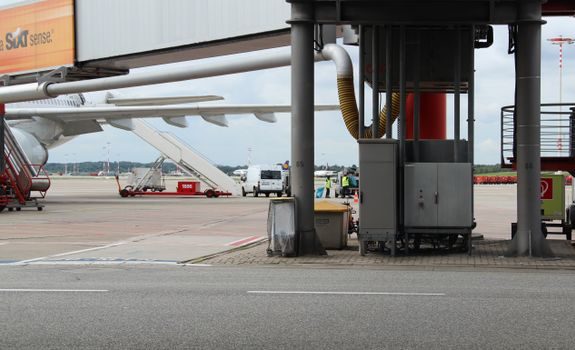
Air-cargo tonnages are small, so a 100–200 mm diameter screw is usually the ceiling; oversized 300–400 mm units waste capital and add inert mass that complicates truck- or dolly-mounting. Bulk density drives power: 0.5 t/m³ flour needs roughly half the installed kW of 1.6 t/m³ dry sand at the same t/h, and conveyor builders (Fipuda, Inotek, CableConveyors) all size motor power to a service factor of 1.25–1.5 against the calculated full-load torque, not to a nameplate [S1][S2][S4]. Where the duty is de-icing glycol recovery solids, the trough must be heated or jacketed because viscosity jumps sharply below 10 °C, and the gearbox should be sized for cold-start stall current rather than warm-running nominal.
Standards, zoning and certification
Air-cargo terminals are not uniform ATEX zones — most ramp space is unclassified, but glycol-recovery enclosures, fuel-additive storage and battery-charging rooms drop into zone 1 or zone 2 depending on ventilation, and a screw in any of those must be supplied with an EU ATEX 2014/34/EU Cat 2 or Cat 3 rating and the matching IECEx certificate for non-EU hubs [S1]. Pressure-vacuum or vacuum-only operation (used on dry-ice reclaim and de-icing vapour capture) brings the Pressure Equipment Directive into scope as well, and CableConveyors explicitly lists both as options on its custom builds [S1]. For catering lines, EHEDG and 3-A sanitary construction plus 316L contact parts and Ra ≤ 0.8 µm finishes are the spec floor, not an upgrade. Hygiene-cleanable screw geometry is not optional once the line carries a food or pharmaceutical intermediate [S1].
Comparison: shafted vs shaftless, and the pneumatic alternative

Putting the main options on a single decision grid is the fastest way to avoid a mis-procurement. Three criteria cover ~80% of air-cargo engineering calls — material state, throughput, and zoning — and the four practical options score as follows: (1) shafted carbon-steel screw, horizontal, 1–5 t/h dry free-flowing, low cost, but no ATEX or food rating; (2) shafted 304/316 stainless screw, inclined 20–30°, 0.5–2 t/h, food/pharma or mild-corrosion duty, mid cost, ATEX-ready as option; (3) shaftless helicoid in 316L or high-alloy, 0.3–1.5 t/h, sticky/wet reclaim or de-icing residue, higher torque drive, full ATEX Cat 2 capable; (4) pneumatic conveying (vacuum or dilute-phase), 1–10 t/h, fully enclosed, dust-tight, ATEX standard, but needs separator/blower and is over-specified for sub-1 t/h duties [S1][S2]. Inotek and Fipuda both publish standard ranges at the 100–300 mm diameter band typical of air-cargo throughput [S2][S4], while a full port-side comparison lives in the port-logistics screw conveyor map.
Vendor landscape and where to look
The 2026 vendor list for short-incline stainless screw conveyors is concentrated in two clusters. Chinese OEM clusters around Jiaxing/Zhejiang (Fipuda, est. 2012) and broader national players (Inotek, ISO 9001:2008 certified, multi-language export desk) cover standard 100–300 mm tubular units with food-grade and ATEX options at the lowest unit cost [S2][S4]. CableConveyors, reporting 20 years in business, sits at the engineered end and explicitly advertises ATEX- and PED-compliant custom units, abrasion-resistant flights, and high-alloy steels for difficult services [S1]. Indian fabricators (Metasis Equipments, Pune) compete on mid-range dry-bulk auger pricing and are commonly used by third-party ground handlers in South Asia [S5]. European and U.S. integrators typically sub-contract to one of these three clusters and re-badge, which is why the same helical geometry shows up under multiple brand names in air-cargo tender documents.
Limitations and failure modes
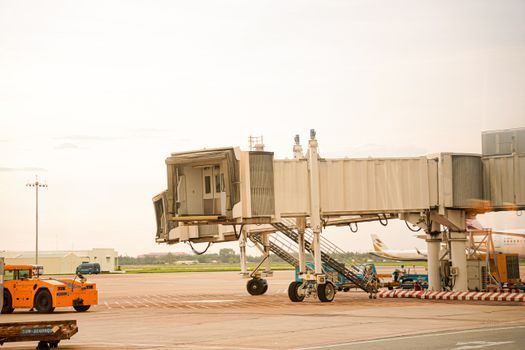
Screw conveyors fail in air-cargo service for four predictable reasons. First, over-inclination: a 35° or 40° flight on a free-flowing 0.5 t/m³ flour reverts to slugging, and a 45° set-up is almost guaranteed to stall on cold start. Second, undersized drive: 1.0 service factor instead of 1.25–1.5 burns the gearbox within 6–12 months on a de-icing reclaim line [S1][S2]. Third, wrong material: carbon-steel flights on chlorinated catering wash-down rust through the welds in under 18 months — 316L is the minimum, not an upgrade. Fourth, missed zoning: a zone-1 glycol-recovery enclosure with a standard industrial motor is a non-compliant build that an EASA or FAA ramp auditor will red-card. When any of these four conditions apply, escalate the design to a multi-gas detector spec for the enclosure first, then re-spec the screw, because a wrongly-zoned conveyor is rarely fixable in the field.
Trackable signals over the next quarter: (a) whether IATA's ULD telemetry roadmap, currently in pilot at two European hubs per the August 2026 Finnair and Korean Air cargo-portal updates, extends to ground-handling bulk inventory by end-2026 [S3][S6]; (b) whether Chinese OEM Fipuda's standard 100 mm and 150 mm food-grade units receive an updated 3-A or EHEDG certificate in Q4 2026 [S2]; (c) whether ATEX-aligned CableConveyors custom builds add an explicit aviation-ground-handling datasheet, which would close the documentation gap most European hub integrators complain about [S1].
Component reference pages worth checking: air pick, air impact wrench, and air quality monitor.