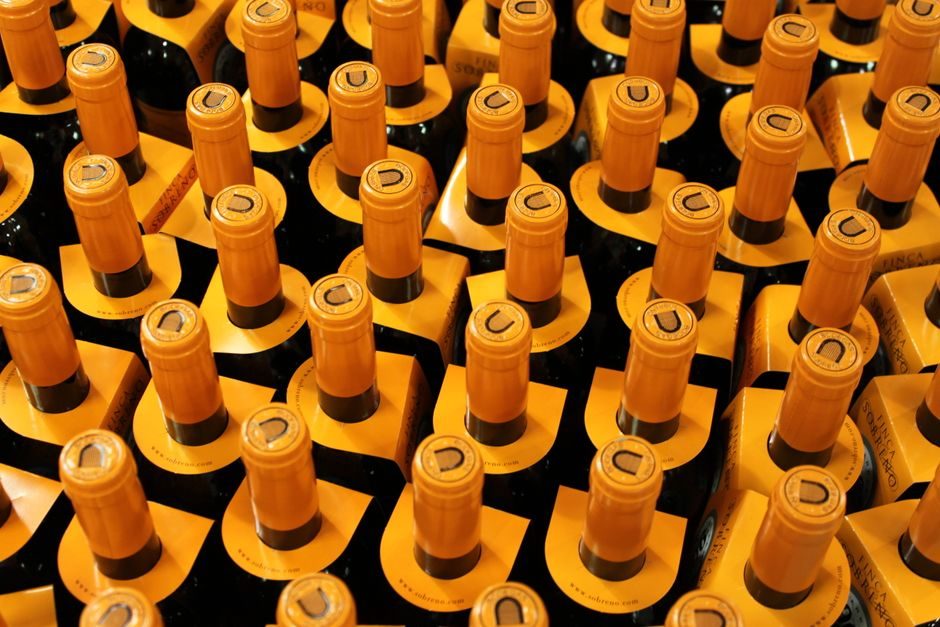
Four drive families dominate capping and sealing machinery: spindle (rotary screw), chuck (pick-and-place), side-wrap (belt-fed), and induction (electromagnetic foil seal), each suited to a different closure geometry and throughput band [S2][S5].
Selection pivots on cap type (screw, press, pump, ROPP, foil), container OD, line speed, and hygienic class, not on vendor preference; the same line commonly runs two capper classes in series when a tamper-evident band follows a screw cap [S1][S5].
Spindle Cappers: Screw Caps, Pump Heads, Trigger Sprayers
Spindle cappers use 2 to 8 servo-driven rotating heads that engage the cap's internal thread and apply a controlled torque of typically 4–25 Nm depending on closure size [S2].
Typical output sits in the 40–120 BPM band for a 4-spindle rotary, scaling to 200+ BPM on 8-spindle lines serving personal care and trigger-spray SKUs [S2][S5]. The mechanism handles LDPE, PP, and metal caps; ROPP (roll-on pilfer-proof) aluminum caps require a dedicated threaded-roller head rather than a flat spindle, and the two should not be mixed on the same drive [S2]. Torque calibration is the dominant maintenance task, and a worn spindle clutch usually shows up as cap-back-off at the unload starwheel rather than at the capping station. For tube-fill lines, the same spindle principle is reused inside filling machine monoblocks that integrate volumetric dosing with heat-seal tail crimping at 30–60 tubes per minute [S9].
Chuck and Pick-and-Place Cappers: Press Caps, Snap Closures, Specialty Fitments
Chuck cappers pick each cap from an orienter bowl with a vacuum or mechanical gripper, lower it onto the bottle, and press-fit at a programmable down-force of 200–600 N [S2][S5].
This class is mandatory for press-on caps, snap-fit closures, and orient-sensitive fitments such as push-pull spouts and child-resistant lids where rotational torque would damage the cap geometry [S2]. Pick-and-place cappers on Likai and Dession product lines are specified for cosmetics and pharmaceutical bottles at 30–80 BPM, with the orienter bowl feeding caps at 99% upright confirmation before the chuck descends [S5]. The cap is then held in a pre-made film liner if induction sealing is also specified downstream, so the chuck capper and the induction sealer are often paired in series on a single conveyor. A typical failure mode is orienter bowl starvation on long shift runs; vibratory feeders and cap-escalator hopper level sensors are the usual mitigation.
Side-Wrap and Belt Cappers: Threaded and Pry-Off Glass
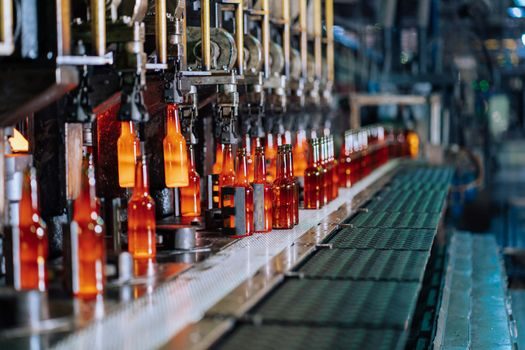
Side-wrap cappers grip the bottle from beneath with a friction belt and rotate the cap against a stationary surface, threading it on without a dedicated spindle head [S2][S5].
Output sits in the 30–60 BPM range and the machine footprint is small, making side-wrap the common choice for short-run food jars, honey bottles, and pharmaceutical syrups with pry-off or lug-style metal caps [S2][S5]. Unlike spindle cappers, side-wrap applies a continuous friction torque rather than a calibrated cut-off, so cap tightness is controlled by belt tension and cap-on-bottle stop geometry. The class is poorly suited to plastic screw caps on slippery PET bottles because the belt cannot generate repeatable friction without crushing the bottle shoulder; a spindle capper is the correct match in that case. For lines pairing a side-wrap capper with a downstream foil induction unit, the conveyor must include a 1.5–2.0 second dwell between cap placement and the induction coil to settle the closure before sealing [S5].
Induction Sealers: Tamper Evidence and Hermetic Liner
Induction sealing uses a high-frequency (typically 50–80 kHz) electromagnetic field to heat a foil laminate inside the cap, bonding it to the bottle lip in 0.3–1.2 seconds [S5].
The class is split into water-cooled and air-cooled coil heads; water-cooled units sustain 100+ BPM continuous duty, while air-cooled heads are typically limited to 30–60 BPM and short shift windows [S5]. Likai's catalog distinguishes a "Missing Foil Detection Module" variant that ejects bottles lacking the inner foil liner, a feature that is now common on pharmaceutical lines and a frequent retrofit on legacy induction tunnels [S5]. Induction sealing does not apply torque or press force, so it is always paired with a cap-tightening station upstream; treating the induction sealer as a standalone capper is the most common specification error on small liquid lines. The hermetic bond produced qualifies the package for many tamper-evidence requirements, but the foil laminate must match the cap substrate — PP caps use a different foil face-stock than PE or HDPE, and a mismatch causes liner lift after 30+ days of storage. Where a sealing washer is also required on threaded metal closures, the induction step is skipped and the washer is crimped in a separate spindle operation.
Drum Bung and Flange Machines: Industrial-Container Class
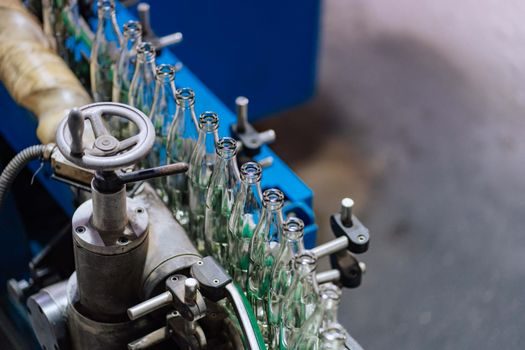
Steel-drum lines use a distinct capping class — the drum bung machine — that combines paint-cap removal, cooling, plug insertion, and seal crimp in a single indexing station [S3].
Chongyi's 55-gallon drum bung machine integrates a multi-function head that handles G2 and G3/4 lacquered plugs, with the flange insertion die running as a one-step punch-and-curl tool rather than the older two-step sequence [S3]. This class is a separate sub-family from FMCG cappers because the closure sizes (2" and 3/4" NPT bungs), torque values (40–80 Nm), and container weights (180–230 kg full) are outside the design envelope of a bottle capper. When a drum line also specifies UN-rated transport packaging, the flange-curl geometry must satisfy the drop and stack tests that the capping machine builder typically validates against the drum maker's own UN certification dossier rather than running a new series of transport trials [S3].
Selection Criteria and Limits
Cap geometry is the first gate: screw caps go to spindle, press and snap fitments to chuck, pry-off glass to side-wrap, foil-only to induction, and steel drum bungs to a dedicated bung machine [S2][S3][S5].
Line speed is the second gate: 30 BPM and below can be served by any class, 60–120 BPM forces spindle or rotary chuck, and 200+ BPM requires multi-spindle rotary or continuous-motion chuck with dual orienter bowls [S2]. Container OD range for FMCG cappers is commonly 20–110 mm, with changeover parts needed at each 10 mm step on most mid-range machines. Hygienic class is the third gate: pharmaceutical and dairy lines typically demand 316L contact parts, IP66 control cabinets, and CIP-capable spray balls, which excludes economy side-wrap units that use open belt frames. Material and throughput for the upstream core machine (typically a 4–18 head monoblock filler) must be matched in cycle time to the chosen capper class; an 8-spindle capper paired with a 4-head filler creates a chronic filler-starvation bottleneck. Field acceptance for the line as a whole follows a five-gate test pattern — empty bottle, fill volume, cap presence, torque value, seal integrity — laid out in detail in this filling-machine installation spec map.
Failure Modes and Maintenance Intervals
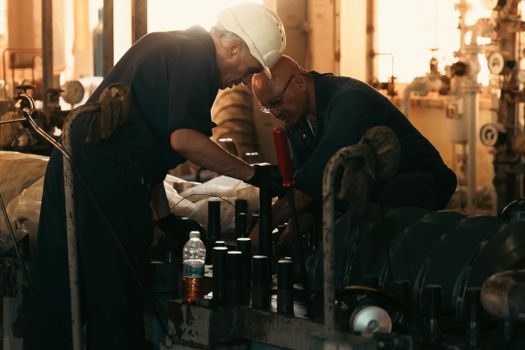
Spindle cappers fail predominantly at the torque clutch and cap pickup O-ring; typical service interval is 4–8 weeks on a 24/7 personal-care line, with cap-back-off as the diagnostic symptom [S2].
Chuck cappers fail at the vacuum gripper seal and orienter bowl discharge chute; a worn gripper shows up as dropped caps at the press station, not as a torque fault, and the vacuum line filter is the first item to inspect. Side-wrap cappers fail at the friction belt and the bottle-neck centering cone; belt glazing is the most common cause of cap slip, and the belt should be replaced rather than re-tensioned once the surface has polished. Induction sealers fail at the coil water circuit (scale buildup) and the foil laminate itself; a hot bottle at the discharge starwheel indicates coil power drift, while a cold bottle with a loose liner indicates a cap-height sensor fault rather than a coil fault. Drum bung machines fail at the plug-orienter drum and the crimp die; die wear shows up as a partial crimp ring and is usually flagged after a 50,000-bung service count [S3]. Across all four FMCG classes, conveyor and starwheel timing drift is the single most common root cause of cap-related line stoppages, and timing-belt re-tensioning is a weekly task on lines running above 100 BPM.
Standards and Sourcing Notes
There is no single ISO or ASME standard that governs capping-machine performance end-to-end; line builders instead reference the closure-maker's torque spec, the container-maker's neck-finish drawing, and hygienic standards such as EHEDG for food and dairy or 3-A for U.S. dairy lines [S2][S5].
Torque-measurement traceability to a calibrated digital gauge (typically ±0.5 Nm) is the usual audit requirement, and the gauge itself should be re-certified annually. For pharmaceutical lines, the upstream coding machine is integrated with the capper reject station so a missing batch code, missing cap, and failed induction seal all feed the same reject starwheel. For sites weighing capper TCO over a 5–10 year horizon, the coding machine TCO spec map gives the parallel cost-stack logic that applies to the capper class as well. When sourcing from Chinese builders, the cutting machine and capping-machine sub-assemblies are often shared SKUs across the same factory, so verifying a builder's adjacent-machine track record is a reasonable proxy for capper build quality [S5].