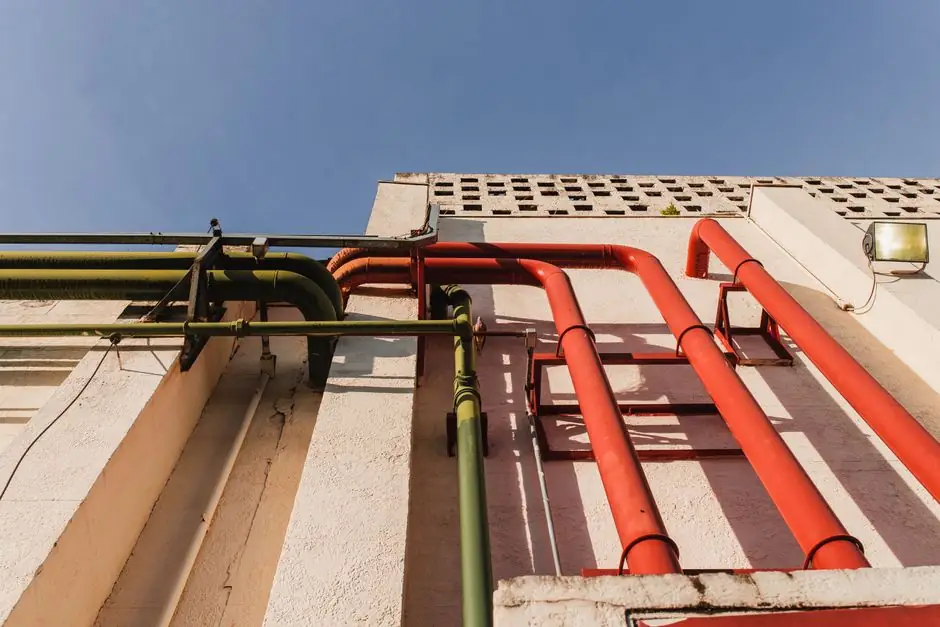
Plastic pipework is a tubular section made of thermoplastic or thermoset polymer, used to convey drinking water, waste water, chemicals, heating and cooling fluids, slurries, gases, compressed air, and vacuum service [S4].
Three structural categories define how the wall is built: solid-wall extruded pipe (single homogeneous thermoplastic matrix), structured-wall pipe (optimised material use for stiffness, often for sewer and drainage), and barrier pipe (a flexible metallic layer bonded between two polymer layers, used where ground contamination could attack the conveyed fluid) [S4]. Material selection is governed by CEN/TC155 product standards in Europe, with service-specific requirements covering drinking water hygiene, gas safety, radiant heating temperature resistance, and sewer chemical resistance [S4].
Polyvinyl chloride family: PVC-U and CPVC
Unplasticized polyvinyl chloride (PVC-U) is specified for non-potable water supply, drainage, and rainwater due to corrosion resistance, smooth bore, light weight, low price, and bondable socket joints; the trade-off is brittleness under impact and poor heat resistance, capped near 60°C in pressure service [S1].
Chlorinated polyvinyl chloride (CPVC) raises continuous service temperature to roughly 93°C (200°F fluid handling) thanks to the chlorinated coating, which lets it carry hot water lines where PVC-U would soften [S2][S5]. PVC service life is reported up to about 70 years in non-exposed conditions, while CPVC is generally rated 20-25 years [S2]. For connection, both rely on socket bonding with primer plus cement, plus plastic welding or flanged joints for transition [S1][S5].
Polyethylene family: LDPE, MDPE, HDPE, PE-RT, PEX
Polyethylene is split by density: LDPE for agricultural drainage and irrigation, MDPE for medium-pressure gas, and HDPE for urban water and gas mains, joined by electrofusion, butt fusion, or flanged couplings [S1]. HDPE and MDPE dominate municipal gas networks outside North America due to high strength, creep resistance, and chemical stability [S1].
PE-RT (raised temperature resistance) is a polyolefin designed for hot-water distribution without the crosslinking step PEX requires; it shares the chlorine-sensitivity of the wider polyolefin family [S3]. Cross-linked polyethylene (PEX) comes in three grades: PEX-a (most flexible, peroxide crosslinked), PEX-b (slightly less flexible, silane crosslinked), and PEX-c (stiffest, radiation crosslinked, suited to quick repairs); colour coding red (hot) and blue (cold) is common in residential supply [S5]. PEX can bend to 90° with fewer fittings, is corrosion-resistant in clean water, and is not rated for outdoor UV-exposed service [S2][S5].
Polypropylene, ABS, PB-1, and PVDF
Polypropylene (PP) is a rigid polyolefin used in domestic hot/cold plumbing, but it shares chlorine-induced degradation risk and requires heat-fusion joining rather than crimp or expansion, which adds labour and burn-hazard overhead in tight spaces [S3]. Acrylonitrile butadiene styrene (ABS) is a black, BPA-containing thermoplastic used for drain, waste, and vent (DWV) pipe, joined with one-step cement; it tolerates cold better than PVC-U but is banned for potable lines in several codes [S5].
Polybutylene (PB-1) was the first polyolefin hot/cold pipe in North America in the 1970s, but premature failures from chlorine attack drove class-action settlements exceeding $1 billion and removed it from new construction; inspectors now flag PB-1 as a mandatory disclosure at resale [S3]. Polyvinylidene difluoride (PVDF) is a high-purity fluoropolymer used for aggressive chemicals, ultra-pure water, and solvent service where commodity plastics fail [S4].
Selection criteria: temperature, pressure, fluid, jointing
Material choice is driven by four interlocking specs, not habit: continuous service temperature, internal pressure rating, fluid compatibility (especially free chlorine for polyolefins), and the jointing method the site can actually execute [S1][S3][S4]. A side-by-side read of the common options looks like this: PVC-U caps near 60°C, joins by solvent cement, is rigid; CPVC extends to ~93°C with the same cement, rigid; PEX is flexible to 90° bends, joins by crimp/expansion, vulnerable to UV; HDPE carries gas and water mains, joins by heat fusion; PP carries hot water but needs fusion welding; ABS handles DWV, joins with one-step cement, but is BPA-bearing [S1][S2][S3][S5].
Code- and standard-anchored rules that engineers verify before specifying: barrier pipe with a metallic mid-layer is required where ground contamination could migrate into drinking-water service, per CEN/TC155 application standards [S4]; polyolefin chlorine-resistance limits are tracked under ASTM F2023 for PEX oxidative stability, while CPVC and PVC-U pressure ratings fall under ASTM D2846 and D1785 respectively; gas distribution MDPE and HDPE fall under ASTM D2513. A working knowledge of how these plastics compare against each other and against engineering plastic grades helps when the spec drifts beyond commodity pressure pipe.
Failure modes and field constraints
The same polymer families that win on corrosion lose to chlorine, UV, and freeze-thaw in different ways, so the failure modes are material-specific rather than generic [S3]. Polybutylene degraded through oxidative attack on molecular bonds, with documented premature failures that triggered re-piping in at least 350,000 North American homes under the class-action settlement [S3]. PEX shows the same micro-cracking pathway under sustained chlorinated water exposure, with field photos showing degradation within two years of hot-water service, so chlorine levels in source water are a design input, not a footnote [S3].
Polypropylene flakes in hot chlorinated water, releasing debris that clogs fixtures and appliances, and is not as ductile as PEX, so it cannot be crimped or expanded [S3]. PVC-U turns brittle under prolonged UV, ABS warps under direct sunlight, and PEX is explicitly not rated for outdoor use [S2][S5]. Composite solutions such as steel-plastic composite pipe and plastic pipe systems address some of these gaps by combining a metallic structural layer with a polymer liner for oxygen barrier, pressure rating, or temperature headroom, and are worth evaluating on chemical-service or heating-system jobs where a single polymer would be marginal.
Where each type fits in industrial and residential service
PVC-U and HDPE dominate buried drainage, irrigation, and non-potable water mains; HDPE and MDPE cover the bulk of medium-pressure gas distribution; CPVC, PEX, and PP split the residential hot/cold market, with PEX preferred for retrofit flexibility and CPVC preferred where solvent-cementing crews and higher continuous temperature matter [S1][S2][S5]. ABS is largely confined to DWV stacks indoors, PVDF to chemical and semiconductor ultrapure loops, and barrier pipe to contaminated brownfield sites [S4].
For procurement, a defensible shortlist for a new build starts with fluid identity, then temperature, then pressure, then jointing method, with chlorine level, UV exposure, and code jurisdiction (CSA, NSF/ANSI 61, ASTM) as hard gates. Specifiers handling process-line tie-ins adjacent to chemical skids will recognise the same chemistry-first logic used in pinch valve selection, where sleeve compound, pressure class, and media resistance drive the call before brand is discussed.
For higher-temperature heating and underfloor radiant jobs, verify the listed PEX-a/b/c grade and oxygen-barrier layer against the boiler-side control limits rather than the generic brochure.