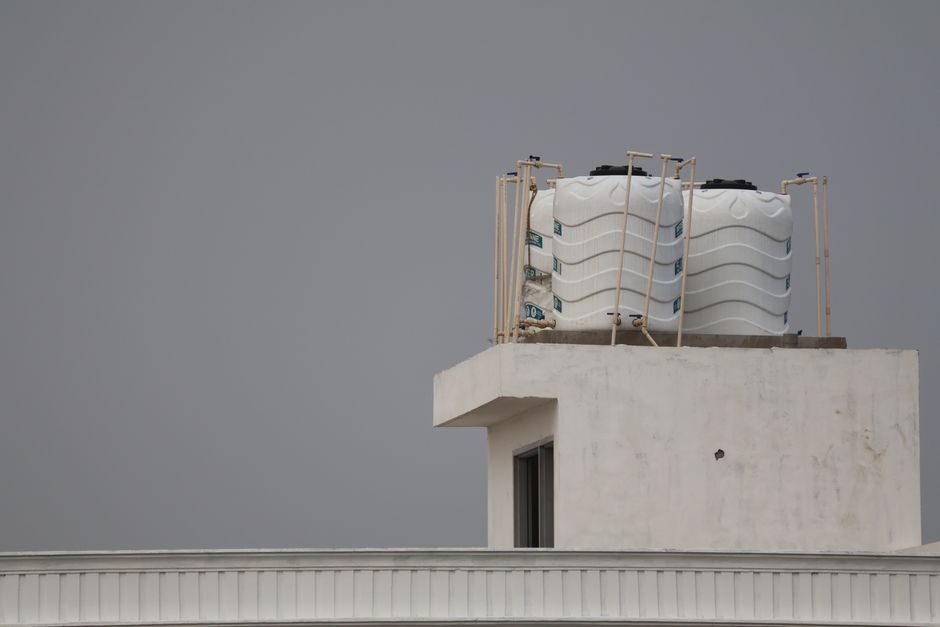
Plastic storage tanks in PE, PP, PVC, and XLPE cover the bulk of indoor/outdoor water, mild-chemical, and food-grade storage up to about 50,000 L, with polyethylene accounting for the majority of general-purpose units shipped globally per the major resin-product catalogues [S1][S2][S3].
Across 2026 supplier listings, the same five resins — PE (LDPE/LLDPE/HDPE), XLPE, PP, PVC, and fluoropolymers (F4/PTFE) — recur as the selectable options, with custom injection-moulded fabricators offering all of them in one moulding cell [S3]. The fit-for-duty question is therefore not "plastic vs steel" but "which resin, what specific gravity rating, what certification" — covered below.
Resin families and the chemistry that drives the choice
Polyethylene (HDPE/LLDPE) is the workhorse for water, rainwater, dilute acids, and most mild caustics; PVC is widely listed for vertical chemical storage where higher rigidity is wanted; PP covers higher-temperature duties; and cross-linked polyethylene (XLPE) adds impact and stress-crack resistance for larger outdoor vessels and fuel/blend storage [S1][S3].
Custom moulders regularly list the full resin menu in one quote line: "PE, PP, PVC, ABS, F4, PMMA, POM, PC, PA, etc., all kinds of plastic" — a useful sanity check that a single supplier can switch grades without sourcing a new tool [S3]. For an indoor chemical tank, PVC's rigidity lowers wall creep; for an outdoor potable tank, HDPE with UV stabilizer plus NSF/ANSI 61 certification is the conservative default.
Specific gravity, wall design, and the "1.5 SG" rule
Wall thickness and top-fittings are sized to the stored liquid's specific gravity: a 1.0 SG tank holds water safely, a 1.5 or 1.9 SG tank is specified for dense liquids (fertilizers, brines, some acids), and a flat-bottom tank above ~5,000 L should always sit on a full concrete pad with no voids to prevent shell stress [S3].
For any liquid above 1.2 SG, OEM datasheets require a heavier-wall or cross-linked build — quoting a standard HDPE tank for 1.5 SG sodium hypochlorite is the most common mis-spec I see, and it shows up as wall bulging inside six months. A storage rack analogy is helpful: the same shelf frame carries very different point loads depending on the rated capacity, and undersizing the shell is a one-way ticket to a leak.
Certifications that actually matter on the datasheet
Potable-water tanks should carry NSF/ANSI 61 (US) or equivalent WRAS/ACS (EU) certification on the resin, not just on the manufacturer — the certificate follows the resin lot. Food-grade tanks add FDA 21 CFR 177.1520 (PE) or 177.2600 (rubber gaskets) compliance. [S3]
Chemical-duty tanks need a published chemical-resistance table from the resin maker, rated by concentration and temperature — generic "PE chemical tank" listings without a compatibility chart should be treated as non-compliant for any service above 5% concentration or 40 °C [S3]. Outdoor UV exposure requires either carbon-black-loaded HDPE (≥2% carbon black by weight) or a gel-coat outer layer; clear or natural PE tanks will embrittle in 18–36 months of direct sun.
Sizing, MOQ, and lead-time reality in 2026
Standard roto-moulded PE tanks ship in 5–7 days for samples and 25–30 days for production runs from the major Chinese moulders, with sample orders starting at 1 piece and 50% T/T deposit on production orders [S3]. That lead time is the same ballpark as custom linear guide rails and most modular industrial components, so PE tanks are not a long-lead bottleneck compared to stainless or FRP.
For a 10,000 L vertical PE tank, plan on a 2,000–2,800 mm height band, a 2,000–2,400 mm diameter, a DN50 flanged top fill, DN50 bottom drain with plug valve, and a vented flip-top lid with breather — these are the standard fitting sizes that every mould shop quotes without re-engineering [S3]. Anything outside that envelope pushes the build into custom tooling and adds 4–8 weeks.
Comparison: PE vs XLPE vs PP vs PVC for common duties
HDPE wins on cost and chemical breadth for water/mild chemicals at ≤60 °C; XLPE wins on impact resistance, larger capacities (≥20,000 L), and outdoor UV life; PP wins on temperature (up to ~100 °C short-term) and is preferred for hot CIP rinse water; PVC wins on rigidity and is the cheapest option for vertical indoor chemical storage where impact is not a concern [S1][S3].
If the stored liquid is above 1.4 SG or the tank is outdoors in full sun for more than two seasons, the only correct resin from the four is XLPE — HDPE creeps and UV-degrades, PP yellows and embrittles, and PVC loses impact strength below ~0 °C. For a storage cage for flammable liquids, plastic alone is not the answer; that is an FM-approved metal enclosure with a sump, not a PE drum.
Who should NOT pick the cheapest PE tank
Three duty classes rule out standard HDPE: (1) any service above 80 °C continuous, (2) any organic solvent (acetone, toluene, MEK) that swells PE, and (3) any buried installation without a sand-bed engineered backfill — the tank needs uniform support, not sharp aggregate. In all three, FRP (fibreglass) or stainless 304/316 is the correct substitute. [S3]
Buyers also routinely confuse "food-grade" with "potable-water-grade" — a food-grade resin is rated for food contact at room temperature, not for long-term drinking-water extraction. For potable water, insist on NSF/ANSI 61 (or local equivalent) printed on the resin certificate, not just "food-grade" in the marketing copy [S3].
Verification checklist before signing the PO
Request four documents from the supplier: (1) the resin manufacturer's lot certificate with FDA/NSF marking, (2) a dimensioned drawing with wall thickness at the sidewall, top, and bottom knuckle, (3) a fitting schedule with flange standards (ANSI/DIN/JIS), and (4) a chemical-resistance table for the specific medium at operating temperature [S3].
On receipt, do a hydrostatic test at 1.3× design SG for 30 minutes, inspect fittings for cross-threading, and verify the lid gasket material matches the chemical service (EPDM for water/caustic, Viton for hydrocarbons). For plants that already run on standardized IBC tank fleets, a new PE tank should be ordered to the same fitting standard so pumps, hoses, and gaskets stay interchangeable — mismatched flanges are the most common field-fit problem after delivery.
Trackable signals to watch through 2026: rising XLPE pricing as cross-linking additives track bromine/acrylate costs, and the gradual phase-in of higher-recycled-content HDPE (PCR-HDPE ≥30%) in NSF 61 listings, which can shift both price and lead time for municipal potable projects.
For related coverage, see Load Cell vs Weighing Indicator: Spec-Level Selection Map.