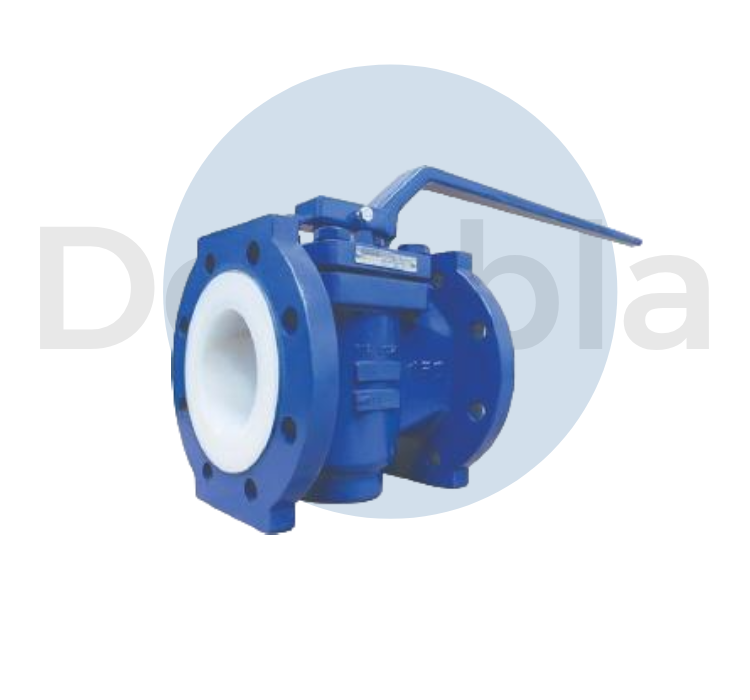
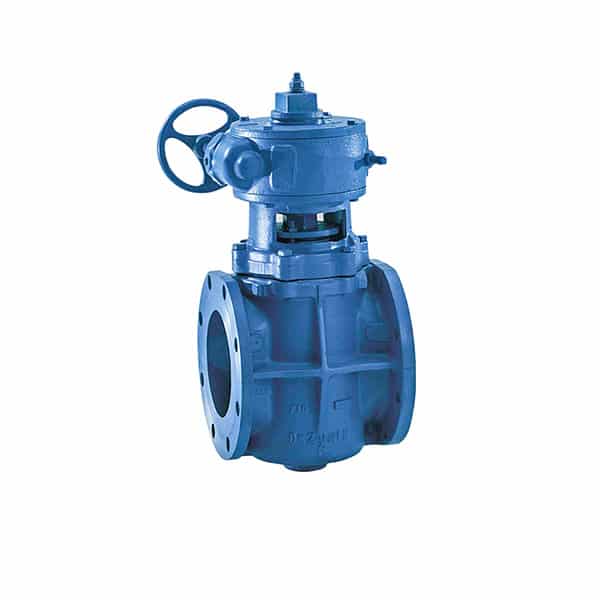
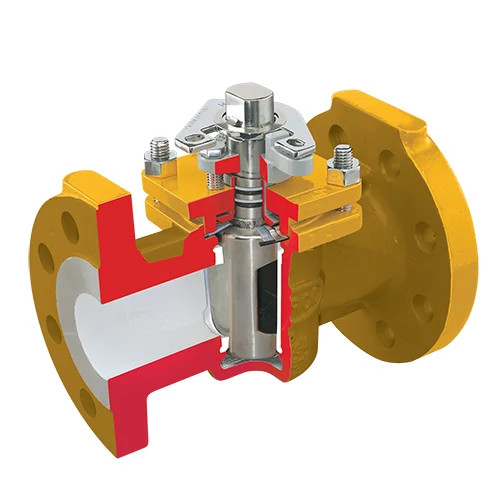
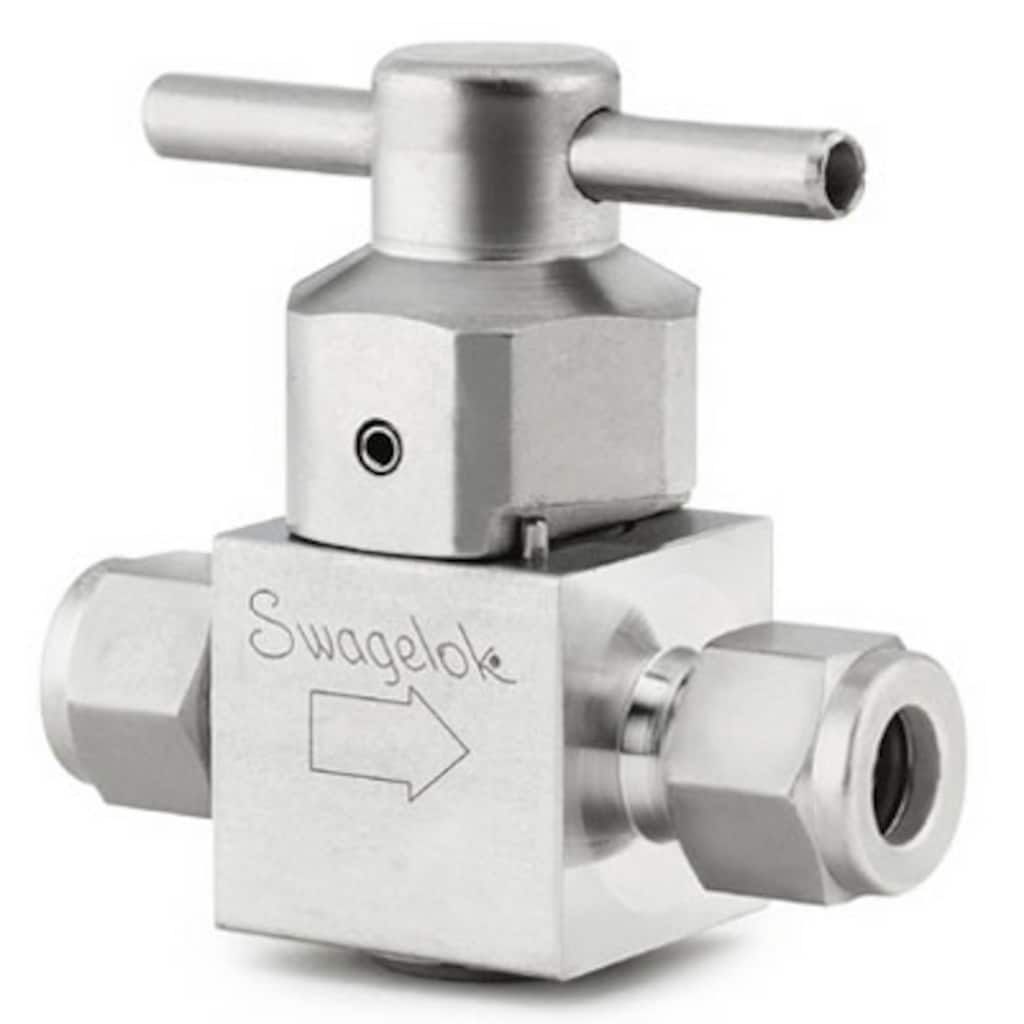
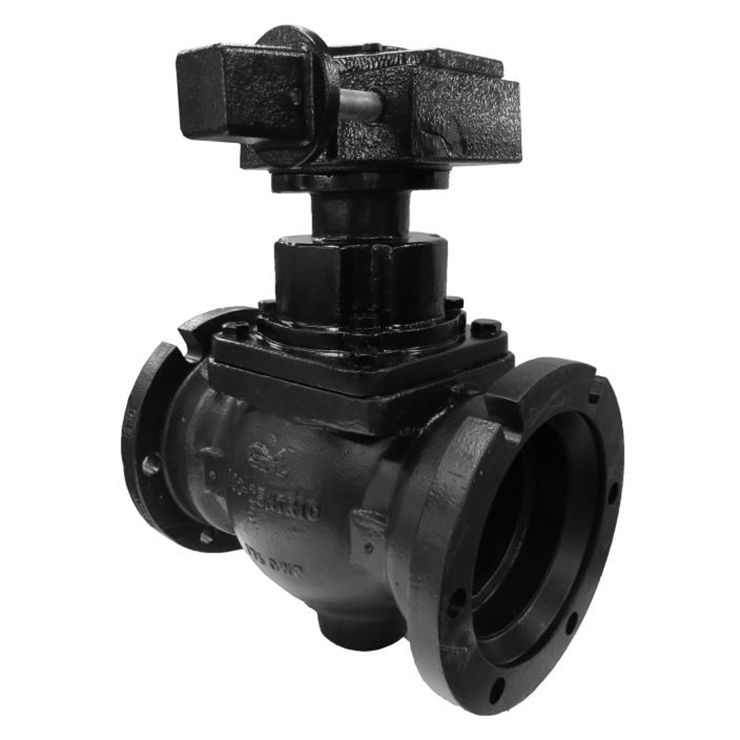
A plug valve is a quarter-turn isolation valve that uses a cylindrical or tapered plug, drilled with one or more flow passages, rotated 90 degrees inside the body to open or block the line. When the passage aligns with the body ports the valve is fully open; rotate the plug a quarter turn and the solid wall of the plug seals against the body, giving fast, positive shutoff. Plug valves are among the oldest valve types still in heavy industrial use, prized for their large sealing surface, compact face-to-face length, and ability to handle slurries and corrosive media that would foul a gate or globe valve.
This guide separates the four families that share the name but behave very differently in service: lubricated, sleeved, fully lined, and eccentric plug valves. Each is governed by its own standard and occupies a distinct niche, from high-pressure pipeline gas isolation to drop-tight wastewater shutoff to severe chemical corrosion service.
Photo: حجت الله ریاضتی (Hojjatollah Riyazati), CC BY-SA 4.0, via Wikimedia Commons
This guide is written for industrial procurement engineers and design engineers selecting plug valves for isolation and diverting duty. It spans 6 chapters from the working principle and history, through type classification, sealing technologies, body and trim materials, spec-sheet decoding, to selection decisions, with 7 selection FAQs and verified manufacturer references. All parameters reference public standards: API 599 (metal plug valves), ASME B16.34 (pressure-temperature ratings), API 6D (pipeline valves), API 598 (inspection and testing), API 607 (fire test), and AWWA C517 (resilient-seated cast-iron eccentric plug valves).
Chapter 1 / 06
What is a Plug Valve
A plug valve is a rotary, quarter-turn flow-control valve in which a solid plug, machined as a cylinder or a truncated cone and bored with one or more passageways, rotates 90 degrees within the valve body. When the plug passage lines up with the inlet and outlet ports, the line is open; rotate the plug through a quarter turn and the unbored face of the plug presents itself across the bore, sealing the line. The plug seats against either the bare metal of the body taper (lubricated and metal-seated types) or against a soft member such as a PTFE sleeve, a fluoropolymer lining, or a resilient elastomer facing (non-lubricated types). This single rotating element, with no separate disc, wedge, or floating ball, gives the plug valve its mechanical simplicity and its characteristically large, wraparound sealing surface.
Functionally the plug valve belongs to the on-off isolation family alongside the gate, ball, and butterfly valve, not the modulating family that includes the globe and control valve. Because the plug travels only 90 degrees and the sealing surface is generous, the plug valve gives a fast, tight, bubble-class shutoff and tolerates frequent cycling. The trade-off is operating torque: the very large sealing surface that makes the valve seal so well also means more friction to overcome, so plug valves of equal size carry higher torque than ball valves and are usually fitted with a gear operator or actuator above roughly DN200 (NPS 8).
The plug valve is one of the oldest valve concepts in engineering. Tapered bronze plug cocks were used by the Romans to control water in lead piping, and the simple gas cock and stopcock are direct descendants. The modern industrial plug valve emerged in the early twentieth century when sealant-injected lubricated designs let the heavy tapered plug be jacked free and sealed against high-pressure gas. The Nordstrom lubricated plug valve, now part of Flowserve, became a pipeline standard, and Flowserve states that the Nordstrom facility is the largest lubricated plug valve manufacturing operation in the world. The non-lubricated sleeved plug valve, pioneered by Durco (now Flowserve) and Xomox (now Crane ChemPharma), arrived to serve corrosive chemical duty where injected grease would contaminate the process.
Four families share the name. The lubricated plug valve relies on injected sealant and dominates high-pressure pipeline gas and refinery isolation. The sleeved plug valve wraps the plug in a replaceable PTFE sleeve and rules clean and corrosive chemical service. The fully lined plug valve coats every wetted surface in PFA or PTFE for the most aggressive acids. The eccentric plug valve offsets the plug from the seat for low-torque, drop-tight shutoff and is the workhorse of municipal water and wastewater. They look alike on a P&ID symbol but differ completely in maintenance, torque, temperature limit, and price, so identifying the correct family is the first selection decision.
Plug valves serve a wide range of process variables and pressures. Metal plug valves under API 599 cover sizes NPS 1 through NPS 24 across ASME Class 150 to Class 900 and higher; eccentric water valves under AWWA C517 reach 72 in (1,800 mm). Typical duties include pipeline block and bypass, refinery and chemical isolation, sludge and slurry lines, custody-transfer headers, and multiport diverting service where a single valve replaces several. Within those duties the four families are not interchangeable, which is why the chapters that follow separate them by sealing technology rather than treating plug valves as one product.
Chapter 2 / 06
Plug Valve Types and Classification
Plug valves classify two ways: by how the plug seals against the body, and by how many ports the plug serves. The sealing classification is the more consequential, because it determines maintenance regime, temperature limit, corrosion resistance, and price. The four sealing families are lubricated, sleeved, lined, and eccentric. The port classification distinguishes the conventional two-way (coaxial inlet and outlet) valve from the multiport diverting valve, where a single plug with a multi-way bore routes flow among three or four ports, replacing a manifold of separate valves. The table below summarizes the four sealing families against the criteria that drive selection.
Type
Sealing Member
Routine Maintenance
Governing Standard
Typical Service
Lubricated
Injected sealant on metal taper
Periodic sealant injection
API 599 / API 6D
High-pressure pipeline gas, refinery isolation
Sleeved (non-lubricated)
PTFE sleeve around plug
None routine; sleeve replaceable
API 599 / ASME B16.34
Corrosive and clean chemical, slurry
Lined
PFA or PTFE lining on all wetted parts
None routine
ASME B16.34
Severe corrosive acids, ultrapure
Eccentric
Resilient plug face into welded seat
Packing adjustment only
AWWA C517
Water, wastewater, sludge, slurry
Lubricated plug valves machine a sealant chamber and distribution grooves into the plug and body. A side-mounted sealant fitting lets the operator inject pressurized grease or oil that lubricates the metal taper, energizes the seal, and hydraulically jacks the heavy plug free so it can be turned. Flowserve's Super Nordstrom design, for example, uses a Sealdport grooving system to distribute pressurized sealant across the seating surfaces. The lubricated family is built for high-pressure gas and hydrocarbon pipeline isolation to API 6D, where its metal taper and renewable sealant film give a robust, fire-survivable block. The cost is a maintenance obligation: the sealant must be replenished on a schedule, and the correct sealant must be compatible with the process medium.
Sleeved or non-lubricated plug valves insert a precision PTFE sleeve between the plug and the body so the plug seals against an inert polymer rather than bare metal or grease. The sleeve completely surrounds the plug and provides a continuous circumferential seal from port to port, with no dead space in the flow path, which suits corrosive, toxic, and high-hazard media where leakage is prohibited and the lubricant of a lubricated valve would contaminate the product. Flowserve's Durco G4 Sleeveline and Crane's Xomox Tufline are the reference designs. These valves run essentially maintenance-free and need no routine sealant; the sleeve is a wear part that can be replaced in overhaul.
Fully lined plug valves extend the soft-seal concept by coating every wetted surface, the body bore, the plug, and the stem area, in a thick fluoropolymer such as PFA or PTFE. This is the most chemically resistant configuration, used for hydrochloric, hydrofluoric, and other aggressive acids and for ultrapure duty where even trace metal pickup is unacceptable. Flowserve's Durco T4E is a representative lined plug valve. Lined valves trade a slightly lower temperature ceiling and higher cost for near-total corrosion immunity.
Eccentric plug valves offset the plug shaft from the body seat so the resilient plug face swings clear of the seat through most of its travel and cams into a welded body seat only in the final degrees of closure. This produces low running torque, minimal wear, and dead-tight shutoff even on grit-laden sludge and slurry, which makes the eccentric design the standard for municipal water and wastewater. DeZURIK's PEC and PEF series are the reference products, built to AWWA C517 with welded nickel seats and grit excluders.
Chapter 3 / 06
Sealing Technologies
The seal is the heart of a plug valve, and the four families achieve it by completely different physics: a renewable grease film, a pressure-energized polymer sleeve, a bonded lining, or a cammed resilient face. Understanding these mechanisms explains the maintenance, torque, and temperature behavior that separate the families. The table below contrasts the key engineering metrics of the four sealing technologies; treat the figures as representative industrial ranges, since exact values depend on size, class, and manufacturer.
Sealing Technology
Temperature Range
Operating Torque
Tightness
Corrosion Resistance
Lubricated metal taper
-29 to +260 C
High
Class VI on sealant
Medium (metal)
PTFE sleeve
-29 to +204 C
Medium
Drop-tight, Class VI
High (PTFE)
PFA or PTFE lining
-29 to +204 C
Medium
Drop-tight
Very high (fluoropolymer)
Eccentric resilient face
-12 to +93 C typical
Low (cam action)
Drop-tight bidirectional
Medium (elastomer/metal)
Lubricated metal taper. The tapered plug and matching body bore are lapped to a fine metal-to-metal fit, then a film of pressurized sealant is injected between them. The sealant does three jobs: it lubricates the taper so the heavy plug can turn, it fills microscopic surface irregularities to make the metal seal tight, and at higher injection pressure it acts hydraulically to jack the plug up off its taper to break it loose. Because the seal is renewable, a worn or scored taper can often be recovered in the field by injecting fresh sealant rather than dismantling the valve. The penalty is the highest operating torque of the four families and the standing need to maintain the sealant and match it to the process fluid.
PTFE sleeve. In a non-lubricated sleeved valve, a precision-molded PTFE sleeve sits in the body bore and the tapered plug presses into it. PTFE's low friction lets the plug turn without grease, and its inertness resists nearly all process chemicals. The sleeve is pressure-energized: line pressure helps force it against the plug, so the seal tightens as pressure rises. Manufacturers secure the sleeve against cold flow and rotation with retention ribs and port lips so it cannot deform or creep out of position over years of service. The sleeve is a defined wear part, replaced at overhaul, which keeps the valve essentially maintenance-free between rebuilds.
PFA or PTFE lining. A lined plug valve molds or sinters a continuous fluoropolymer skin over every wetted surface. There is no metal in contact with the process at all, so the corrosion resistance is set entirely by the fluoropolymer rather than by the underlying body casting, which can therefore be ordinary ductile iron or carbon steel. This is the configuration of choice for concentrated acids and for processes that cannot tolerate metallic contamination. The limits are mechanical: fluoropolymer linings have a temperature ceiling around +204 degrees Celsius and can be damaged by abrasive solids or by rapid thermal or pressure cycling, so lining thickness and bonding quality are critical specifications.
Eccentric resilient face. The eccentric design relocates the plug pivot off the seat centerline. As the plug rotates toward closed it swings into the line and the resilient plug face cams firmly into a welded, corrosion-resistant body seat only in the last few degrees, pressing in with a smooth, low-torque, cam-like action that creates a positive seal with minimal seating compression. Through the rest of the stroke the face is clear of the seat, so abrasive media cannot grind it, and the seat does not wear from the medium dragging across it. The result is dead-tight, often bidirectional shutoff on the dirtiest service, which is why eccentric plug valves dominate water and wastewater.
Chapter 4 / 06
Body Materials and Standards
Plug valve selection is anchored in two standards systems: the metal-valve family governed by API 599 and ASME B16.34, and the waterworks family governed by AWWA C517. API 599 covers lubricated and non-lubricated metal plug valves with two-way coaxial ports, with bodies conforming to ASME B16.34 and any combination of flanged, threaded, socket-welding, or butt-welding ends, in sizes NPS 1 through NPS 24. ASME B16.34 sets the pressure-temperature ratings, dimensions, materials, examination, testing, and marking for the body. Pipeline service adds API 6D, and corrosion or contamination service drives the choice between metal trim, a PTFE sleeve, and a fluoropolymer lining. Body material selection then proceeds exactly as for any valve: match the casting alloy and trim to the medium, temperature, and pressure class.
Carbon steel (ASTM A216 WCB) is the default body for general hydrocarbon and utility service. It covers water, steam, air, oil, and most non-corrosive process fluids across the full ASME class range, is weldable and economical, and is the standard casting for lubricated pipeline plug valves. Its limit is corrosion: WCB is not suitable for wet, acidic, or chloride-bearing media without a lining, and low-temperature service below roughly -29 degrees Celsius requires the impact-tested grade LCC or forged LF2 instead.
Stainless steel (ASTM A351 CF8M, the cast equivalent of 316) adds chromium, nickel, and molybdenum for resistance to a far wider range of chemicals and is the workhorse body and trim for chemical plug valves, including the metal parts of sleeved designs. CF8M handles dilute acids, many organics, and oxidizing media that would attack carbon steel, but like all 316-family alloys it is vulnerable to chloride stress-corrosion cracking and pitting, so chloride brines and wet chlorine push the selection to higher alloys or to a fluoropolymer-lined valve where the lining, not the body, faces the medium.
Ductile iron is the standard body for AWWA C517 eccentric water and wastewater valves and for many economy lined plug valves. It offers good strength and toughness at modest cost, and in waterworks service its wetted surfaces are protected by an epoxy or fusion-bonded coating while the seat is a welded nickel overlay. In lined chemical valves, ductile iron simply provides the pressure-containing shell behind a continuous PFA lining, so the casting alloy never contacts the process. The table below maps common service to a recommended body and trim and the standard that governs it.
Service
Recommended Body / Trim
Governing Standard
High-pressure pipeline gas
WCB body, metal trim, lubricated
API 6D / API 599
General hydrocarbon isolation
WCB body, sleeved or lubricated
API 599 / ASME B16.34
Dilute and moderate acids
CF8M body, PTFE sleeve
API 599 / ASME B16.34
Concentrated HCl, HF, severe acids
Ductile iron body, PFA lining
ASME B16.34
Water and wastewater, sludge
Ductile iron, welded nickel seat
AWWA C517
Cryogenic / low temperature
LCC or LF2 body, qualified seat
ASME B16.34
Two cross-cutting standards govern verification rather than construction. API 598 sets the inspection and pressure-test regime for plug and other valves: a shell hydrostatic test at 1.5 times the 38-degree-Celsius rating, plus high-pressure and low-pressure seat tests with defined allowable leakage by seat type. Fire-safety is verified by API 607 or API 6FA, which burn the valve at roughly 750 to 1,000 degrees Celsius and confirm it still seals afterward; soft-seated sleeved and lined plug valves achieve this with a secondary metal or graphite backup seat that takes over if the PTFE burns. Specifying these test standards on the purchase order is what converts a catalog body alloy into a verified, traceable valve.
Chapter 5 / 06
Key Specification Parameters
A plug valve datasheet lists many fields, but only a handful actually drive selection and pricing. The decisive parameters are size and pressure class, port pattern and percent area, end connection, seat or sleeve material with its temperature limit, operating torque and operator type, and the applicable test and certification standards. Each is decoded below so that a procurement engineer can read any manufacturer sheet against a common framework.
Size and pressure class. Size is given as nominal pipe size, NPS 1 through NPS 24 for API 599 metal valves and up to 72 in (1,800 mm) for AWWA C517 water valves. Pressure class follows ASME B16.34: Class 150, 300, 600, 900, 1500, and 2500, each defining a pressure-temperature curve where allowable pressure falls as temperature rises. The crucial caveat for plug valves is that a soft seat or sleeve derates the body class: a Class 300 body fitted with a PTFE sleeve is limited by the sleeve, typically to ASME Class 150 or 300 within the polymer's temperature window, not by the body casting. Always read the seat rating, not just the body rating.
Port pattern and percent area. Because a tapered plug with a full round bore would be impractically large, most plug valves use a reduced or rectangular port. A regular-pattern port commonly passes 40 to 70 percent of the pipe cross-section, which raises pressure drop and flow velocity through the valve. Round-port and full-port (100 percent area) patterns exist for pigging and minimum-loss service but require a larger, costlier valve. A venturi pattern is an intermediate compromise. Specify the port pattern explicitly: a reduced port that is acceptable for isolation may be unacceptable where a cleaning pig must pass or where head loss is critical.
End connection. API 599 permits flanged, threaded, socket-welding, and butt-welding ends. Flanged ends to ASME B16.5 or B16.47 dominate process plant; butt-welding ends suit high-pressure pipeline; threaded NPT ends serve small utility lines. AWWA water valves add mechanical-joint and grooved ends. Face-to-face dimensions follow ASME B16.10 for flanged and welding-end valves, which matters when a plug valve must drop into an existing flanged gap.
Seat or sleeve material and temperature. This single line sets the chemical and thermal envelope. A virgin PTFE sleeve, as in the Flowserve Durco G4 Sleeveline, is generally rated about -29 to +204 degrees Celsius, with the upper limit set by PTFE cold flow rather than chemical attack. PFA-lined valves such as the Durco T4E reach a similar ceiling near +204 degrees Celsius with broader corrosion immunity. Metal-seated lubricated valves extend higher, and eccentric water valves are limited by their elastomer face, commonly to roughly +93 degrees Celsius. Below -29 degrees Celsius, both body alloy and seat must be cryogenically qualified.
Operating torque and operator type. The plug valve's large sealing surface means relatively high seating and unseating torque, especially in larger sizes, which is the chief practical drawback versus a ball valve. Lubricated valves need their sealant injected and the plug jacked before turning; eccentric valves, by contrast, achieve notably low torque through their cam action. Manual lever operation is practical only to roughly DN150 to DN200; above that a worm gearbox, or a pneumatic or electric actuator, is fitted. The datasheet should state the maximum break torque so the actuator can be sized with margin.
Bubble-tight shutoff: Soft-seated sleeved, lined, and eccentric plug valves all deliver drop-tight, bubble-class isolation; metal-seated lubricated valves rely on the injected sealant film for tightness.
Bidirectional sealing: Many plug valves seal in both flow directions, useful for block-and-bleed and reversible service; confirm on the datasheet rather than assuming it.
Fire-safe rating: API 607 or API 6FA certification for hydrocarbon service, achieved on soft-seated valves through a secondary metal or graphite backup seat.
Test standard: API 598 for general process valves, API 6D for pipeline valves; specify the standard and the allowable seat leakage class on the purchase order.
Multiport configuration: 3-way and 4-way diverting plugs replace a manifold of separate valves; verify the flow pattern (L-port, T-port equivalent) for your switching logic.
Chapter 6 / 06
Selection Decision Factors
To turn the preceding chapters into a specific model, work through the decision sequence below in order. Most plug valve selection errors come not from a single wrong field but from choosing the wrong family at the top of the tree, then forcing the rest of the specification to fit. These eight steps double as a fixed RFQ template.
Choose the sealing family first: high-pressure pipeline gas points to a lubricated valve; corrosive or clean chemical points to a sleeved valve; severe acids point to a lined valve; water, wastewater, sludge, and slurry point to an eccentric valve. This choice fixes the maintenance regime, torque, and temperature ceiling before any other field is set.
Set size and pressure class: derive NPS and ASME Class 150 through 2500 from the line and design conditions, then confirm that the seat or sleeve material does not derate the body class below the design pressure at the operating temperature.
Specify port pattern: accept a reduced or rectangular port for ordinary isolation; demand a round-port or full-port (100 percent area) plug only when a cleaning pig must pass or when head loss is genuinely critical, accepting the larger, costlier valve.
Match materials to the medium: WCB for general hydrocarbon, CF8M for moderate acids and chemicals, ductile iron with PFA lining for concentrated acids, and ductile iron with welded nickel seat for water. Verify the seat, sleeve, and packing materials against the medium, not just the body alloy.
Define end connection and face-to-face: flanged to ASME B16.5 or B16.47 for plant, butt-welding for pipeline, threaded for small utility, mechanical-joint or grooved for waterworks; confirm face-to-face per ASME B16.10 so the valve fits the existing gap.
Set temperature and certification: confirm the seat or sleeve temperature window (about -29 to +204 degrees Celsius for PTFE), add fire-safe API 607 or API 6FA for hydrocarbon duty, and add SIL or other functional-safety documentation where the loop requires it.
Size the operator: specify the maximum break torque, then choose lever (to roughly DN200), gear operator, or pneumatic or electric actuator with margin; remember lubricated valves must be jacked before turning and eccentric valves run at low torque.
Specify the test standard and total cost of ownership: require API 598 (or API 6D for pipeline) testing with a stated seat-leakage class, then weigh purchase price against the lubricated valve's recurring sealant maintenance, the sleeved valve's periodic sleeve replacement, and the downtime cost of failure over a 10-to-20-year service life.
One dimension that is easy to overlook at the purchasing stage but decisive over a 10-to-20-year service life is manufacturer serviceability: availability of replacement sleeves and seats, field sealant service for lubricated valves, gear and actuator spares, and documented torque data for actuator resizing. Flowserve (through the Nordstrom and Durco brands), Crane ChemPharma (Xomox and Tufline), and DeZURIK for eccentric water valves maintain established product lines and spare-part support across chemical, pipeline, and municipal sectors, which makes them defensible default choices for large projects. For non-critical or budget-driven loops, verify that a lower-cost supplier still certifies to API 599, ASME B16.34, and API 598 before treating it as equivalent.
FAQ
What is the difference between a plug valve and a ball valve?
Both are quarter-turn valves, but a ball valve uses a spherical ball with a round bore, while a plug valve uses a cylindrical or tapered plug with a rectangular, round, or diamond port. The plug presents a much larger circumferential sealing surface than a ball, which gives superior tight shutoff and better slurry handling, but it also demands higher operating torque and tends to cause more pressure drop through the reduced port. Ball valves are generally lighter, lower torque, and preferred for high-pressure clean service; plug valves are preferred for dirty liquids, slurries, frequent cycling, and corrosive chemical duty where a sleeved or lined design seals port to port.
What is the difference between a lubricated and a non-lubricated plug valve?
A lubricated plug valve has a sealant chamber and channels machined into the plug and body. Pressurized grease or oil sealant is periodically injected to lubricate the metal-to-metal taper, energize the seal, and hydraulically jack the plug to break it free. These valves suit high-pressure pipeline gas service per API 6D but require a sealant maintenance schedule. A non-lubricated plug valve replaces the grease film with a permanent soft member: a PTFE sleeve, a fluoropolymer lining, or an elastomer-faced eccentric plug. It needs no routine sealant injection, which makes it the default for clean chemical and corrosive service where lubricant contamination is unacceptable.
How does an eccentric plug valve achieve tight shutoff?
An eccentric plug valve offsets the plug shaft from the seat so that the resilient plug face lifts clear of the seat during most of the 90-degree travel, then cams firmly into the welded body seat only in the last few degrees of closure. This cam action presses the plug into the seat with low running torque and minimal seating compression, giving dead-tight, drop-tight shutoff while resisting wear from sludge, grit, and slurry. The design is the workhorse of municipal water and wastewater service and is standardized by AWWA C517 for cast-iron eccentric plug valves from 3 in (75 mm) through 72 in (1,800 mm).
What pressure classes and sizes are plug valves available in?
Metal plug valves under API 599 are built to ASME B16.34 pressure-temperature ratings in sizes NPS 1 through NPS 24, in Class 150, 300, 600, 900, and higher, with flanged, threaded, socket-welding, or butt-welding ends. Sleeved fluoropolymer plug valves such as the Flowserve Durco G4 and Xomox Tufline are typically offered in ASME Class 150 and 300. AWWA C517 eccentric plug valves carry a minimum design pressure of 175 psig (1,208 kPa) for 3 in through 12 in and 150 psig (1,034 kPa) for 14 in through 72 in. Always confirm that the seat or sleeve material derates the body pressure class with temperature.
What is port reduction and why does it matter in plug valves?
Most plug valves use a reduced or rectangular port rather than a full round bore, because a tapered plug with a full-area opening would become impractically large and heavy. A regular-pattern port typically passes 40 to 70 percent of the pipe area, which raises pressure drop and flow velocity and prevents passage of a full-bore cleaning pig. Round-port or full-port (100 percent area) patterns exist for pigging and low-loss service but cost more and run a larger valve. When sizing, account for the higher head loss of the reduced port, and specify a round-port or venturi-port plug only when pigging or minimum pressure drop genuinely requires it.
Are plug valves fire-safe and how are they tested?
Metal-seated and graphite-backed plug valves can be certified fire-safe to API 607 or API 6FA, which verify that the valve maintains an acceptable seat and body seal after a controlled burn at roughly 750 to 1,000 degrees Celsius. Soft-seated sleeved and lined plug valves rely on a secondary metal or graphite backup seat that engages if the PTFE sleeve burns away. Pressure and seat-tightness testing for plug valves follows API 598: a shell hydrostatic test at 1.5 times the 38-degree-Celsius pressure rating, plus high-pressure and low-pressure seat tests. For pipeline service, API 6D adds its own testing regime.
What temperature can a PTFE-sleeved plug valve handle?
A virgin PTFE sleeve in a non-lubricated plug valve such as the Flowserve Durco G4 Sleeveline is generally rated for continuous service from about -29 to +204 degrees Celsius, with the upper limit set by PTFE cold flow and creep rather than chemical attack. PFA-lined plug valves such as the Durco T4E push the ceiling to roughly +204 degrees Celsius while adding lining for severe corrosion. Above these limits, PTFE loses mechanical strength and the seal can leak, so high-temperature duty moves to metal-seated lubricated or eccentric designs. Below -29 degrees Celsius, confirm low-temperature body material such as LCC or LF2 and a cryogenic-qualified sleeve.
Plug Valve Manufacturers
Source-backed product routes. Open a company dossier for procurement scope and cited evidence.
Flowserve's Flow Control Division designs, manufactures and distributes engineered-to-order and configured-to-order isolation valves, control valves, valve automation products and related services.
Published product fact
Argus FK76M trunnion-mounted ball valves
Published product fact
Edward Flite-Flow main steam isolation Y-pattern globe valves