Industrial heat exchanger purchase prices in mid-2026 range from about US$500 per piece for compact plate-fin dry coolers to US$7,000-7,500 per piece for VFD-controlled brazed plate units built for data-center IT loads, with shell-and-tube and titanium-clad units quoted above US$10,000 [S4].
The published list on Made-in-China.com alone returns 78,648 heat-exchanger SKUs across plate, tube, brazed-plate, air-cooler, oil-cooler, stainless sanitary steam plate, and shell-and-tube families, which is the structural reason a single "average price" is meaningless without a spec envelope [S4].
What a "heat exchanger price" actually covers
Heat exchangers are devices that transfer heat between two or more process fluids, with widespread industrial and domestic applications across steam power plants, chemical processing plants, building HVAC, transportation power systems, and refrigeration units [S1]. The ScienceDirect overview is explicit that fabrication cost, installation cost, weight, and size play decisive roles in design selection from a total cost of ownership standpoint, and that in many cases size and footprint dominate the decision even when capital cost is high [S1]. That framing is the reason vendor quotes must be decomposed into material, surface area, pressure class, and code stamp before any like-for-like comparison is possible.
A 78,648-SKU catalog spanning plate heat exchangers, tube heat exchangers, brazed plate heat exchangers, air coolers, oil coolers, stainless sanitary steam plates, and shell-and-tube units confirms that the product class is fragmented by geometry, not unified by a single price benchmark [S4]. Buyers comparing quotes should expect a 10-20x spread between a stainless plate-fin dry cooler and a titanium tube exchanger in identical duty [S4][S6].
Spec bands that move the price
Four spec parameters dominate the price delta: material, surface area, pressure class, and code certification. On the material axis, copper-tube and stainless-steel sanitary plate units cluster in the US$500-2,000 band, while titanium tube exchangers carry a premium driven by raw material cost and weld-procedure qualification [S4][S6]. The ET Heat Exchanger product line lists titanium, copper, and stainless variants with "flexible, changeable" design that is built to customer-supplied duty, which is the typical commercial pattern for small-batch titanium units [S6].
On surface area, plate-fin dry coolers at 40 kW server-cooling capacity list at US$800-1,000 per set, while a condensing-unit plate-fin cooler at the low end of the same vendor catalog lists US$500-600 per piece, illustrating a roughly 2x delta for similar fin geometry at different face areas [S4]. On control integration, a VFD-controlled plate heat exchanger dry cooler for data-center IT equipment lists at US$7,000-7,500 per piece, a 10x multiplier over the bare dry cooler for adding variable-frequency fans, controls, and IT-grade redundancy [S4].
WWHES, a UK plate heat exchanger manufacturer acting as official UK agent for SONFLOW A/S of Denmark, offers full thermal and mechanical design with after-sales service, which is the typical bundled-cost pattern that shifts a portion of engineering hours into the unit price [S5]. Heat Exchanger Shop in Watertown, MA stocks shell-and-tube, brazed plate, plate-and-frame, air-cooled, marine, and HVAC coil families and advertises more than 100 years of cumulative staff experience, indicating that stocking distributors set list price on availability and lead time rather than engineered one-offs [S3].
Comparison: plate vs brazed plate vs shell-and-tube vs air-cooled
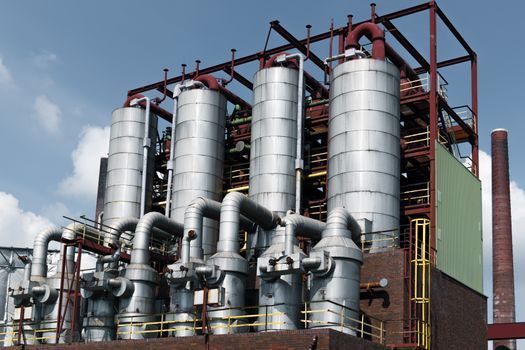
For a process engineer selecting a type on a fixed budget, four practical options line up against cost, footprint, pressure rating, and cleanability. Plate-and-frame heat exchangers have the lowest capital cost per kW at low pressure and clean service, but require gasketed maintenance access. Brazed plate heat exchangers (BPHEs) eliminate gaskets by vacuum-brazing stainless plates, raising pressure and temperature rating while reducing footprint, at the cost of non-cleanability — once fouled, the unit is typically replaced rather than opened. Shell-and-tube units dominate high-pressure, high-temperature, and two-phase duty, with retubing extending service life rather than scrapping the shell. Air-cooled finned exchangers (dry coolers) eliminate water-side fouling and water consumption entirely, at the cost of larger footprint and fan power. [S1]
The pressure transmitter and flow meter instrumentation paired with each type also moves total cost: a shell-and-tube condenser with NACE MR0175 sour-service trim will carry instrumentation multipliers that an air-cooled glycol loop will not. The cleanest cost-control rule is to size the cheapest geometry that meets the highest pressure and cleanability constraint, then spend the savings on heat treatment furnace-qualified welding procedure specifications if the duty is two-phase. Rotary regenerative exchangers, described in Chinese-language technical references as a separate class with rotating matrix elements, sit outside this four-way comparison and are typically justified only on large air-handling heat-recovery duties [S7].
Total cost of ownership: purchase, install, retube, energy
Capital cost is the smallest line item on a 20-year horizon for most shell-and-tube and plate heat exchanger fleets. RetubeCo's value proposition is built explicitly on the statement that "replacement is rarely practical" for main steam condensers, and that retubing and repair offer the most cost-effective path to restoring performance and preventing prolonged downtime [S2]. That positioning matches published field practice: a 100-year-old Heat Exchanger Shop in Watertown, MA runs a full-service repair facility providing hydrostatic testing, cleaning, and retubing, including scheduled service and emergency turnaround, precisely because the shell and the channel head typically outlast the tubes by a factor of three or more [S3].
Energy cost is the second-largest line and is where VFD-controlled dry coolers earn their US$7,000-7,500 premium for data-center IT loads [S4]. The third line, installation, is dominated by footprint and rigging weight, both of which are why ScienceDirect flags size and footprint as the dominant selection factor in many plant builds, not capital cost [S1]. For a worked example of multi-line cost math on a different capital equipment class, see the Truck-Mounted Crane TCO 2026 breakdown, which uses a parallel five-cost-line framework.
What to verify before accepting a quote

Three contract terms decide whether a quoted price is real. First, confirm the ASME stamp and pressure-class rating — a U-stamp versus U3-stamp versus no-stamp at all will move the price by 20-40% on the same geometry. Second, confirm the tube material and wall thickness in writing; titanium Grade 2 versus Grade 7, or 304L versus 316L stainless, will move the quote by double-digit percentages with no visible change in envelope dimensions [S6]. Third, confirm the retubing lead time and field-service scope, since the same OEM will quote 50% lower capital cost if the buyer accepts a 16-week retube lead time versus a 4-week emergency turnaround [S2][S3].
RetubeCo maintains an in-house welding shop, tool shop, and full-time W4 workforce that performs code-certified high-pressure welding, and explicitly states that "if we can't fix something, we guide you toward the best alternative" [S2]. Heat Exchanger Shop holds authorized distributor status for Bowman, SWEP, Thermal Transfer Products, and TFI Everhot, and stocks pre-engineered units for fast shipment alongside specially engineered builds [S3]. For a parallel reference on how a different capital-equipment class is structured around spec bands and TCO math, see the Electronic Load Price 2026 cost-driver map.
Where the market is moving
Two structural signals are worth tracking. First, the explosion of 78,648 catalog SKUs on a single B2B portal as of mid-2026, including adiabatic dry-cooling systems and VFD-controlled data-center plate coolers, indicates that the market is bifurcating into commodity stainless plate units and engineered VFD-controlled packages for hyperscale IT loads [S4]. Second, the persistence of multi-decade service-oriented shops (100-year Heat Exchanger Shop, decades-tenured RetubeCo crews) confirms that the retubing-and-repair aftermarket remains a structural feature of the industry rather than a residual one [S2][S3]. A practical next node is to request a retubing-only quote alongside any new-unit quote on existing shell-and-tube assets, since the retube number is the credible floor for total lifecycle cost on any installed base older than ten years.