
Pressure vessel selection is governed by the operating pressure × volume × fluid toxicity envelope defined in ASME BPVC Section VIII, with Chinese GB 150 serving as the dominant domestic code for non-export builds [S1]. Low-pressure vessels in the Made-in-China catalog index 2026 listings explicitly segmented by material, complexity, and exporter track record, signalling that buyers should sort on those three axes first [S1].
Custom vessels, as opposed to catalogue-standard air receivers, routinely need 8-16 weeks of lead time once weld procedure specification records (WPS/PQR) and ASME U-stamp or U2-stamp certification enter the critical path [S2]. Jiangsu Green Leaf Boiler Co., Ltd., founded 1958 in Zhenjiang, is one of the older Chinese shops running utility boiler and pressure vessel work under that same WPS regime [S2].
Code Basis: ASME Section VIII Divisions vs GB 150 vs PED
ASME BPVC Section VIII splits pressure vessel rules into Division 1 (rules-based, no fatigue analysis required) and Division 2 (alternative rules, requires detailed stress and fatigue analysis for higher-pressure lethal-service duty) — picking one locks in weld joint efficiency, allowable stress, and NDE coverage [S1]. Buyers specifying into Europe must additionally meet Pressure Equipment Directive 2014/68/EU, which uses fluid group and PED category (I-IV) driven by PS × V; Chinese domestic builds run on GB 150-2011 with HG/T or TSG 21 oversight [S3].
For a 1.0 MPa saturated-steam carbon-steel shell of 5 m³, Division 1 typically lands a Category 1 PED module, while the same vessel carrying H₂S above NACE MR0175 limits re-classifies into Division 2 or PED Category IV with full impact testing at -46 °C. The arrival-inspection doctrine — “THE ARRIVAL INSPECTION OF PRESSURE VESSEL MUST BE STRENGTHENED” — is reflected in multiple Chinese QA bulletins, reinforcing that ex-works certificates (mill cert, hydrostatic test report, radiographic film) are the buyer's first line of defense, not the last [S3].
Material and Wall-Thickness Logic
Wall thickness follows the Barlow-formula-derived path: t = (P × R) / (S × E − 0.6 × P) with S as allowable stress, E as joint efficiency (1.0 for fully radiographed, 0.85 for spot, 0.70 for none), and corrosion allowance typically 1.5-3.0 mm added on top of calculated t [S1]. Carbon steel SA-516-70 dominates for -29 to +425 °C non-corrosive service; SA-387-11/22 (1.25Cr-0.5Mo) takes over for 425-595 °C hydrocracker and boiler feedwater duty, while SA-240-304L/316L stainless is selected for clean-side pharmaceutical and food builds.
Where service crosses NACE MR0175 sour-service limits (H₂S partial pressure above 0.0003 MPa), carbon steel is restricted unless hardness is held to HRC 22 max and the plate carries a sour-service certificate. Vessel-opening reinforcement — nozzle pads, reinforcing pads, and integral saddles — is solved with area-replacement rules per UG-37 of Section VIII Div.1; a mis-applied nozzle is the most common cause of the “hydraulic crack of a pressure-vessel case” failure pattern documented in Chinese failure-analysis literature [S3].
Comparison: Air Receiver vs Steam Drum vs Reactor vs Heat-Exchanger Shell
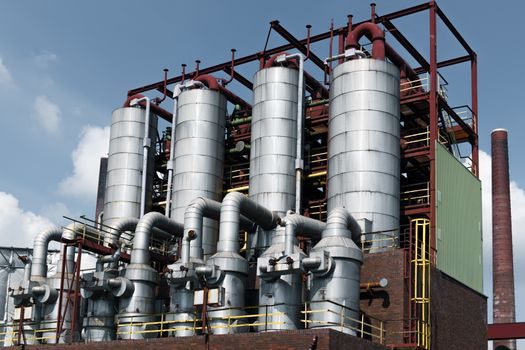
Air receivers (small, low-pressure, carbon steel, 0.8-1.6 MPa, Division 1 rule-of-thumb design) are the catalogue-stock item where price is the dominant decision factor [S1]. Steam drums (medium pressure 4-12 MPa, SA-516-70 + stainless-clad strip, internal cyclones) shift the decision to WPS qualification and shop NDE capacity. Reactor vessels (process-side agitator mount, often jacketed, dimpled, or half-pipe coil) demand torque-resistant nozzle design and typically a U2-stamp rather than U-stamp.
Heat-exchanger shells (TEMA C/B/A, with channel/bonnet) are coded as pressure vessels and add the complication of floating-tube-sheet expansion. Across the four types, the dominant criterion rotates: for the air receiver it is landed cost, for the steam drum it is weld-procedure track record, for the reactor it is mechanical-design margin and agitator-side load case, for the heat-exchanger shell it is thermal-expansion tolerance [S2]. Buyers who default to a single shop without confirming which family is the shop's core competency usually pay 15-25 % more for the same drawing because the shop's tooling and WPS library do not match the duty.
Manufacturer Vetting on a Chinese Sourcing Run
The Made-in-China sourcing guide pushes buyers toward manufacturers with custom-vessel experience, competitive price agreements, and an export record — that is the same three-axis filter applied to low-pressure vessel pricing, where material grade, design complexity, and shipping terms drive the spread [S1]. A legitimate shop will produce an A1/A2-class pressure-vessel manufacturing licence (issued by China's SAMR via the provincial market regulator), a U/U2/U3 ASME stamp if export-bound, and a documented WPS/PQR library keyed to the actual plate grades offered.
For reactor-class work, audit the welding engineer headcount: Chinese job ads consistently require “at least 5 years welding engineer working experience, pressure vessel industry is preferred,” which functions as a minimum competency floor rather than a target [S3]. Shops below that bench depth should be excluded from sour-service, ethylene, or high-temperature hydrocracker bids regardless of headline price [S2].
Instrumentation and Interface to the Loop
Every pressure vessel in instrumented service needs at minimum a pressure gauge on the local panel, a pressure switch hard-wired into the ESD loop, and a pressure sensor feeding the DCS via 4-20 mA + HART for trim and diagnostics. For safety-instrumented-function (SIL) service the pressure switch trips independently of the DCS, and the pressure sensor carries a separate proof-test interval keyed to the SIL target. [S1]
Calibration discipline falls on a pressure calibrator dead-weight or electronic reference with traceability to a national institute (NIM, NIST, NPL); annual re-cal is the typical interval for asset-class vessels in continuous service. On the mechanical side, the linear guide and crossed-roller guide families matter only for sliding-cover furnaces or travelling manifolds around the vessel, not for the pressure boundary itself, but they show up in batch-furnace and pusher-conveyor bids adjacent to the vessel scope.
Inspection, NDE, and Acceptance
Acceptance testing on a hydrostatically tested carbon-steel shell typically covers 100 % radiographic or ultrasonic volumetric NDE on Category A and B welds, magnetic-particle or dye-penetrant on the rest, plus a 1.5 × design-pressure hydrostatic hold for 30 minutes with no pressure drop and no visible leak or weep [S3]. Documentation handed over at arrival is the buyer's only objective evidence of code compliance: mill cert, WPS/PQR map, NDE reports, hydrostatic chart, nameplate photo, and the U/U2 data report if the vessel is ASME-stamped.
The opening-inspection reinforcement — “AT LEAST 5 YEARS WELDING ENGINEER WORKING EXPERIENCE, PRESSURE VESSEL INDUSTRY IS PREFERRED” — is the same filter that should be applied to the buyer's incoming-inspection team, not only the supplier's fabrication team [S3]. A 72-hour arrival window for visual + dimensional + document review before off-loading is cheap insurance against a 12-month latent defect.
Selection Logic and Shortlist
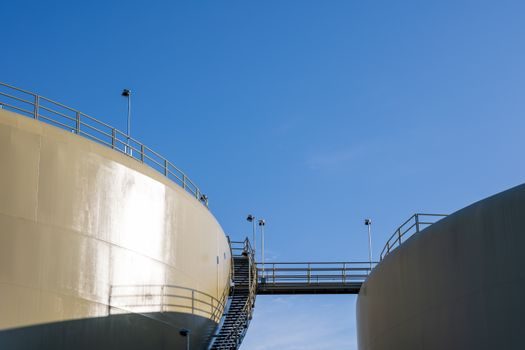
Buyers who should NOT pick a Division 1 / GB 150 carbon-steel shell include anyone with cyclic-fatigue duty (compressor suction pulsation, thermal cycling above 10⁴ cycles), lethal-service fluid above the threshold in UW-2, or sour H₂S above NACE MR0175 — those projects need Division 2 + impact-tested plate + sour-service certificate regardless of apparent cost penalty. Buyers who should NOT pick a shop from price alone are the ones with reactor-class geometry, jacketed walls, or ASME U2-stamp demand. [S1]
For an industrial air-receiver duty, shortlist three or four Chinese shops on (a) A1/A2 licence status, (b) WPS/PQR map keyed to SA-516-70, (c) 100 % RT or UT capacity in-house, and (d) verified export record under ASME U-stamp [S1]. For a steam-drum or hydrocracker vessel, shortlist on WPS library breadth and the best retaining ring for power generation compatibility of internal fittings, since the drum typically mates to a generator or turbine train. Reactor bids should run alongside a parallel industrial mixer selection guide review so the agitator nozzle torque case is sized in the same pass, not retrofitted after fabrication.
Trackable signals over the next two quarters: the China General Administration of Market Regulation (SAMR) updates to the A-class licence list, any revision of GB 150 successor standards, and the post-2025 PED 2014/68/EU enforcement notes for vessels imported under the “China Export Pressure Vessel Quality License.” Pair those with on-site weld-procedure map review and an arrival-inspection hold — that sequence catches the failures the catalogues do not show.