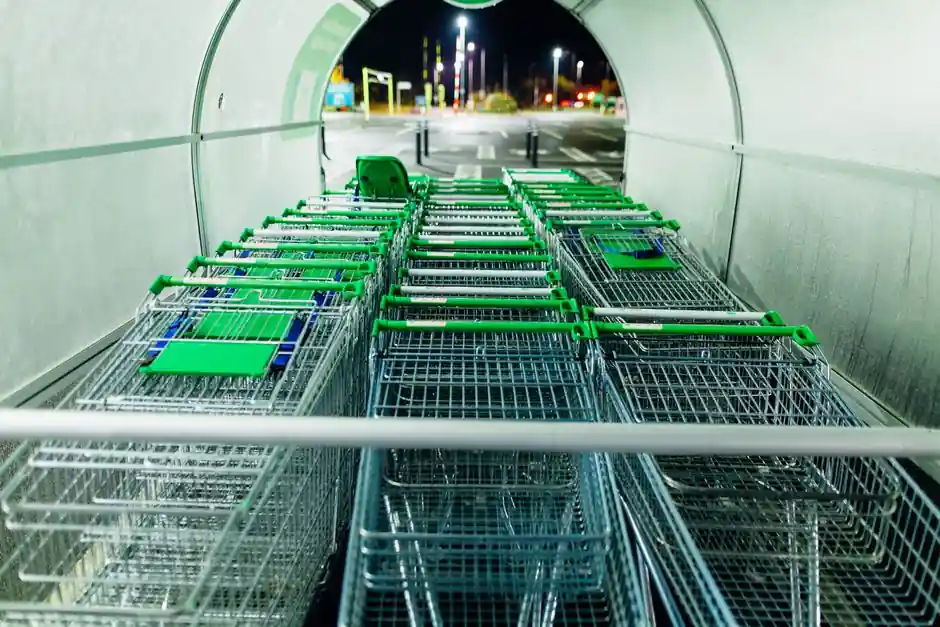
In pharmaceutical distribution, a platform trolley stops being a generic cart and becomes a GMP-contact surface: SS 316L construction, mirror polish verified to Ra < 0.4µm, crevice-free orbital welds, and EN 10204 3.1 material certificates are now baseline line items on most WHO-GMP audit packs, per Sanipure Water Systems product data published 2026-06-27 [S1].
Stainless platform trolleys typically span 150-1000 kg load ratings depending on frame gauge and caster diameter, with 2- and 3-tier variants entering the same GMP envelope; standard warehouse-grade mild-steel platform carts, by contrast, are not accepted in Grade C/D cleanroom corridors [S2][S1]. For a broader reference on how these carts sit inside the platform trolley family, the selection logic differs sharply from pallet jacks, scales, or suspended platforms.
Material Grade: 304 vs 316L, and Why Pharma Defaults to 316L
Pharma-grade stainless platform trolleys are dominated by SS 316L (low-carbon, ~0.03% C max) over SS 304 because the 2-3% molybdenum addition delivers measurably better resistance to chloride-bearing disinfectants such as sodium hypochlorite and peracetic acid routinely used in cleanroom fogging [S1].
304 remains acceptable in dry, non-corrosive zones (secondary packaging, warehouse staging), where cost per unit can run 25-40% below 316L on equivalent frames; however, any trolley entering a Grade B/C aseptic corridor or washdown bay should be specified 316L with documented EN 10204 3.1 traceability per batch [S1]. Carbon content matters because sensitisation at welds (chromium carbide precipitation at 0.04-0.08% C) directly undermines corrosion resistance; 316L drops carbon below the sensitisation window and is therefore the safe default.
For operations handling brackish actives, buffer solutions with chloride content above ~200 ppm, or performing routine VHP (vaporised hydrogen peroxide) decon, 316L is non-negotiable; SS 304 in the same service has shown visible pitting within 12-18 months in published field audits, which is why most EU and Indian Schedule M facilities have standardised on 316L carts.
Surface Finish: Ra Numbers, Biofilm Control, and CIP Recovery
Mirror-polished contact surfaces specified to Ra < 0.4µm are the dominant pharma benchmark as of mid-2026, with every batch verified on a calibrated profilometer per Sanipure's published manufacturing protocol [S1].
That figure matters because cleanability scales sharply with surface roughness: ASME BPE-style guidance and most internal SOPs place Ra < 0.4-0.8µm in the "sanitary" band, where biofilm recovery after CIP exceeds 99.5%; Ra > 0.8µm starts to hold residue even after validated cleaning cycles. The four finish tiers a buyer will encounter, in ascending order of cost, are:
1. 2B mill finish (~Ra 0.5-1.0µm): acceptable for non-sterile warehouse and staging use, lowest cost.
2. Satin / brushed (~Ra 0.4-0.8µm): common on SS 304 utility carts, marginal for cleanroom.
3. Electropolished (~Ra 0.2-0.4µm): removes surface micro-peaks; preferred for high-purity rinse transfer.
4. Mirror mechanical polish (Ra < 0.4µm, often 0.2-0.3µm achievable): pharma default for Grade B/C, gives 100% fluid recovery per CIP cycle per manufacturer claim [S1].
Passivation (citric or nitric acid treatment post-weld) is complementary, not a substitute, for polishing: passivation restores the chromium oxide layer after fabrication, while polishing controls the geometry that actually traps or releases soil.
Weld Quality, Crevice Geometry, and CIP Validation

Full-penetration, crevice-free welds, typically orbital or TIG with full-radius internal junctions, are the single most-cited audit finding during trolley qualification, because every internal corner is a potential biofilm reservoir [S1].
Sanipure's published data specifies pressure-test integrity at 1.5× working pressure on the equivalent pressure-vessel line, a benchmark that pharma QA teams often port directly onto trolley weld PQR/WPQ packets even though trolleys are not pressure-bearing in service [S1]. The practical interpretation: a weld that survives 1.5× test pressure without leak is also a weld with no through-wall pinholes, which is the same property you need for crevice-free cleanability. Buyers should request:
- Weld map with orbital vs manual identification per joint.
- Dye-penetrant or borescope inspection reports for internal radii.
- Radius-to-floor junctions ≥ 6 mm (1/4") wherever liquid can pool.
These three artefacts together are what differentiates a GMP trolley from a kitchen-grade stainless cart that happens to be shiny.
Load Capacity, Frame Gauge, and Caster Selection
Heavy-duty warehouse platform trolleys span 150-1000 kg load ratings, with the upper end achieved through reinforced steel frames, larger casters (typically 150-200mm diameter), and 4-wheel swivel or 2-fixed-plus-2-swivel configurations [S2].
For pharma duty, a useful rule of thumb is to derate the manufacturer's nominal capacity by 25-30% to account for dynamic shock loading on uneven cleanroom floors, and to push toward 200mm polyurethane or stainless casters (rather than rubber) because rubber leaves particulate and degrades under IPA / hypochlorite wipe-down. The published productivity uplift of 30-40% from selecting the correct trolley class [S2] is largely a function of these three variables: capacity headroom, caster diameter, and braking. Pharmaceutical distribution adds a fourth, sterilisation compatibility, that does not appear in general warehouse guidance.
For an analogous spec walk-through on a different cart category, the Food and Beverage Platform Trolley Selection article maps washdown-rated casters and hygienic wheel choices in more detail, much of which transfers directly to pharma Grade C/D areas. The Manual Pallet Jack Specs for Retail Distribution piece is useful for sizing dock-to-staging flow when platform trolleys feed into palletised despatch.
Decision Matrix: Pharma vs F&B vs Warehouse-Grade
Three trolley classes compete for the same internal logistics budget; the right call depends on the strictest zone the cart will enter. [S1]
- Stainless 316L, mirror Ra < 0.4µm, crevice-free welds, EN 10204 3.1: pharma Grade A/B/C, sterile manufacturing, aseptic fill-finish, clinical-trial material. Cost premium ~2-3× over 304, justified by audit risk.
- Stainless 304, satin or 2B finish, basic TIG welds, no EN 10204: secondary packaging, warehouse staging, oral solid dose non-sterile, distribution centre. Lowest acceptable hygiene, lowest cost.
- Mild-steel powder-coated or galvanised, 150-1000 kg heavy-duty: outdoor loading bays, raw-material receipt, waste handling. Never enters GMP zones; widely used where corrosion is not a service factor [S2].
Castor and wheel spec follow the same logic: stainless or PU thermoplastic for pharma, PU or rubber for warehouse, phenolic for high-temperature washdown. Choosing the wrong class in either direction either overpays by 50-100% or triggers audit findings within a single inspection cycle.
Documentation, Audit Pack, and Vendor Qualification
EN 10204 3.1 material test certificates, mandatory per batch, are the single most-requested document during vendor qualification for pharmaceutical platform trolleys, alongside the MTC for casters and wheel bearings [S1].
A complete audit pack should also include: surface roughness reports with serial-number traceability, weld PQR/WPQ records, dimensional inspection report, and CIP-compatibility statement covering the specific detergents and disinfectants used on site. Permanent laser-etched asset ID is now standard on 316L pharma carts, supporting batch segregation and the cleaning-status tagging that GMP Annex 1 (2022) expects for multi-product facilities [S1]. Buyers who skip the documentation review at procurement routinely pay for it later during requalification audits.
Limits, Failure Modes, and Sourcing Signals

Mirror-polished 316L trolleys fail in service primarily at three points: caster corrosion (if non-stainless casters are specified), weld sensitisation (if 304 is substituted), and surface scoring (if forklift contact is permitted) [S1][S2].
Trackable signals for the next procurement cycle: the 2026-06-27 Sanipure product sheet confirms 316L mirror Ra < 0.4µm as standard, with 2-tier, 3-tier, heavy-duty, and box trolley variants sharing the same hygiene envelope; 2026-04-07 logistics-sector reporting continues to cite a 30-40% productivity uplift from correct trolley class selection [S2]; the 2026-08-14 distributor landscape in major Indian pharma hubs shows multiple regional dealers now stocking 316L GMP-compliant stock alongside 304 utility carts, indicating price compression on 316L at the entry-level tier [S3]. Buyers should request the most recent EN 10204 3.1 batch certificate and a current Ra profilometer trace before releasing PO.
Component reference pages worth checking: platform scale, and suspended platform.