
Field maintenance data show that pneumatic nail guns used for HVAC duct and insulation fastening fail most often from three causes: wrong lubricant (ATF, motor oil, hydraulic fluid, acetone), storage below 32°F, and shop-air pressure above 120 psi [S1]. A disciplined oil, grease, and pressure routine keeps framing, roofing, and finish nailers firing on ductwork, fiberglass duct board, and exterior insulation without the chronic misfires that cost HVAC crews hours every week.
For HVAC crews, the nail gun is a daily driver alongside the pneumatic actuator and stapler on every duct and register run, so its downtime lands directly on the installer's productivity. The maintenance rules below are distilled from a contractor-supply trade article [S1], a year-round service guide [S2], and a field-style tool guide [S3], and they apply to both framing nailers on duct-support hardware and finish/brad nailers on trim and register covers.
Lubricant Selection: Air-Tool Oil Only, White Lithium for Metal Joints
Air-tool oil is formulated to maintain separation from impurities and provide a small level of water dissipation, which ordinary engine lubricants cannot do, and switching to ATF, motor oil, or hydraulic fluid causes O-rings, bumpers, and the white plastic wear parts inside a nailer to swell, crack, and fail in a short period of time [S1].
For sliding metal contact points where grease is needed, white lithium grease outperforms wheel-bearing or axle grease because its lower weight, smaller particle size, and lower concentration reduce friction while still giving good adhesion and a moisture barrier; heavy greases pack into the small clearances of a nailer and starve the moving parts [S1]. Acetone and antifreeze additives are explicitly not recommended in air lines, since they attack the same plastic and elastomer parts [S1]. When winter storage drops below freezing, the tool oil itself should be a cold-grade variant with anti-freeze additives, and the tool room should stay above 32°F, which is the threshold the maintenance guide calls out for prevention [S1].
Air Pressure vs. Air Volume: Stay in the 70–120 psi Window
Most pneumatic nailers are designed to run on 70–120 psi at a specified CFM; pressure above 120 psi shortens the life of internal O-rings and bumpers and is one of the leading causes of chronic air-bleed exhaust and "fsssst" failures that contractors describe [S1]. Low air volume (insufficient CFM from the pneumatic conveyor line or compressor) is the more common hidden cause of misfires, so raising pressure to compensate only accelerates seal wear [S1].
Symptoms that point to volume starvation rather than low pressure include nails not driven flush or set below the surface, skipped shots under load, and intermittent jams that clear with a brief rest; the corrective action is a larger compressor, a larger supply line, or shorter hose runs, not a regulator turned up past 120 psi [S1]. HVAC crews running multiple guns off a single pneumatic cylinder manifold should spec the compressor CFM at 1.5× the nameplate draw of all simultaneous tools, which is the practical buffer the contractor-supply article implies when it warns that "low air volume" causes the failure pattern above [S1].
Cold-Weather Storage and the 32°F Threshold

Storing nailers in an unheated truck or jobsite trailer below 32°F lets moisture that has condensed inside the air passages freeze, which cracks the same plastic and elastomer parts that wrong lubricants attack; the prevention rule in the trade article is to keep tools in a heated space above 32°F and to use air-tool oil blended with anti-freeze additives for winter jobs [S1].
Year-round service guidance echoes this, framing cold-weather damage as a routine, not exceptional, failure mode and tying it directly to the air-supply side of the pneumatic tool chain [S2]. For HVAC work that often starts on cold rooftops or in unconditioned mechanical rooms during shoulder seasons, the practical fix is a heated van, an insulated job box, or a 10-minute warm-up on shop air at 80 psi before going onto the deck.
Matching the Nailer Type to the HVAC Fastening Task
The This Old House tool guide breaks pneumatic nailers into five families: brad nailers for delicate trim and thin materials, finish nailers for trim, moldings, and fine carpentry, flooring nailers for hardwood, framing nailers for heavy-duty construction, and roofing nailers for shingles and underlayment [S3]. HVAC crews typically use a framing nailer for duct-hanger strapping and sub-floor work, a roofing nailer for mod-bit attachment on flat-roof curbs, and a finish or brad nailer for register covers, trim returns, and line-covers around marine HVAC-style equipment enclosures.
Gauge selection matters: 15-gauge is the thickest common option (1.25–2.5 in. length range) for heavier trim, while 18- and 23-gauge fire finer fasteners for delicate moldings, and the general rule is "a nail two and a half times the thickness of the plank" [S3]. For HVAC trim and register covers, 18-gauge brad nails are the common pick; a single gun does not cover every task, so crews should expect to keep two or three types on the truck and load each with the correct collation angle and gauge [S3][S4].
Daily, Weekly, and Seasonal Service Intervals
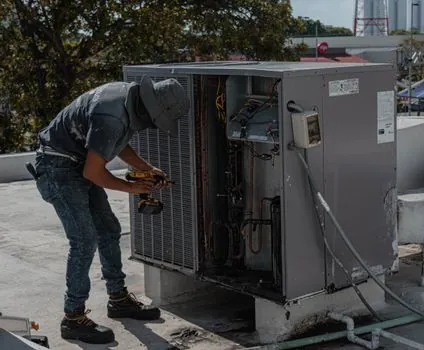
The service rhythm the year-round guide recommends breaks maintenance into a quick daily step and a deeper weekly and seasonal step: before each shift, a few drops of air-tool oil into the air inlet, a 5–10 second purge, and a check of the O-rings and bumpers; weekly, a teardown wipe-down and re-lube of the moving parts; and seasonally, a full inspection of seals, the trigger mechanism, and depth adjustment [S2].
Acceptance criteria after service are straightforward: a clean exhaust on every shot, no continuous air bleed at the cap, and nails driven flush or to a set depth with no skipped strikes. If a tool continues to misfeed or blow air after two service cycles, the trigger valve or the head valve is usually the failure point and replacement is more economic than repair, which matches the trade-article line that chronic misfires after the wrong-lubricant damage are scrap, not service items [S1][S2].
Comparison: Common Lubricants and Their Effect on Nailer Internals
The table below lines the four most commonly substituted fluids against the criteria a contractor actually cares about: compatibility with O-rings and white plastic, water-shedding behavior, suitability as a daily in-line oil, and cold-weather performance, drawn from the contractor-supply trade article [S1].
Across the comparison, the only line of products rated "Yes" for daily air-line use is dedicated air-tool oil, and the only grease rated for internal metal contact is white lithium; every other common substitute fails at least one of the four criteria [S1].
Limits of Field Repair: When to Send the Tool Out
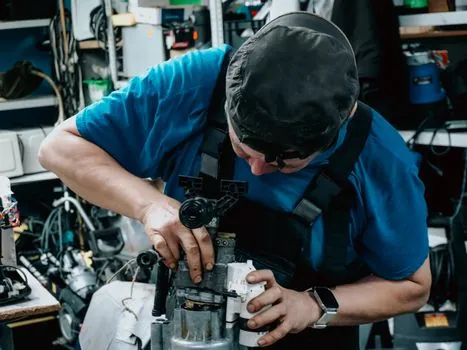
Field-level maintenance covers lubrication, pressure regulation, and seal inspection, but it does not cover head-valve seat damage, cracked magazine castings, or worn driver blades; once a tool fails the dry-fire test or shows scored cylinder walls, it is a shop repair, not a truck-bed fix [S1][S2]. For an HVAC crew running two or three pneumatic nail gun models, the rule of thumb is that any tool that has been run on the wrong lubricant (ATF, motor oil, hydraulic fluid, or acetone) is no longer serviceable in the field, because the O-ring and bumper damage is cumulative and will keep surfacing as chronic exhaust leaks [S1].
Trackable signals to watch over the next service cycle: a measurable rise in shop-air pressure at the regulator (compressor drift above 120 psi at the gun is the first warning), any return of the "fsssst" exhaust after a clean re-lube (head valve suspect), and visible swelling or cracking on the white plastic end-cap or bumper (immediate teardown). For related upstream spec work on industrial solvent choice for cleaning metal and plastic parts before re-assembly, see this industrial solvent selection reference for construction sites, and for lubricant chemistry that intersects pneumatic seals, the electronics lubricant selection guide on plastic compatibility covers the same elastomer rules from a different angle.