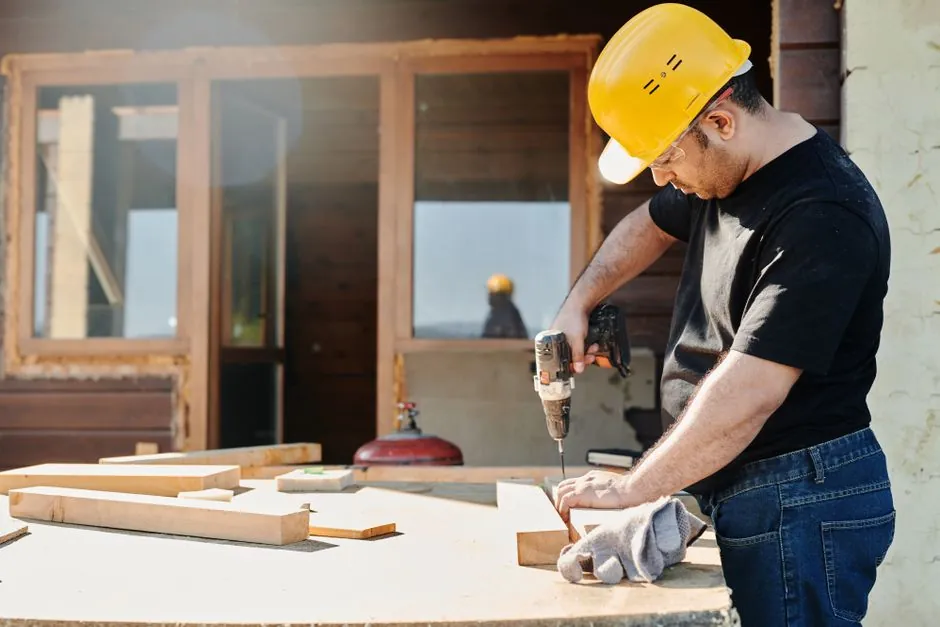
A standard pneumatic nail gun is rated for compressed air only, with a maximum working pressure of 0.8 MPa (8.3 bar) and a typical operating window of 60-100 PSI (4-7 bar), as specified for the SF5040 dual-purpose 18 Ga. brad/staple model [S1]. That pressure class is suited to wood, plywood, and thin boards, not concrete or fired brick, where fastener kinetic energy is the limiting factor rather than air supply pressure.
Masonry substrate nails require either a dedicated concrete nailer (a sub-class of pneumatic nail gun) firing hardened concrete pins, or a powder-actuated tool; a generic brad nailer driven harder will either sink flush, ricochet, or damage the magazine. Wholesale listings for concrete-rated pneumatic brad nailers cluster in a US$45-55 FOB band at 2-piece MOQ on industrial sourcing catalogs [S3], giving buyers a baseline for budget evaluation.
Operating Envelope: Pressure, Weight, and Fastener Geometry
The SF5040 specification sheet states required pressure of 60-100 PSI (4-7 bar), max pressure of 120 PSI (8.3 bar), 100-piece magazine capacity, and a tool mass of 1.5 kg (3.3 lb) in a 55 x 245 x 250 mm housing [S1]. The manufacturer explicitly prohibits oxygen, flammable gases, and high-pressure air compressors as the power source, and caps continuous-nailing duty to "limited" or single-shot disengagement operations.
For concrete substrates, those limits are conservative but instructive: the tool is single-nail per trigger pull, depth is set by an adjusting wheel, and the air exhaust is direction-adjustable, three controls that matter when fastening into dense material where rebound can stall a cycle. Note the operating ceiling is a hard 0.8 MPa (8.3 bar) regardless of compressor capacity, so a masonry-rated air compressor should be regulated, not oversized.
Substrate-First Selection: Wood, Drywall, Concrete, or Steel
Generic 18 Ga. brad/staple guns are explicitly intended for "furniture manufacturing, decoration industry, woodbox industry," that is, wood veneer, old wood, and construction templates [S1]. They are NOT specified for concrete, hollow CMU, or structural steel attachment; a buyer who routes a brad nailer into a concrete nail job will see fastener shank bending and tool damage within the first magazine.
The decision split runs four ways: (1) softwood/plywood trim, use a 15-50 mm F-type or horse-shoe brad/staple at 4-7 bar; (2) drywall to wood stud, use a dedicated drywall screw gun or narrow-crown stapler; (3) wood to concrete, step up to a concrete pin nailer, the category represented by the St64 model on the Made-in-China catalog at US$45-55/unit [S3]; (4) steel framing, switch tool class entirely to a powder-actuated or threaded fastener system. The reference pneumatic nail gun category page covers the wood-side envelope; masonry and steel each warrant their own tool class.
What a Masonry-Rated Pneumatic Nailer Must Demonstrate

Three concrete criteria separate a true masonry pneumatic nailer from a rebranded wood gun: hardened concrete pin fasteners (not brads), a magazine geometry matched to those pins (typically 15-30 mm shank length for light concrete), and a published per-shot energy or pressure profile that the manufacturer has validated on C20/25 concrete or equivalent. The catalog entry for the St64 lists it as a "Pneumatic Brad Nailer for Concrete Nails" at US$45-55 wholesale with a 2-piece MOQ, a price point that signals entry-tier OEM supply rather than premium European brands [S3].
Buyers should request three numbers from any masonry-rated candidate: (a) compatible fastener shank diameter and length range, (b) maximum allowable working pressure, matching the air-compressor regulator setting, and (c) demonstrated cycles per shift on a defined concrete strength class. The 60-100 PSI (4-7 bar) operating window of the SF5040 is too narrow for hardened concrete; expect masonry-rated tools to sit at 70-120 PSI (4.8-8.3 bar) and to require a regulator, not a direct compressor feed.
Safety Stack: PPE, Gas Purity, and Trigger Discipline
The SF5040 operating manual lists nine non-negotiable safety rules: compressed air only (no oxygen, no flammable gas), no high-pressure air compressors, mandatory safety goggles and protective gloves, regulator and pressure gauge verification before each shift, mandatory air-disconnect during reload, and a prohibition on aiming at persons or working near flammable or corrosive atmospheres [S1]. These rules carry over to masonry use with two additions: hearing protection (masonry cycles are louder than wood cycles), and hard-hat and eye-shield rated for ricocheting concrete spall.
Magazine discipline matters more on masonry than on wood: a jammed pin in a concrete nailer is harder to clear, and the "immediately disconnect air and remove all nails from the magazine for maintenance" instruction applies on every misfire, not just hard faults. Operators should also confirm the air supply is oil-free and dry; concrete dust ingestion through the exhaust is the dominant failure mode on job sites that share compressors with concrete-cutting tools.
Compressor Pairing and Air Quality

Regulated pressure of 0.6-0.8 MPa (6-8 bar) at the tool inlet is the working range for most concrete-rated brad nailers; a 50-litre tank with a 1.5-2.5 kW compressor is the floor for continuous nailing, while intermittent trim work runs on smaller 24-litre portable units. Inline filtration (5 micron particulate, moisture separator) is mandatory, and a dedicated regulator must be visible and labeled; oversizing the compressor without a regulator is a documented failure path because the SF5040 manual explicitly bans "high-pressure air compressors as the power source" [S1].
For procurement teams comparing candidates, a useful cross-check against the pneumatic reference and the pneumatic actuator reference is whether the supplier publishes a duty-cycle or cycles-per-shift figure. Suppliers that publish only "max pressure 8.3 bar" without a duty curve are typically resellers; manufacturers publishing cycles-per-shift are sourcing candidates for serious volume.
Cost Frame and Sourcing Path
Three price tiers appeared in the May-July 2026 sourcing data: entry concrete nailers (St64 class) at US$45-55 wholesale per unit, 2-piece MOQ [S3]; general-purpose 18 Ga. brad/staple guns in the sub-US$50 band on direct-from-factory channels, such as the SF5040 listing on Yiwu industrial sourcing portal [S1]; and premium or cordless hybrid units, exemplified by the GSR40 automatic rechargeable electric nail gun listed at US$597.64 per unit on secondary retail channels [S2]. The 10x price jump between entry-tier pneumatic and cordless hybrid reflects battery, electronics, and brand premium, not fastener capability.
Procurement rule: specify the substrate (concrete strength class or wood species) and required cycles-per-shift before asking for a price; vendors who skip this question are pricing the wrong tool. For related tool-class decision logic on adjacent categories, the stud welder selection for bridge construction guide covers AWS D1.5 gates that intersect masonry and steel attachment, while the pneumatic conveyor selection map covers the broader compressed-air system on which a masonry nailer is a downstream consumer.
Limits and Failure Modes Specific to Masonry Use

Three failure modes are diagnostic on a misapplied nailer: (1) fastener shank bending or fish-hooking on withdrawal, indicating insufficient kinetic energy or wrong nail geometry; (2) magazine jam from concrete dust ingestion, indicating missing inline filtration; (3) tool-frame fatigue cracks around the nosepiece, indicating the operator is forcing the tool into a substrate harder than its rating, a misuse pattern the SF5040 manual flags as prohibited [S1]. A fourth risk, regulator drift on shared compressors, is silent until a cycle fires at >0.8 MPa and the seal stack blows.
The hard exclusion: a standard brad/staple pneumatic nailer is not a substitute for a masonry insulation fastener system on rigid foam or mineral wool over CMU, where fastener pull-through and thermal bridging require a different anchor class. For interior wood-to-wood or wood-to-drywall trim, the interior finishing nail gun selection map gives the complementary spec window.
Next verifiable signals to track: a published cycles-per-shift figure for a named masonry-rated pneumatic nailer from a Tier-1 OEM, and a duty-cycle curve tied to a concrete strength class (C20/25, C30/37) on a European spec sheet; both would convert the current entry-tier US$45-55 wholesale price band into a defensible cost-per-cycle procurement benchmark.