
A conveyor cell picks tubing the way it picks an actuator: by duty cycle, pressure, temperature, and what the line actually touches. The four materials that cover 90% of compressed-air circuits in a conveyor cell are polyurethane (PUR), nylon 12, polyethylene (LLDPE/LDPE), and PTFE, each with a documented pressure/temperature envelope and a different bend behaviour [S1][S3].
Inside a cell the dominant decision is rarely the resin — it is the outer diameter (OD) for tubing or inner diameter (ID) for hose, because push-to-connect fittings, valves, and the pneumatic cylinder ports are all keyed on that dimension. Main supply circuits in cells typically run 1/4-in. to 1/2-in. OD; branch control circuits 1/8-in. to 3/8-in. OD; both metric and inch sizes exist, and the two must not be mixed on the same machine [S3].
Material envelope: pressure, temperature, and what each tube can actually carry
Nylon 12 (Series 32 in the TOPRING chart, SMC Series T/TIA) leads the pressure table: metric sizes such as T0425 and T0604 are rated up to roughly 3.0–3.3 MPa at 20 °C with air/water, falling to about 0.75–1.0 MPa near 100 °C, and operate down to −40 °C [S1][S4]. PUR LongLife holds the next tier — strong kink resistance, tight OD tolerance, working pressure ≥150 psi (~1.0 MPa) — and is the most commonly used material in flexible pneumatic circuits [S1][S3].
Polyethylene (LLDPE/LDPE) and AL.PE (PE-aluminium laminate) sit in the lower-pressure, low-cost band; PVC is the lowest-pressure commodity option and is the only mainstream flexible tubing routinely listed as food-grade by compound [S1][S3]. PTFE covers the extreme end — 500 °F (~260 °C) capability, chemical inertness, anti-static grades available — and is the right call when the conveyor cell routes near ovens, sterilizers, or solvent washdown [S3].
Spec-by-spec on the four workhorses (data points from [S1] and [S3]):
• Nylon 12 — up to ~3.0 MPa at 20 °C, −40 to ~+100 °C continuous, 800 psi (~5.5 MPa) burst class, hard/rigid, excellent chemical and UV resistance. The first choice for fixed main-supply drops and any high-pressure branch above ~1 MPa.
• PUR (polyurethane) — ≥150 psi working pressure, widest operating temperature swing among flexibles, outstanding kink and abrasion resistance, tight OD tolerance, broadest push-to-connect fitting range. Default for moving carriers, tool changers, and the last 0.5 m before the pneumatic actuator.
• Polyethylene (LLDPE/LDPE) — lower pressure rating, flexible, low cost. Useful for long, fixed, low-cycle utility air in a cell; not for high-cycle moving harnesses.
• PTFE — high heat (to ~260 °C), chemically inert, dielectric, static-safe grades available. Reserve for hot zones, solvent lines, or where no other plastic survives the chemistry.
PVC is the fifth option: cheapest, very flexible, FDA grades available, but softer and lower-pressure than PUR — appropriate only for low-duty drop lines and food-zone air where the lower cost outweighs the durability loss [S1][S3].
Sizing rules: OD vs ID, push-to-connect vs barb, and the airflow penalty
Tubing is always specified by outside diameter; hose is always specified by inside diameter; confusing the two is the single most common ordering error on conveyor-cell bills of material [S3]. Because pneumatic fittings clamp the outside of the tube, the OD drives the fitting choice and the wall thickness drives the effective bore — thicker walls on a given OD shrink the ID and choke airflow [S3].
Barb fittings sit inside the tube bore and create a measurable flow restriction; push-to-connect fittings clamp the outside and add no flow restriction, which means a smaller-OD push-to-connect line can carry the same air as a larger barb line and save both space and money [S1]. For a cell, the working rule is: pick the push-to-connect tube one OD size smaller than the equivalent barb tube, then recheck the Cv against the valve and pneumatic cylinder bore.
Main-supply circuits in conveyor cells normally sit in 1/4-in. to 1/2-in. OD (≈6–12 mm); control circuits in 1/8-in. to 3/8-in. OD (≈4–10 mm); hose for shop-air and blow-off drops is typically 1/4-in., 3/8-in., or 1/2-in. ID with NPT or quick-disconnect ends [S3]. Mixing metric and inch on the same machine is a documented mis-spec: the same nominal "8 mm" tube and 5/16-in. tube look interchangeable on a print but will not both seal in the same fitting [S3].
Vacuum conveying inside the cell: when the line is metal, not plastic
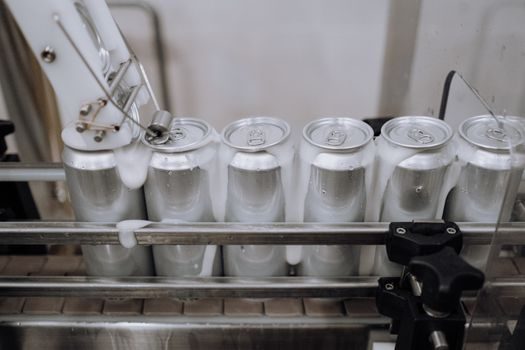
If the conveyor cell uses vacuum to move powder, pellets, or granulate, the tube/hose decision changes. Rigid metal tubing — stainless steel (304/316), carbon steel, or aluminium — is the right spec for long, straight runs because the smooth bore keeps cohesive powders moving at a consistent velocity; stainless is mandatory for corrosive product and for any food, beverage, petfood, or pharmaceutical service that must be FDA-compliant [S2].
Flexible PUR hose is the right spec for the short, bendy sections: suction wands, drum pickups, and the run up to the receiver port on a mixer, reactor, or vessel. PUR is cut-to-length, easy to clean, transparent (so the operator can see the slug), and available in food-grade, chemical-resistant, and anti-static variants matched to the powder [S2].
Most cells end up with both: a PUR suction wand or flexible drop into a section of rigid metal pipe that carries the product across the long horizontal run to the receiver. The pneumatic conveyor decision is therefore not "metal or plastic" but "where does the rigid section start and how long can the flexible section be before conveying power drops" [S2]. Keep flexible lengths short, keep bends generous, and use stainless the moment the line enters a sanitary or corrosive zone.
Compliance, environment, and the spec sheet footnotes
RoHS is now the baseline compliance citation for almost every plastic tubing line; FDA-grade nylon, polyethylene, and PVC variants are flagged separately for food-contact service, and NSF-listed compounds exist for potable-water and certain food-zone rinses [S1]. For conveyor cells that ship into Europe, request the EU RoHS declaration alongside any REACH statement on the resin; for cells exporting to North American food processors, the FDA-grade citation on the data sheet is non-negotiable.
Environmental stressors collapse a tube faster than pressure does. Nylon 12, PUR, and PTFE all carry good UV resistance for outdoor conveyor skids; PVC and standard polyethylene degrade under prolonged UV unless the compound is stabilized [S1]. Moisture absorption is the silent killer of nylon: wet nylon loses a measurable slice of its burst pressure and grows slightly in length, so humid washdown environments around a conveyor cell should default to PUR or PE rather than nylon unless the line is protected [S1].
Abrasive environments — granulate dumping stations, can-handling, glass or metal-part transfer — push the choice toward PUR (best abrasion/kink combination) or PTFE (best chemical/heat combination); standard PVC is the wrong call there because it cuts through quickly [S1][S3].
Selection logic and who should NOT pick the default
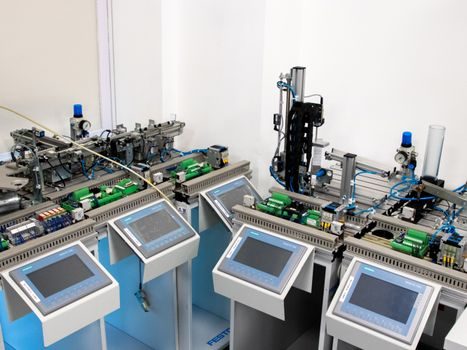
Default rule for a conveyor cell: PUR for moving harnesses and the last metre to the pneumatic actuator; nylon 12 for fixed main-supply drops above ~1 MPa; PTFE for any line that sees >120 °C or aggressive solvents; rigid 304/316 stainless for vacuum-conveying runs over ~3 m in sanitary or corrosive duty. LLDPE/LDPE only for low-pressure, low-cycle, fixed utility drops where cost dominates [S1][S2][S3].
Do not pick PUR as the default when the line is fixed, high-pressure, and runs through a hot zone — it will creep, soften above ~80 °C, and the working pressure derates quickly with temperature [S1][S3]. Do not pick nylon 12 on a high-cycle moving harness — its lower flexibility leads to fatigue cracking at the fitting within months. Do not pick PVC for any line near a heat source, solvent, or abrasive granulate: it is the lowest-cost option but the lowest-survivability one as well [S1][S3].
Before signing the BOM, validate three numbers against the cell's air-supply unit and the load cell of any integrated checkweigher: (1) tube working pressure at the cell's actual peak temperature, not at 20 °C, (2) effective ID after wall thickness is subtracted, and (3) fitting compatibility — push-to-connect vs barb vs compression — across every transition [S1][S3]. A pneumatic system sized by these three numbers plus a documented RoHS/FDA citation per line is the shortest path to a cell that runs without a tubing-induced stop.
See also our earlier report, FRL Unit vs Push-In Fitting for Pneumatic Diagnostics.
