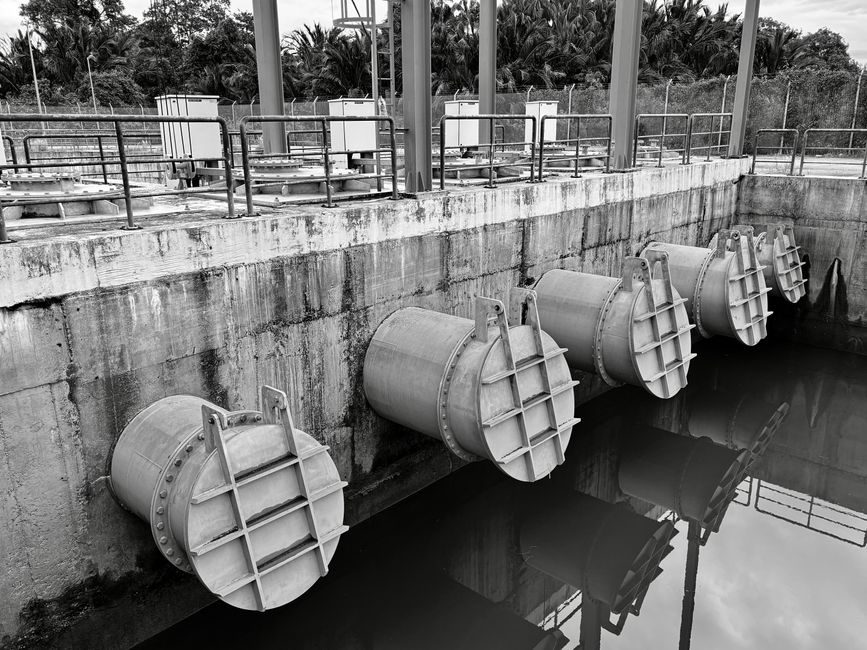
Specifying a ball valve for corrosive chemical service is a material-matching exercise first and a pressure-rating exercise second: the wetted path (body, ball, seat, stem seal) must resist the specific chemical at the operating temperature before ASME Class or flanged-end standard is even considered [S1].
Three material families dominate the duty: thermoplastics such as UPVC for low-pressure water, brine and dilute acid lines; austenitic stainless 304/316L for general oxidising service; and duplex / super-duplex or alloy 20 / Hastelloy for chloride-bearing, sour, or high-temperature chemical streams [S1][S2].
Body Material Options and Chemical-Compatibility Boundaries
UPVC ball valves are widely used on water, brine, seawater, dilute acids, and corrosive chemical-liquid lines where operating temperature stays within the polymer's published limit and pressures remain modest, with the body weight kept low for easy install on plastic-pipe rack systems [S2]. Carbon steel (ASTM A216 WCB, A105N) is acceptable only when the wetted parts — ball, seat, stem — are upgraded to stainless or alloy, because bare carbon steel corrodes rapidly in acidic, saline, or oxidising service [S1]. 304/316L stainless is the default pick for oxidising chemicals, with 316L (F316L) preferred whenever chlorides are present, and L-grade chosen over standard 304/316 to mitigate weld-decay intergranular corrosion after any field repair [S1].
For higher chloride, sour, or acid service, duplex (ASTM A890 4A/5A) and super-duplex (6A) grades deliver higher pitting and crevice-corrosion resistance than 316L, and aluminum-bronze bodies remain a niche choice for seawater and certain non-oxidising chemical duties where copper-alloy tolerance is acceptable [S1]. A352 LCC and ASTM A350 LF2 are restricted to low-temperature hydrocarbon or non-corrosive cryogenic service and should not be substituted for chemical duty on that basis alone [S1].
Seat, Seal, and Trim — Where Corrosion Actually Kills Valves
A valve body can survive the chemical; the seat is usually what fails first. PTFE (TFM) seats handle most acids and caustics up to roughly 200 °C but are limited on hard-particle slurries; PEEK seats extend temperature and creep resistance where PTFE softens; metal-to-metal seats with Stellite or alloy overlays are mandatory for high-temperature, slurry, or fire-safe service but require harder mating alloys on the ball [S1]. Stem sealing uses PTFE or graphite packings, and ISO 5211 mounting pads let a part-turn actuator be direct-mounted without bracketing, which keeps the corrosion envelope on the stem side smaller [S1].
End connections matter as much as trim: flanged ball valves dominate chemical-plant skids, threaded ends are confined to low-pressure utility lines, and butt-weld ends suit stainless systems where crevice-free, full-penetration welds are mandatory [S1]. For any lined or plastic valve, the operator's torque must stay inside the seat's published Nm value, or the seat deforms and the chemical gains a leak path.
Pressure-Temperature Rating and the Floating-vs-Trunnion Question

For chemical service, ASME pressure class (150/300/600) and the published pressure-temperature curve drive the wall-thickness call; under-sizing the class for a one-off cost saving is the single most common cause of seat extrusion and blow-out in acid service [S1]. Floating ball valves are standard up to ASME 600 and small-to-mid bore, where line pressure pushes the ball onto the downstream seat for a tighter shut-off; trunnion-mounted designs take over at larger bores and higher pressure classes because the ball is held by upper and lower trunnions, dropping operating torque and letting the seats be spring-loaded for bi-directional sealing [S1].
Top-entry and fully-welded ball valves are specified when the line cannot be depressurised for maintenance — chemical plants running continuous acid or chlorine services — because the bonnet or full-pipe weld can be removed without breaking the line [S1]. A105+ENP (electroless nickel plating) bodies are a common middle path: carbon-steel mechanical strength with a 50–75 µm ENP barrier that resists mild acid and alkaline attack at lower cost than solid alloy [S1].
Criteria-Based Comparison of the Main Material Choices
Lining the four common routes against four decision criteria makes the trade-off visible to a buyer. Use this as the first-pass shortlist before opening a vendor datasheet:
1) UPVC body with PTFE/PE seats — lowest cost per valve, lightest install, but limited to roughly ANSI 150 and ≤ 60 °C service, and incompatible with aromatic solvents, ketones, and concentrated oxidising acids [S2]. 2) 316L/F316L stainless body with PTFE seats — mid cost, broad oxidising-chemical coverage to roughly 200 °C, with the L-grade crucial if any field weld repair is anticipated [S1]. 3) Duplex/super-duplex body with PTFE or PEEK seats — higher cost, but the correct call for chloride-bearing brines, sour service, and seawater where 316L pits, with pressure ratings typically available through ASME 600 [S1]. 4) Carbon-steel body (A216 WCB / A105N) with ENP or rubber lining and alloy trim — lowest metal-alloy cost, but only viable when the lining or plating forms a continuous barrier; a single scratch defeats the system in strong acid [S1].
Selection rule of thumb drawn from the comparison: pick the cheapest material whose published chemical-compatibility chart explicitly lists the working fluid at the working temperature, then verify the pressure-temperature curve covers the worst-case upset, not the normal operating point.
Who Should NOT Pick the Default Stainless Option
For any brine with chloride content above roughly 1,000 ppm and temperatures above 50 °C, specify duplex or super-duplex; 316L will pit and crevice-corrode at gaskets and seat edges.
Avoid mixing seat elastomer with the process without checking a published compatibility table: EPDM fails in hydrocarbon service, Viton (FKM) fails in some amines and hot water/steam, and PTFE — while near-universal — cold-flows under sustained load and must be re-torqued on first thermal cycle.
Standards, Documentation, and Sourcing Checks
Specifying engineers should anchor the BOM to recognised standards: ASTM A216/A216M for carbon-steel valve castings, ASTM A105N for forged carbon-steel bodies, ASTM A352 LCC and ASTM A350 LF2 for low-temperature service, and EN ISO 5211 for actuator-mounting pad geometry so any part-turn actuator drops on without a bracket [S1]. Forged-steel bodies (A105, A105N, LF2) and cast equivalents (WCB, LCC) carry different mechanical and impact-property envelopes at sub-zero temperature, and the wrong call shows up as brittle fracture during a winter acid unloading event [S1]. Material test certificates to EN 10204 3.1 and, for sour service, NACE MR0175 compliance on wetted hard-facing, are the minimum documentary trail an EPC contractor should demand before signing a chemical-service valve PO [S1].
For buyers balancing chemical-resistance against budget, the working submersible pump reference for corrosive chemical transfer follows the same material-logic chain — wetted-end alloy first, mechanical rating second — and is worth a cross-read when a skid mixes pumping and valving duties, see this submersible-pump selection guide [S1]. Plastic storage tanks paired with UPVC ball valves form a coherent low-cost chemical loop, with resin specific-gravity duty matching valve body pressure rating, see the plastic storage tank selection guide for the upstream choice [S2].
Failure Modes and Maintenance Planning
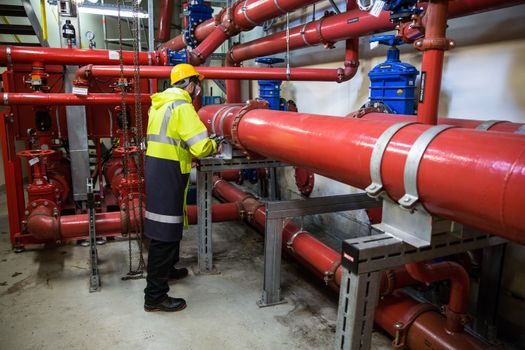
Corrosive-service ball valves fail in predictable ways: seat swelling or cold-flow from chemical attack, stem-packing leakage once the packing dries out after a long idle period, crevice corrosion under gaskets in chloride duty, and galling of the ball/seat interface when metal-seated valves are cycled dry. A scheduled annual torque-check and re-torque of PTFE seats after the first hot cycle catches most seat failures before they become releases; a documented seat-replacement kit on the shelf turns a 48-hour chemical-shutdown into a 4-hour swap. [S1]
Spec-level background on the components involved: electric ball valve, and chemical anchor.