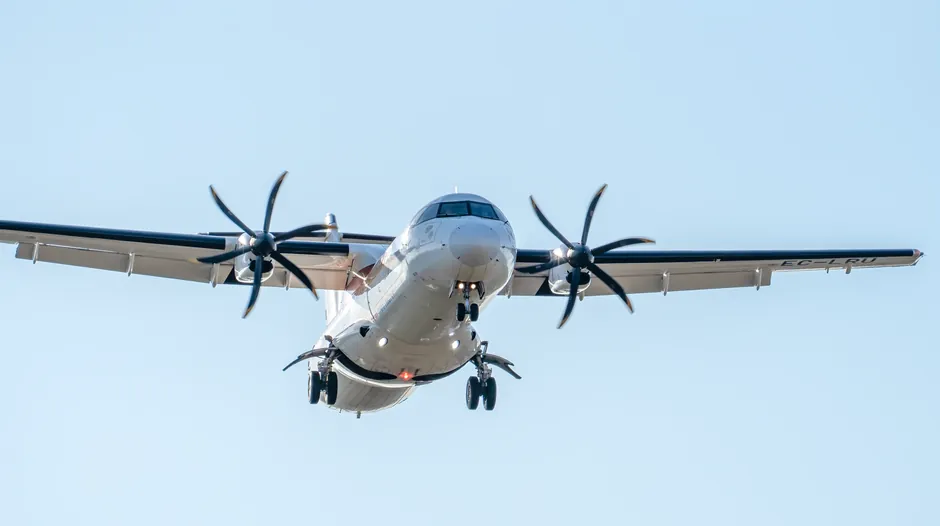
Polycarbonate (PC) holds 17% of the global aerospace plastics market as of mid-2026, with cabin interiors, transparencies, and lightweight enclosure brackets absorbing the largest volumes [S2]. Engineers pick PC where the part needs a density of 1.20–1.22 g/cm³, 90% light transmittance, and notched Izod impact strength of 600–850 J/m, which together make it the go-to amorphous thermoplastic for aircraft glazing and seating shells [S3][S1].
The trade-off is well documented: PC hydrolyses in high-pressure steam, yellows under UV without stabiliser package, and cracks under solvent attack, so aerospace specs revolve around stabilised, flame-retardant grades rather than off-the-shelf resin [S1]. The three decisions that drive every aerospace PC spec are grade family, flame/smoke/toxicity compliance, and machining or forming process.
PC Grade Families Used in Aircraft Interiors
Bisphenol-A polycarbonate (BPA-PC, formula (C16H18O3)n) dominates aerospace transparent and structural parts, while PC/ABS blends take secondary structural mouldings where paintability and lower cost matter more than optical clarity [S3][S1]. BPA-PC ships with a heat deflection temperature near 130°C in unfilled form and 135°C in the datasheet's 1.18 MPa load condition, with glass-fibre-reinforced variants pushing that to roughly 145°C and bending modulus above 2,300 MPa [S1]. For transparent cabin applications such as lens covers and light housings, unfilled optically clear grades transmit about 90% of visible light, with transmittance and refractive index comparable to cast acrylic but with 30× the impact strength [S3].
Aerospace buyers should match grade to environment: extrusion-grade PC sheet (Lexan 9034 or equivalent) for flat transparencies, injection-moulding grade for high-volume interior brackets, and glass-filled structural grade for seat components and armrest cores [S1]. Modified categories such as anti-static, UV-stabilised, flame-retardant, and glass-fibre reinforced are produced as discrete product families rather than one-off additives, so procurement should request datasheet evidence of the additive package rather than trust generic marketing claims [S1]. For comparison, common aerospace PC categories line up as: unfilled extrusion grade (clarity, moderate impact, lowest cost), glass-filled injection grade (highest modulus, lower clarity), PC/ABS blend (paintable, lower heat resistance, lowest cost), and UV-stabilised capped grade (outdoor or window-adjacent cabin parts).
Flammability, Smoke, and FAR 25.853 Compliance
Unfilled PC carries an inherent UL94 V-2 flammability rating from the base resin, with self-extinguishing behaviour and no flame-drip ignition of cotton in the standard test, but aircraft interior panels and seat components must additionally clear the FAA's 12-second vertical burn, smoke density under 200 Ds in the flaming mode, and toxic gas emission limits per FAR 25.853 [S1]. Aerospace moulders therefore select flame-retardant PC grades formulated around brominated or, increasingly, phosphorus-based FR systems that depress heat release without producing the dense black smoke that disqualifies a part on the OSU heat-release test.
Heat ageing is the second qualifier: the UL temperature index for reinforced PC reaches 120–140°C depending on glass content, which covers most cabin environments but falls short of engine-bay or APU-adjacent zones where continuous exposure above 130°C mandates polyetherimide or polyethersulphone instead [S1]. For interior transparencies, specify a UV-capped, mar-resistant hardcoat (typically a polysiloxane or acrylate topcoat) to address PC's well-known yellowing under UV and its poor scratch resistance relative to glass and PMMA [S1]. PC's dielectric constant of 3.0–3.2 and arc resistance of 120 s make it an easy choice for in-cabin electrical enclosures, a path that engineers also follow for related industrial PC panel builds on the flight-line support side.
Machining vs Forming: Process-Specific Specs
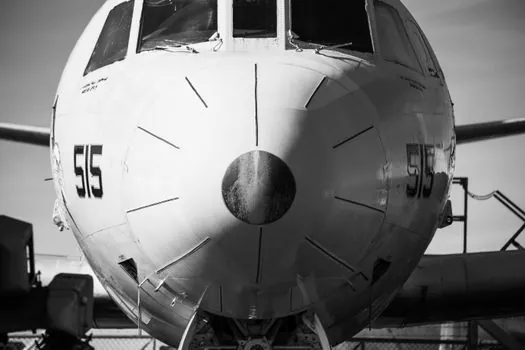
CNC routing, milling, and turning all cut PC cleanly when chip load, feed, and coolant are tuned to the resin's low thermal conductivity of 0.19–0.22 W/m·K and glass transition at 147°C, with mel <p>Forming temperatures cluster between 150°C and 180°C, well below the 155°C melting point, and vacuum forming of PC sheet yields cabin lens covers, overhead bin liners, and air duct transitions in a single draw [S3]. Bonding is the area most prone to surprise failure: the reference adhesive menu ranges from G-933 single-part elastic for vibration damping to KD-833 instant cyanoacrylate for rapid fixturing, with QN-505 and QN-906 two-part epoxies for large-area structural joints, and G-988 RTV silicone for waterproofing; UV-curable KD-5606 gives optically invisible bonds on transparent PS or PC sheet but is not for high-temperature service [S1].
Parts that will see repeated high-pressure steam cleaning should be re-evaluated, because PC's hydrolysis resistance is poor and a steriliser-grade application effectively rules out standard BPA-PC [S1]. Likewise, any application that involves contact with strong alkalis, aromatic solvents, or ketones must trigger a chemical compatibility review rather than rely on the resin's general resistance to weak acids, weak bases, and neutral oils [S1].
Mechanical Performance and Operating Envelope
The headline mechanical numbers to carry into a PC spec sheet are notched Izod impact of 600–850 J/m, tensile strength of 55–75 MPa, compressive strength of 80–90 MPa, and flexural modulus of 2,300–2,400 MPa, with elongation at break well above commodity plastics thanks to the resin's amorphous, ductile behaviour [S3]. Creep under sustained load stays low below 100°C, which is the practical upper limit for any unfilled grade running under long-duration cabin loading [S1].
Water absorption sits at 0.15–0.35% by weight, a low figure that nevertheless translates into dimensional change on long humidity cycles, so tight-tolerance optical mounts typically need dry-as-moulded storage and a controlled-humidity assembly cell [S3]. The lower operating limit drops to around -45°C, below which the material's impact behaviour begins to shift and a cold-rated grade or a PC/ABS blend should be substituted [S1]. The reference polycarbonate properties database documents the same density and Izod envelopes, useful as a cross-check against an OEM datasheet.
Selection Criteria: PC vs Acrylic vs Polyetherimide
Specify PC where impact dominates the failure mode, acrylic (PMMA) where scratch resistance and UV clarity dominate, and polyetherimide (PEI, Ultem) where continuous service temperature exceeds 150°C, and the choice becomes a four-criteria comparison rather than a single-parameter call. On impact, PC leads at 600–850 J/m versus roughly 15–25 J/m for PMMA and 50–80 J/m for PEI; on continuous service temperature, PMMA caps out near 90°C, PC near 120–135°C reinforced, and PEI near 170°C; on density all three sit between 1.18 and 1.27 g/cm³, with PC the lightest of the three; on flame-smoke-toxicity for cabin use, all three can be formulated to pass FAR 25.853, but only PC and PEI self-extinguish from the base resin, while PMMA needs a coating or additive system [S1][S3].
A practical rule for a procurement engineer: pick PC for cabin transparencies, seat shells, and lighting lenses; pick PMMA for decorative laminates and galley inserts where scratching is the main concern; pick PEI for air-handling ducting, avionics chassis, and any zone above the cabin pressure bulkhead. For tooling-side decision making on the assembly fixtures that hold these parts, the same spec-first selection discipline used in industrial fluid systems applies: do not buy the resin, buy the data.
Limitations, Failure Modes, and What PC Cannot Do
PC yellows under UV without a stabiliser cap, hydrolyses in high-pressure steam, and attacks under strong alkalis and a wide range of organic solvents, so a bare unfilled grade has no business in an engine-bay, steriliser, or fuel-tank-adjacent zone [S1]. Scratch resistance is poor relative to glass and PMMA, which is why most aircraft transparencies are factory-coated with a polysiloxane or acrylate mar-resistant hardcoat and why a refurbishment schedule for cockpit windows usually tops out at a few years [S1][S3].
Two further constraints are easy to miss at the spec stage: dielectric constant of 3.0–3.2 means PC is not a candidate for high-frequency RF-transparent radomes, where glass-reinforced PES or cyanate ester take over; and continuous load above 100°C triggers measurable creep, so a sustained cabin load path or vibration mount in a hot zone should be specified in glass-filled PEI or PPS instead. The general industrial plastics reference is a useful cross-check when an aerospace PC datasheet is being compared against a generic industrial grade that shares the same base resin but lacks the FR and UV additive package.
Sourcing, Standards, and Trackable Signals
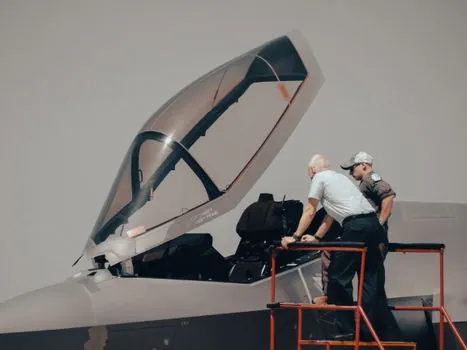
Procurement should require a grade-specific datasheet showing density, Izod impact, heat deflection temperature at 1.82 MPa (or 1.18 MPa where the datasheet is older), and an FAR 25.853 or equivalent EASA CS-25.853 test certificate from the resin supplier, plus a UV-stabiliser and hardcoat certificate from the coating supplier where the part is transparent [S1]. Lot traceability under AS9100 and a Conflict Minerals declaration are baseline requirements; ask for the OEM's manufacturing site and any post-consumer recycled content, since aerospace PC remains almost entirely virgin resin for cabin and transparency parts. The next trackable signal is the EASA and FAA's ongoing review of OSU heat-release and smoke-density test methods, and the resin suppliers' move from brominated to phosphorus-based FR systems; any new aerospace-qualified grade released in the next 6–12 months will likely carry a phosphorus-FR formulation, and procurement specs should be written to accept either system as long as the test certificate is on file.
Spec-level background on the components involved: pressure transmitter.