
POM (polyoxymethylene) is a high-density, high-crystallinity linear polymer with no side chains, used as a skeleton material in gears, bearings, automotive parts, machine tools, and instrument internals [S3].
For rail specifiers, the practical question is not whether to use POM but which family: homopolymer (POM-H) or copolymer (POM-C), and which filler package, since the rail environment imposes fire, smoke, toxicity, dimensional, and wear constraints that commodity engineering plastics do not have to meet. Knorr-Bremse's rail portfolio covers braking, entrance, HVAC, power, sanitary, and platform screen door systems across ~40 global locations, the kind of systems where plastic gears, bearings, and sliding elements in door operators, wiper linkages, and HVAC dampers are the realistic insertion points for POM [S2].
POM-H vs POM-C: chemistry, crystallinity, and processing window
POM grades split into two families, homopolymer (POM-H) from formaldehyde polymerization and copolymer (POM-C) with a small comonomer unit inserted into the chain [S3]. POM-H is the higher-performance family: higher density, higher crystallinity, and a higher melting point, which translates into better mechanical strength and harder surface for wear parts. The trade-off, and the reason homopolymer is rarely the right answer for rail, is a narrow processing window of roughly 10°C, plus weaker acid and alkali resistance [S3].
POM-C trades a small loss in peak tensile strength and surface hardness for a much wider processing window (about 50°C), better thermal stability during compounding, and markedly better resistance to hot water, weak acids, and alkalis. For rail HVAC components, door roller bearings, and sanitary flush hardware exposed to cleaning agents, the wider processing window alone makes POM-C the more forgiving material on real production lines. Both families share POM's core weaknesses that rail designers must design around: limited UV resistance, notch sensitivity, and susceptibility to stress cracking in strong acids or chlorinated media. Refer to the POM engineering plastic reference for the full property comparison.
Fire, smoke, and toxicity: EN 45545-2 hazard levels and filler choice
For any POM part inside a rail vehicle, EN 45545-2 is the binding standard, and the target hazard level (HL1, HL2, or HL3) is set by the vehicle category and the part's location (interior, exterior, under-floor, roof). HL3 is the most demanding, applied to sleepers and sleeping cars; HL2 covers most standard intercity and metro interior parts; HL1 is the lower bar for vehicles without sleeper areas. Unmodified POM does not meet HL2 or HL3 on its own, so the specifier must add a flame-retardant package, typically a melamine cyanurate or a nitrogen-phosphorus system for copolymer grades. [S2]
Glass fibre or mineral filled POM compounds are common in structural rail parts for their higher stiffness, lower coefficient of thermal expansion, and lower shrinkage, which keeps tolerances stable across the operating temperature range of roughly -40°C to +100°C for most rail interiors. Carbon-fibre-filled grades exist for sliding/anti-static parts but push cost up sharply. Note that glass fibre reinforcement tends to reduce wear life versus neat POM, so any filled grade used in a gear or bearing still needs a tribology test under the actual load and surface speed.
Where POM fits inside a rail vehicle, and where it does not
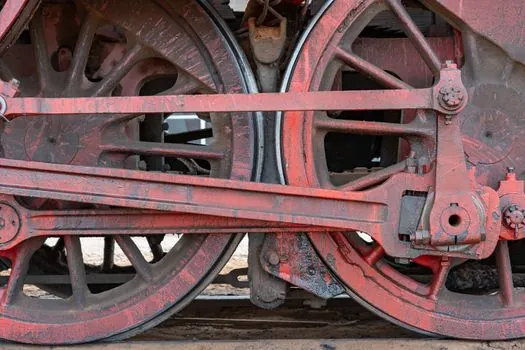
POM's strength is dimensional stability under load combined with low sliding friction, which makes it the standard pick for small gears, gear racks, bearings, bushings, rollers, cam followers, fasteners, clips, and housing shells across door operators, pantograph auxiliary drives, seat adjusters, and HVAC damper actuators. A Knorr-Bremse-type door operator, for example, may use POM rollers and gear segments that need to run quietly for a million-cycle service life under the temperature and humidity swing of an entrance system [S2].
POM is the wrong material where the application requires high continuous service temperature above roughly 100°C, exposure to strong acids, strong bases, or chlorinated solvents, prolonged UV without a cover, or very high dynamic loads above POM's fatigue limit. In those locations, PA66, PPS, or PEEK are the realistic alternatives. Inside the control cabinet, by contrast, POM is rarely used; structured cabling transitions go through metal-enclosed 19'' or DIN-rail patch panels with proven EMC shielding [S1], which is a different material conversation from on-vehicle mechanics.
Selection checklist: 5 criteria a rail spec must answer
A spec sheet for a rail-grade POM part should lock down at least five items: (1) resin family, POM-H or POM-C, with the reason stated; (2) filler system, neat, PTFE-lubricated, glass-fibre, carbon-fibre, or mineral, plus weight percent; (3) flammability rating, EN 45545-2 HL1/HL2/HL3 with the R1 requirement set number called out; (4) continuous service temperature rating, typically -40°C to +100°C for rail interior parts; and (5) tribology data, dynamic coefficient of friction against the mating material under the part's real load (PV value) and surface speed, not just generic datasheet numbers. [S1]
For comparison, neat POM-H gives the highest hardness and tensile strength, neat POM-C gives the widest processing tolerance and best chemical resistance, and glass-fibre filled POM-C sits between them on toughness but ahead on stiffness and dimensional control. Lubricated grades (PTFE, silicone, or oil-filled) shift the comparison toward wear life at the cost of slightly lower mechanical properties, and are the usual pick for unlubricated gear and bushing service.
Supply, processing, and what to verify before signing off a grade

Beyond the resin decision, the rail specifier must verify three more items before locking the part. First, ask for a lot-traceable certificate showing that the actual production lot meets the EN 45545-2 rating, not just a generic grade brochure, since the FR additive level and dispersion control the result. Second, confirm the mould shrinkage, typically 1.8-2.5% for POM-H and 1.5-2.2% for POM-C, against the part tolerance budget; tight-tolerance gears may need annealed mouldings. Third, request a hydrolytic stability or aging test result if the part sees the HVAC condensate path, since POM-C and POM-H both degrade under prolonged hot-water exposure above ~60°C. [S2]
Procurement signals worth tracking on a 6-month cadence: (a) any updates to EN 45545-2 interpretation documents from the rail industry's notified bodies, since small clarifications change which grades qualify at HL2; (b) new copolymer grades with higher continuous service temperature ratings, which open up under-floor and roof zone applications; (c) tighter supply on POM-C base resin, which has historically moved with the automotive acetal market. For adjacent spec work on related drivetrain and control hardware, see the self-aligning bearing selection for automotive production lines and the Programmable Logic Controller suppliers and manufacturers: 2026 sourcing guide.
Spec-level background on the components involved: pressure transmitter, and flow meter.