
Rigid PU insulation board in China is being quoted at a 500 m² MOQ with 100,000 m²/month supply capability per OKorder listings dated 2026-05-30, with sandwich-panel format dominating export enquiries [S4].
Spray-can one-component PU foam — the format sold through hardware and construction channels — shows a US$0.60–0.90 per-can price band on Made-in-China as of 2026-06-06, with Shandong Sailgoal New Materials Co. Ltd. quoting 750 ml/500 ml packs at a 4,000-piece MOQ and ISO 9001:2015 audit status [S3]. For an engineer pricing a project, the headline number on a per-can basis does not translate to per-m²-R-value cost; density, closed-cell content, lambda value and fire grade are the real cost drivers, as detailed in the parallel polyurethane insulation buying guide.
Spray foam, rigid board and sandwich panel: format drives unit price by an order of magnitude
Aerosol-can expanding PU foam is sold in unit counts, not square metres; the 2026-06-06 Made-in-China listing shows 750 ml/500 ml cans at US$0.60–0.90 each with a 4,000-can MOQ [S3]. For comparison, the same platform indexes 124 insulation-polyurethane manufacturers offering 372 SKU lines, and the bulk of catalog volume is moulded PU foam, custom PU parts, and corner protectors — not insulation-grade board [S2]. The implication for a specifier: can-foam quotes are meaningless for board-wall or roof-deck budgets; a separate RFQ against the rigid-board / sandwich-panel format is mandatory. Encyclopedia reference data on closed-cell PU chemistry is consolidated at polyurethane insulation.
Rigid PU insulation board and PU sandwich panel — the format that competes head-to-head with EPS board and XPS — is quoted at MOQ 500 m² with stated 100,000 m²/month supply capability on OKorder 2026-05-30 [S4]. The same listing cites a rigid-PU thermal conductivity coefficient as low as 0.0xx W/(m·K) (the listing truncates, but published rigid PU lambda values are 0.020–0.024 W/(m·K)). Sandwich-panel format typically pairs a PU core with steel or aluminium facings and is sold per square metre of panel, not per board.
Density, lambda and fire grade: the three specs that move price more than raw material
For rigid PU foam, bulk density (kg/m³), thermal conductivity (W/(m·K)) and fire / reaction-to-fire classification are the three cost axes. Higher density (typically 30–45 kg/m³ for construction-grade board, 45–60 kg/m³ for higher compressive-strength applications) raises both raw-material consumption and freight cost per m². Lambda is governed by the closed-cell ratio: >90% closed cell is the industry baseline; 95%+ commands a premium. Fire grade — typically B1 (difficult-to-ignite) or B2 (normal) under GB 8624, or Euroclass B-s2,d0 / C-s3,d0 under EN 13501-1 — is the largest single price delta, because the PIR (polyisocyanurate) modification that achieves B1/B-s2 needs a different isocyanate stoichiometry and adds cost. Encyclopedia data on rigid-foam taxonomy is at insulation board. [S1]
For spray-foam (SF) applications, the in-place density is higher (28–35 kg/m³ open-cell, 30–45 kg/m³ closed-cell, up to 55–60 kg/m³ for roofing/aggressive-traffic), and the cost is quoted per kg or per board-foot rather than per m². Insulation-grade polyols are typically sucrose- or amine-initiated polyether polyols with OH values 350–600 mg KOH/g; MDI or polymeric MDI is the isocyanate side, with the index (NCO/OH ratio) tuned for closed-cell content. Material background is in polyurethane elastomer.
MOQ, lead time and the China-export cost stack
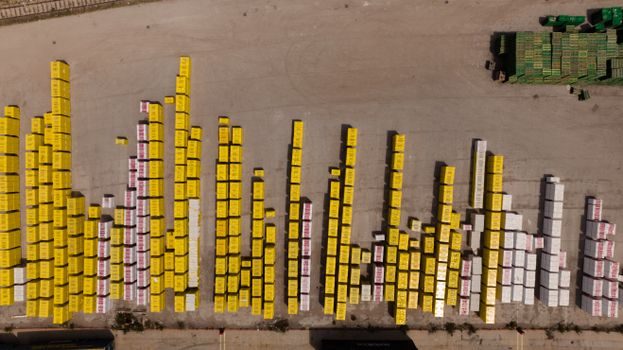
MOQ tiers observed on 2026-06 listings: 4,000 cans for spray foam, 500 m² for rigid PU board / sandwich panel, and 60 m³ for extruded polystyrene (the comparator product on OKorder) [S3][S4][S1]. A 500 m² MOQ is roughly one 20 ft container for 30 mm-thick PU sandwich panel; sub-MOQ orders are typically accepted at 10–20% price premium or with mixed-SKU loading. Supply capability for PU sandwich panel is stated at 100,000 m²/month, implying multi-line continuous production rather than batch kettle [S4].
Lead time: a Chinese PU sandwich-panel mill quoting from stock typically delivers in 10–18 days for MOQ-volume orders, 25–35 days for custom-thickness or non-standard colour facings. For spray foam in cans, lead time drops to 7–15 days because the can-filling line is decoupled from polyol blending. The 60 m³ MOQ on extruded polystyrene reflects a different supply chain (continuous extrusion line, larger minimum run) and is the reason XPS often loses on flexibility to PU for small-area retrofits [S1].
Decision matrix: PU vs XPS vs EPS vs mineral wool on the cost-R-value-freight triad
For a 50 mm-thick roof or wall insulation spec, the four mainstream options compare on three decision criteria: thermal performance, fire performance, and landed cost per m². PU rigid board (typical 0.022 W/(m·K) lambda) achieves R-2.27 m²·K/W at 50 mm; XPS (0.029–0.034 W/(m·K)) achieves R-1.47–1.72; EPS (0.032–0.038 W/(m·K)) achieves R-1.32–1.56; mineral wool (0.035–0.040 W/(m·K)) achieves R-1.25–1.43. To match the same R-value, the XPS/EPS/mineral wool thickness has to grow 30–60%, which means more freight, more fixing hardware, and more façade depth. The per-m² material cost ranking typically runs EPS < XPS < PU board < PIR-modified PU board, but the per-R-value-m² cost ranking often inverts in favour of PU once thickness-driven façade costs are added. The cross-product reading in EPS board buying guide confirms EPS density (15–25 kg/m³) is the lower bound, with lambda penalty at every kg/m³ step. [S2]
On fire performance, mineral wool is non-combustible (Euroclass A1/A2-s1,d0), PIR-modified PU is B-s2,d0 to B-s3,d0, and standard PU is C-s3,d0 to E. Encyclopedia context on the elastomer chemistry behind fire-grade choice is at polyurethane elastomer.
Failure modes and constraints that change the cost calc

Three failure modes commonly trip up PU cost engineering. First, vapour drive: closed-cell PU is a Class I or II vapour retarder at 50 mm+, but open-cell spray PU is not — open-cell SF must be paired with a separate vapour control layer, which adds material and labour cost. Second, dimensional stability at temperature: PU sandwich panels used in dark-coloured façades or near rooftop solar arrays can see surface temperatures 70–80 °C in summer, and standard PU foam begins to lose lambda performance and dimensional stability above 100 °C; for >80 °C continuous service, specify PIR or rock-wool. Third, blowing agent: legacy HCFC-141b-blown PU has a higher lambda than cyclopentane-blown PU, and the global phase-out of HCFCs under the Montreal Protocol means Chinese export product has migrated predominantly to cyclopentane and HFC-245fa — verify on the mill datasheet because the lambda difference is real and per-m²-R-value cost differs accordingly. [S3]
For pipeline and process-equipment insulation, where the operating envelope is more aggressive than building service, the linear-guide analogue for mechanical precision is at linear guide — different physics, same discipline of matching a generic catalogue listing to a specific service duty.
What to ask the supplier before signing a PO
Five datasheet items must be verified before any PU insulation PO. (1) Density in kg/m³, test method GB/T 6343 or ISO 845, not a marketing range. (2) Thermal conductivity at 10 °C mean (or 23 °C, declare which), test method GB/T 10294 or ASTM C518, with the actual measured value not the nominal. (3) Closed-cell content (GB/T 10799), ≥90% for moisture-critical service. (4) Fire grade with certificate number (GB 8624-2012 B1/B2, or EN 13501-1 Euroclass with notified-body ID). (5) Dimensional stability (GB/T 8811), declared at the project-specific temperature, e.g. 70 °C / 48 h ≤ 1.0%. Encyclopedia context on adjacent insulation testing practice is at insulation resistance tester. [S4]
For an instrument-side project comparison where the same discipline of sensor stack, certification tier and MOQ lever applies, see fixed gas detector 2026 price & cost guide and the portable-detector counterpart — the procurement logic is identical, only the medium changes.