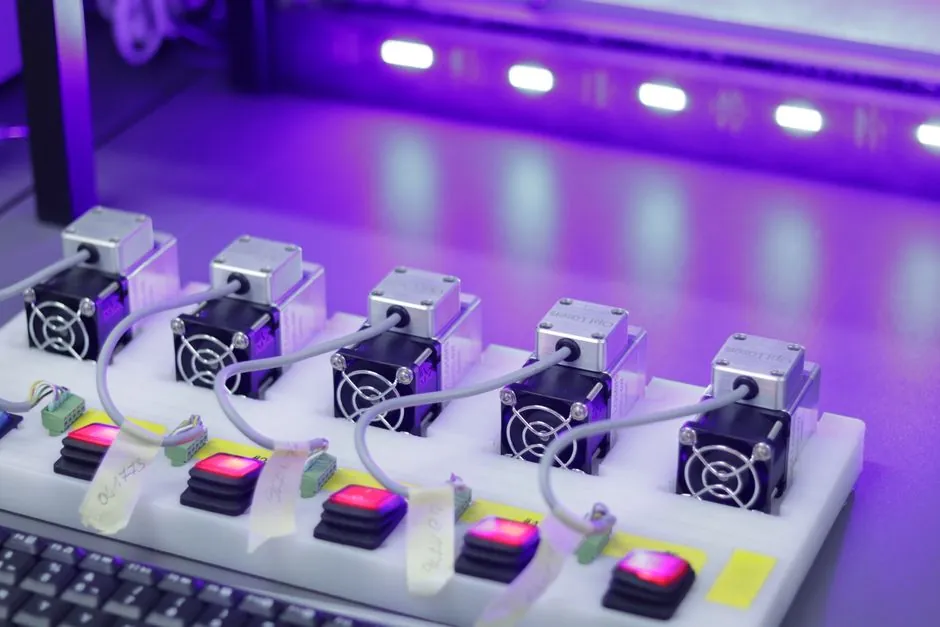
IEC 61131 defines a Programmable Logic Controller (PLC) as a digital-operation electronic system built for industrial environments, executing logic, sequencing, timing, counting, and arithmetic over discrete and analog I/O [S3]. Modern units from suppliers such as VEICHI expose a PLC under the Motion Control category alongside AC/DC servo systems and HMI, illustrating how the device sits inside a wider drive-and-control stack [S1].
The August 2026 supplier landscape splits into three tiers: premium global platforms (Siemens S7-1500, Allen-Bradley ControlLogix, Mitsubishi MELSEC iQ-R, Schneider Modicon M580, Omron NX/NJ, ABB AC500), mid-range Asian volume lines (Delta DVP/AS, Fatek, Xinje, INVT, VEICHI), and component vendors that design the I/O and analog front ends used inside them, including ROHM's PLC I/O unit reference designs [S4]. Indian distributors such as Fieldman Control System in Ahmedabad stock Omron, Delta, Mitsubishi, Keyence, and Fatek lines alongside FLUKE and KYORITSU test instruments, giving buyers a single PO for sensors, encoders, and PLCs [S2].
How IEC 61131 Defines a PLC vs. a Generic Controller
The IEC 61131 working group issued the first PLC standard draft in November 1982, a second draft in January 1985, and a third draft in February 1987, where a PLC is specified as a digital-operation electronic system designed for industrial environments with programmable memory for logic, sequencing, timing, counting, and arithmetic operations [S3]. The same standard stresses that the controller plus its peripherals must be "easy to integrate into an industrial system" and "easy to expand," which is why most suppliers sell a backplane or modular I/O architecture rather than a fixed-pin brick [S3].
That definition is the reason a PLC is treated as a separate device from a general-purpose PC or microcontroller: it must run user-defined logic under hard industrial noise, temperature, and vibration limits, scan inputs in a deterministic cycle, and drive 24 V discrete outputs or 4-20 mA / 0-10 V analog channels directly to field wiring. Suppliers like VEICHI group the PLC with HMI, AC servo, DC servo, and VFD accessories on a single product page because the same cabinet, the same backplane, and the same programming environment are reused across motion and logic control [S1].
The Four Architectural Families Buyers Source From
Compact brick PLCs, modular rack PLCs, PC-based / soft-PLC controllers, and PLC + HMI + drive all-in-one panels make up the four architectural families a sourcing team will see on a 2026 BOM. Compact bricks from Delta, Fatek, and Omron CP1 typically expose 8-32 local I/O with one or two expansion ports, suiting small machine builders who need 16-128 I/O total. Modular rack platforms such as Siemens S7-1500, Allen-Bradley ControlLogix, and Schneider Modicon M580 scale from a few hundred to several thousand I/O per station, and they share the same IEC 61131-3 programming languages (ladder diagram, function block diagram, structured text, instruction list, sequential function chart) [S3].
PC-based / soft-PLC controllers run a real-time control kernel on industrial PCs from suppliers such as Beckhoff (TwinCAT) and Phoenix Contact (PLCnext), and they target plants where a motion controller function and a PLC scan must share a single deterministic processor. All-in-one panels combine an HMI touchscreen, a PLC backplane, and sometimes a VFD or servo drive in the same enclosure, which is the format VEICHI pushes for solar pump, textile, packaging, and water/wastewater skids where cabinet space is at a premium [S1]. Selection between the four families is driven by I/O count, scan time, environmental rating, and the engineering effort to program and certify the code base, not by a generic "better/worse" ranking.
Core Specification Criteria a Spec Engineer Should Lock First
Before comparing brand or price, lock down I/O count and type (24 VDC sinking/sourcing, relay, 0-10 V, 4-20 mA, RTD, thermocouple, high-speed counter, PTO/PWM), required scan time (often 1-20 ms for packaging lines, sub-1 ms for high-speed canning), program memory size (8-64 KB typical brick, 1-10 MB rack), and communication protocols (Modbus RTU/TCP, PROFINET, EtherNet/IP, EtherCAT, CC-Link, OPC UA, MQTT). The 1987 IEC 61131 definition explicitly names communication and networking as part of the controller's job, so any candidate that cannot publish data over OPC UA or MQTT into a SCADA/MES layer is functionally incomplete for Industry 4.0 retrofits [S3].
Pair the PLC to its I/O front end carefully, since sensor-level signal conditioning is a frequent failure source, and suppliers such as ROHM build the op-amps, analog-to-digital converters, gate drivers, and isolated power ICs that sit between the field wiring and the PLC's CPU, including rail-to-rail op-amps with ≤ 2.5 mV input offset, low-noise types at ≤ 20 nV/√Hz, and 5 MHz+ GBW high-speed amplifiers used inside analog input modules [S4].
Programming Languages and Vendor Toolchains Under IEC 61131-3
IEC 61131-3 normalises five programming languages: ladder diagram (LD), function block diagram (FBD), structured text (ST), instruction list (IL, now deprecated in the 2013 third edition), and sequential function chart (SFC). Ladder logic remains the dominant language in factory automation because it maps 1:1 to the relay diagrams it replaced when PLCs were introduced in the U.S. automotive industry in the late 1960s to replace relay logic, with logic organised as input scan, logic execution, and output refresh cycles that engineers can trace rung by rung [S5].
Each supplier then layers proprietary extensions on top: Siemens uses TIA Portal with SCL (Structured Control Language, ST-compatible) and GRAPH (SFC-compatible), Rockwell uses Studio 5000 with Add-On Instructions, Mitsubishi uses GX Works, Omron uses Sysmac Studio, and lower-cost Asian lines (Delta ISPSoft, Fatek WinProladder, VEICHI's own suite) cover the same IEC 61131-3 set with smaller library footprints. For plants already running PID loops, motion, and vision, the same supplier stack usually extends to a PID controller function block, a vision controller interface, or a temperature controller module, which is why distributor line cards such as Fieldman's bundle PLCs, sensors, encoders, and temperature instruments under one roof [S2].
Supplier Comparison Across Four Decision Criteria

Across the August 2026 supplier set, four criteria separate the brands: (1) global service footprint and spare-parts coverage, (2) programming environment maturity and library depth, (3) hardware temperature and certification range, and (4) total cost of ownership including programming labour. Siemens, Rockwell, Mitsubishi, Schneider, Omron, and ABB score highest on the first two criteria and command 20-40 % price premiums over Asian volume brands, but they win on spare-parts availability for plants with multi-country operations. Delta, Fatek, Xinje, and VEICHI typically deliver 30-60 % lower unit cost with 8-64 KB program memory, 16-256 local I/O, and Modbus/Ethernet ports that cover most OEM machine builds [S1].
On the hardware envelope, premium brands usually publish -25 to +70 °C operating ranges, marine-grade conformal coating, and ATEX/IECEx variants for hazardous areas, while compact bricks are commonly rated 0-55 °C with IP20 finger-safe terminals only, which is fine inside a sealed cabinet but not on the machine frame. On TCO, mid-range Asian platforms close the gap once programming hours and training are factored in, and Fieldman-style distributors in India stock a mix of Omron, Delta, Mitsubishi, and Fatek so a plant can standardise on one rack family and buy the others as low-cost spares [S2]. Where machine builders need a compact PLC next to a VFD on the same heatsink, suppliers such as VEICHI package them as one subassembly rather than two separate SKUs [S1].
Where PLCs Beat and Lose Against a Motion Controller or Smart Relay
PLCs win on discrete and analog I/O density, scan determinism, and the ability to run a mix of logic, PID, and simple motion in one program, which is why they remain the default for packaging lines, water treatment, and material handling. They lose to dedicated motion controllers when the application needs interpolated multi-axis trajectories (CNC machining, robotic pick-and-place with coordinated paths, electronic cam profiling), and they lose to smart relays and remote I/O on cost for sub-10 I/O panels where a Siemens LOGO! or an IDEC SmartRelay plus a few buttons is the right answer. Hybrid all-in-one panels try to close the gap by pairing a PLC scan engine with a multi-axis motion kernel, and the IEC 61131 definition was deliberately written to make such integration a normal engineering task rather than a special case [S3].
PLCs also overlap with vision controller functions, since modern machine builders want a single Ethernet ring carrying PROFINET or EtherNet/IP traffic, plus image data from Cognex, Keyence, or Banner vision sensors, all stitched into the same ladder or structured-text program. Distributors such as Fieldman stock Keyence sensors alongside the PLC lines precisely because the same Ethernet and serial infrastructure serves both [S2]. When a system designer specifies the wrong layer here, paying for either a PC where a $300 brick would do, or a brick that cannot move four servos in sync, the cost penalty is structural, not a simple line-item overrun.
Common Failure Modes, Sourcing Pitfalls, and What to Verify on Datasheets
The three failure modes that show up most in field returns are (1) I/O count mis-counted because high-speed counters or PTO channels were not booked against the digital-input budget, (2) communication mismatch where the plant runs PROFINET but the chosen PLC supports only Modbus TCP, forcing a gateway that adds latency, and (3) environmental underspec where a 0-55 °C brick is fitted in an unventilated outdoor cabinet that hits 60 °C in summer. The IEC 61131-3 mandate that PLCs and their peripherals be "easy to integrate and easy to expand" is the reason most suppliers publish I/O expansion tables, communication matrixes, and certified temperature/humidity ranges, and a sourcing engineer should treat those tables as binding rather than aspirational [S3].
Verify on the datasheet, not in marketing collateral, the cycle time per 1 K of boolean instructions (typically 0.08-0.3 ms/K), the program memory in KB or MB, the retain memory for non-volatile tags, the number of communication ports and the supported protocols, the surge and ESD ratings on the discrete inputs, and the MTBF figure in hours when it is published. For a side-by-side BOM, request the IEC 61131-3 programming software license cost and runtime royalty (some suppliers bundle it free, some charge per seat), the spare-parts lead time for the specific CPU and I/O module, and the firmware update policy. The global premium suppliers usually have 5-10 year product life and 10+ year spare-parts windows; Asian volume brands often move faster, which can shorten both.
Signals to Track for Sourcing Over the Next Quarter
Two trackable signals will shape PLC sourcing through Q4 2026: the migration of mid-range Asian lines to OPC UA over TSN on the Ethernet port, and the rollout of vendor-neutral runtime environments that decouple the program from a specific CPU family. The first is visible in supplier product pages as new "OPC UA server" badges appearing next to PROFINET/EtherNet/IP support, and the second is visible in IEC 61131-3-based soft-PLC controllers that load the same project onto different vendors' hardware, similar to how Fieldman's distributor page lists Omron, Delta, Mitsubishi, and Fatek units that all sit on compatible Modbus TCP and can be specified in parallel [S2]. Industrial buyers comparing crane and rigging quotes alongside their PLC BOM can reference the same rough terrain crane selection capacity, boom, and mobility tradeoffs framework when deciding whether to standardise one PLC family across multiple sites, and the cross-vendor runtime trend is the more important of the two signals to monitor.