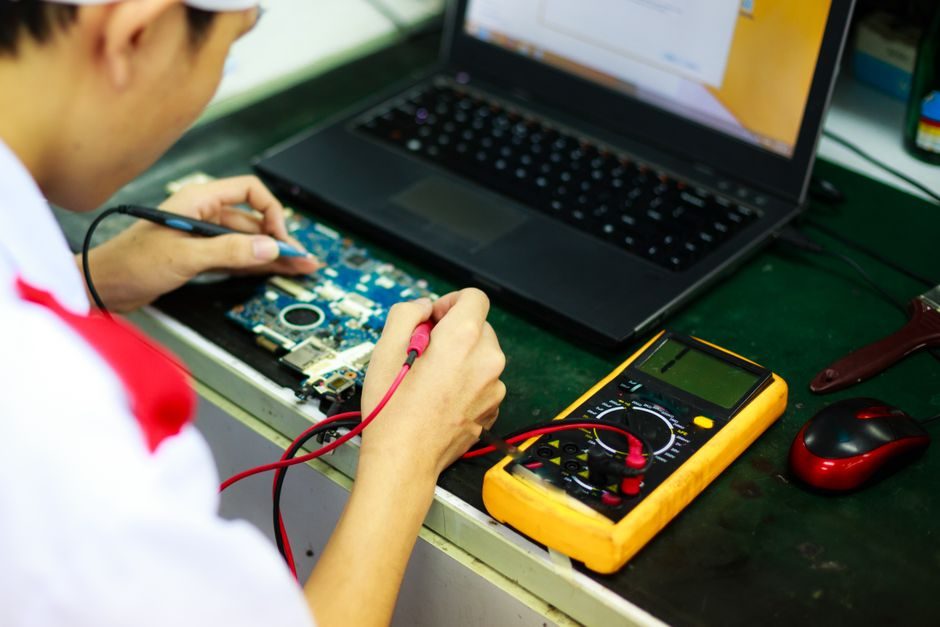
Electrical work in switchgear rooms, underground cable vaults, and SF6/N2-insulated bays exposes crews to combustible gas, oxygen displacement, and toxic byproducts of partial discharge — a 4-gas LEL/O2/CO/H2S portable detector with ATEX or IECEx Zone 1 certification is the baseline specification [S2][S3].
Hanwei's portable line covers single-gas LEL, O2, H2S, and CO units plus multi-gas detectors reading four parameters simultaneously, and ships products out of Zhengzhou for global distribution [S2]. ATO lists handheld units at $223.94 for a 0–500/1000/2000 ppm CO tester and $433.99 for a 0–10/20/50/100 ppm Cl2 monitor, both with diffusion sampling [S3].
Four-Gas Versus Single-Gas: Matching Detector Count to Task
Four-gas portables (LEL + O2 + CO + H2S) are the default for electrical confined-space entry because battery overheating, cable pyrolysis, and welding near busbars each create different hazard profiles within a single shift [S2].
Single-gas units remain the right tool when one toxicant dominates — a CO-only tester for indoor generator rooms, a H2S-only unit for wastewater lift stations powering pump controls, or an O2-only monitor for nitrogen-purged panels [S2]. The cost gap is meaningful: a single-gas CO tester at $223.94 is roughly half the price of a 4-gas unit when bought from the same channel [S3].
Sensor Range and Resolution Specifics from Current Catalog Data
ATO's CO tester ships in 0–500, 0–1000, and 0–2000 ppm ranges, while the Cl2 monitor covers 0–10, 0–20, 0–50, and 0–100 ppm — all diffusion-sampled handheld form factors, with audible/visual alarms per the product listing [S3].
Resolution in this class typically runs 1 ppm for CO and 0.1 ppm for Cl2; the multi-gas detectors in Hanwei's catalog combine catalytic-bead LEL, electrochemical O2/CO/H2S, and optional infrared CO2 in one enclosure [S2]. For a primer on how these sensors integrate into a fixed plant system, see the gas detector reference page.
Certification, Ingress Protection, and Alarm Output
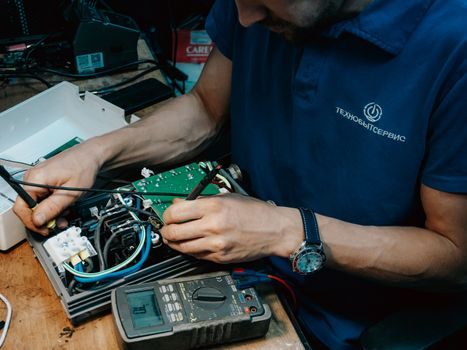
Portable detectors carried into classified electrical spaces must carry ATEX Ex d ia IIC T4 Gb or equivalent IECEx marking for Zone 1, plus IP66 or IP67 against dust and water ingress — both are now table stakes on Hanwei's portable and Zetron's PTM600-S wireless interconnected alarm [S1][S2].
Alarm output should be three-mode: audible ≥95 dB at 30 cm, 360° visible LED, and vibrating motor, so a worker in a noisy substation or a face-down crawler position still receives the warning [S1]. Sampling method is a decision point — diffusion for personal clip-on use, internal pump draw for pre-entry confined-space testing of cable vaults before human entry [S2][S3].
Use Cases: Where Electrical Crews Actually Carry the Detector
Switchgear maintenance in 10 kV–35 kV substations generates arc-flash byproducts (CO, HF trace) and may displace O2 in SF6 gear rooms during gas handling — a 4-gas LEL/O2/CO/H2S unit is the standard issue [S2].
Cable jointing in underground vaults and manholes triggers OSHA-style confined-space rules (atmospheric testing before entry, continuous monitoring during work), and the detector must log or stream readings — Hanwei's E6000 and BX616 multi-gas series support this continuous-monitoring role [S2]. For adjacent selection work on the valves and actuators installed in gas-handling skids, see the electric ball valve sizing and selection guide.
Decision Comparison: Single-Gas vs Multi-Gas vs Pumped Multi-Gas
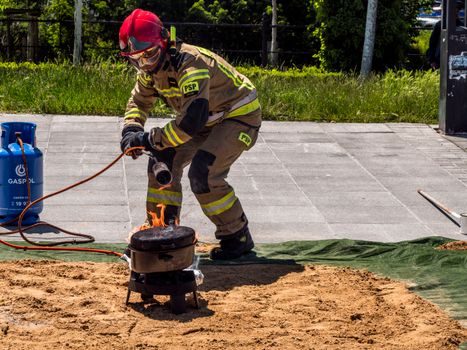
Three configurations cover most electrical-trade scenarios. The criteria-based comparison: (1) Single-gas diffusion unit — lowest cost, lightest weight, one hazard, no pre-entry sampling; (2) 4-gas diffusion personal monitor — covers LEL/O2/CO/H2S simultaneously, clip-on, ~120–200 g class, suited to walking patrol in switchgear halls; (3) Pumped multi-gas with hose and wand — required for confined-space pre-entry testing of manholes and vaults, adds motorized sampling pump and longer battery burden [S2][S3].
Specifiers who skip the pump option for vault work are accepting a real risk — diffusion sensors only read atmosphere in contact with the sensor face, while a pumped sample pulls from a wand 1–10 m into the space [S2]. For related fixed-system architecture on detection-controller channel counts, outputs, and compliance, see the firefighting gas alarm controller spec breakdown.
Calibration, Bump Test, and Battery Runtime Constraints
Electrochemical H2S and CO sensors drift within 6–12 months and require calibration with certified gas — a 4-gas unit used daily in electrical work needs a documented bump test before each shift, which adds consumable-gas cost but is the only way to catch a poisoned sensor [S2].
Lithium-ion runtime in this class typically lands at 14–24 hours continuous with a 4-sensor load; a hot-swap battery or USB-C recharge is a practical requirement for multi-shift plants and outage windows [S1]. Catalytic-bead LEL sensors fail in silicone- or lead-containing atmospheres — environments found in some cable-compounding rooms — so infrared (NDIR) LEL is the upgrade path for those specific sites [S2].
Sourcing and Standards Anchors
China-origin portable detectors from Hanwei Electronics (Zhengzhou, stock code 300007, founded 1998) and Zetron Technology (Beijing) dominate the OEM supply chain for diffusion-type 4-gas units in this category [S1][S2]. ATO distributes handheld units into the US e-commerce channel with published price points in the $223–$434 range as of July 2026 [S3].
Applicable standards for portable units in electrical work are IEC 60079-0 / IEC 60079-1 (explosive atmospheres — general and flameproof enclosures), IEC 60079-11 (intrinsic safety), and the ATEX 2014/34/EU equipment directive for EU sites — for a primer on how those rules differ for fixed hardware, see the explosion-proof electrical reference. The next signal to track is wider adoption of wireless interconnected portable alarms (Zetron PTM600-S platform [S1]) that mesh across a substation so a single LEL event pages every crew member within 100 m.
For the relevant spec sheets and selection criteria, see portable gas detector.