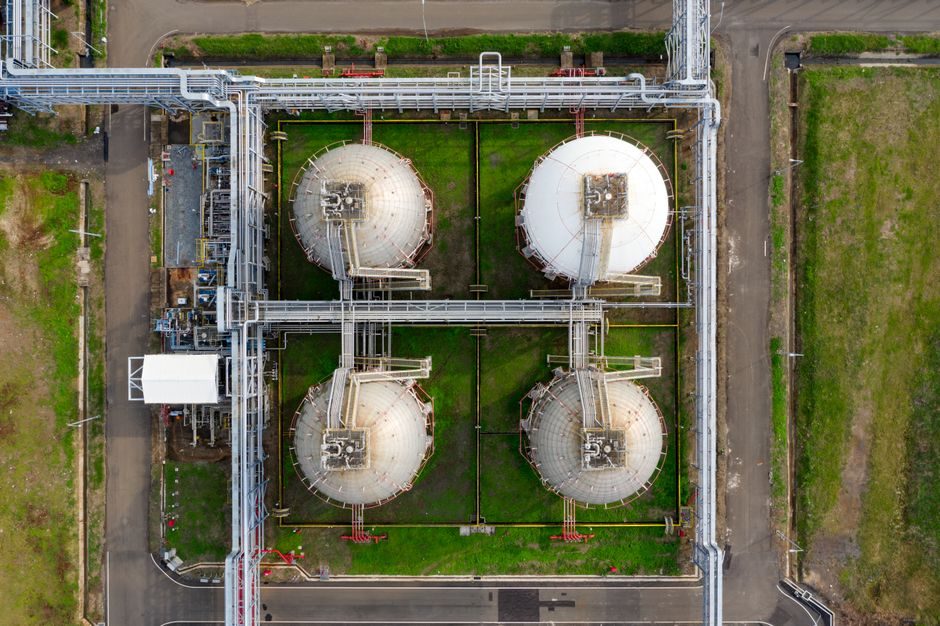
A portable gas detector for upstream, midstream, and refinery work is a multi-sensor instrument that simultaneously measures combustible gases (as %LEL or %vol), oxygen (O2 deficiency/enrichment), and one or more toxics — most commonly carbon monoxide (CO) and hydrogen sulfide (H2S) — and must carry hazardous-area certification before it is admitted to a classified zone [S1][S3][S4][S8].
The selection question is not "which brand" but which sensor stack, which certification level, and which battery/datalogging profile match the work being done: turn-around confined-space entry, routine operator wear, tank/vessel purging, or fugitive-emission surveys at a wellhead [S1][S6][S7].
Sensor Stack: Catalytic Pellistor vs IR vs Electrochemical
Triple Plus+ from Crowcon ships with the option of infrared (IR) sensors for flammable hydrocarbons or CO2, and the IR module is explicitly described as resistant to poisoning and inhibition — a failure mode that regularly disables catalytic pellistor/LEL sensors in silicone-, lead-, or sulfur-rich oilfield atmospheres [S1]. The same source states the IR module measures hydrocarbons in both %LEL and %vol ranges, which is the configuration a process engineer needs for line and tank purging where the gas concentration must be read above 100% LEL without saturating the sensor [S1]. Catalytic pellistor sensors remain the default low-cost choice for the 0–100% LEL band in air, but the manufacturer note is unambiguous: they perform poorly in inert (oxygen-free) backgrounds — exactly the environment created during nitrogen purge of a vessel [S1].
For toxics, the dominant cell type is electrochemical, with H2S, CO, NH3, Cl2, NO2, and SO2 cells available as drop-in modules on the same chassis; O2 is almost always its own dedicated electrochemical cell with a typical 0–25% vol range and a 5–10 second T90 response [S1]. Where a worker needs to read a single toxic — for example, ozone in a disinfection skid or H2S at a sour-gas header — single-gas portables exist as a cheaper, lighter alternative to a four-gas unit [S3][S4][S5].
Hazardous-Area Certification: ATEX, IECEx, SIL, and the Zone Question
Portable instruments carried into a Zone 1 or Zone 2 area on a production platform must be certified to the appropriate Ex protection concept — most commonly Ex ia (intrinsic safety) for handheld detectors, because the unit's own battery and circuit energy is the ignition source that must be limited [S1][S3][S4]. Marketplace listings for Chinese-manufactured LPG leak detectors explicitly bundle "ATEX and SIL2 Certified" as a single product attribute, with the supplier (AIYI Technologies) holding SGS and ISO third-party certifications [S3][S4]. SIL2 is a functional-safety rating against IEC 61508 and is independent of, but commonly co-stated with, ATEX/IECEx Ex protection — the two are answers to different questions (will the device ignite the atmosphere, and will the safety function fail dangerously) [S3][S4].
For an oil and gas facility the practical rule is: require ATEX or IECEx Ex ia for Zone 1 carry, confirm the certification number matches the unit serial range, and treat SIL2 as the floor for safety-instrumented functions such as automatic gas detection tied to plant shutdown — not as a substitute for Ex certification [S1][S3][S4].
Options Comparison: 1-Gas, 4-Gas, Multi-Gas with IR
The portable family splits into three tiers by sensor count and capability, and the choice is driven by the job rather than by price. A typical working comparison: (a) single-gas sniffers — cheapest, lightest, used for one targeted toxic (e.g. CO at a fired heater, H2S at a wellhead), 0–500/1000 ppm class range with audible/visual/vibration alarms [S3][S4][S5]; (b) 4-gas confined-space monitors — LEL (pellistor or IR), O2, CO, H2S, mandatory for hot-work permit and vessel-entry, typically 12–24 hour battery, datalogging standard [S3][S4]; (c) multi-gas plus IR with %vol flammable — adds tank/vessel purge capability and is the only tier that can be used in nitrogen-inerted backgrounds without false-low readings [S1].
Dräger markets the same three-tier architecture and explicitly states 70+ years of experience in this technology, with the catalog cover position of "toxic gases, oxygen deficiency, combustible gases and vapours" as the four hazard classes their portables target [S8]. Crowcon's Triple Plus+ data point is the most concrete in the research: over 90,000 units of the prior-generation "Triple" family sold to oil and gas, chemical, utility and manufacturing companies worldwide — the reference install base for multi-gas portables in this sector [S1].
Use-Case Map: Where Each Tier Earns Its Keep
Confined-space entry on a hydrotreater or a crude-oil tank requires the 4-gas LEL/O2/CO/H2S configuration, with sample-draw or diffusion sensing selected by entry method — diffusion for harness-mounted, sample-draw for pre-entry remote readings through a manhole [S3][S4][S8]. Fugitive-emission surveys at a wellhead pad or a gas-processing plant benefit from IR-based combustible sensing because wind, low gas concentrations, and intermittent plume contact make pellistor poisoning a recurring reliability problem in the field [S1]. Purging a vessel to inert or to fuel-gas service is a separate use case: the same IR sensor module that handles %LEL also reads %vol hydrocarbons, eliminating a second dedicated instrument [S1].
For a single targeted toxic in a process stream — an ozone slip from a produced-water treatment package, for example, where measuring ranges of 0–10, 0–20, or 0–50 ppm are offered as selectable options on a handheld with audible/light/vibrating alarms — a single-gas detector is the right tool and is a fraction of the cost of a four-gas monitor [S5]. Specification of the toxic species on a given site should drive which cell is ordered, because electrochemical cells are gas-specific and a CO cell will not respond to H2S or SO2 [S1][S5][S8].
Limitations, Failure Modes, and Sourcing Reality

Three failure modes dominate field returns. First, pellistor poisoning/ inhibition in atmospheres containing silicones, phosphates, lead, or halogenated compounds — IR is the documented mitigation and is offered as an option on at least one major multi-gas portable [S1]. Second, sensor end-of-life — electrochemical H2S and CO cells typically have 12–36 month operating life in field service and must be bump-tested against known gas on a defined schedule; portable units almost universally include a datalogger for this audit trail [S1][S8]. Third, battery and Ex-certification interaction — lithium-ion chemistries (e.g. the LIBRA pack on Triple Plus+) raise energy density but require that the cell pack itself be part of the Ex certification, so aftermarket battery substitution is not a maintenance option [S1].
Sourcing reality in 2026: the B2B catalog layer is dominated by Chinese suppliers offering ATEX + SIL2 bundles at price points below European OEM equivalents, with SGS and ISO 9001 third-party audits cited as the quality system basis [S3][S4]. For a facility on a Western operator's approved-vendor list, Dräger and Crowcon remain the reference names with published install-base figures and IR sensor options [S1][S8]. The portable detector category overlaps with the portable gas detector and multi gas detector reference classes in our encyclopedia, which give the technology-level background; for the higher-tier single-gas role, the combustible gas detector and fixed gas detector entries cover the LEL measurement principles that portables inherit. For a plant-level rather than personal-monitor view of gas detection, the gas detector overview is the appropriate starting point. Related reading on adjacent specification problems is available in our article on gas alarm controller selection for welding operations and the confined-space variant gas alarm controller spec map for confined space entry.
Track, over the next procurement cycle, whether your site standard is rewritten to require IR rather than pellistor for hydrocarbon measurement in any inert-purge task, and whether the ATEX + SIL2 bundle continues to be accepted by your operator's technical-authority function as a substitute for a Western OEM unit [S1][S3][S4][S8].