
For plumbing rough-in and fixture-setting work, the power mixer choice collapses to one engineering question: does the unit tumble the mix (drum) or fold it (paddle)? Mortar, grout, drywall mud, and thin-set need paddle mixing; a rotating drum concrete mixer over-works these materials and traps excess air, so it is the wrong tool even though it is the most common mixer on a jobsite [S2].
The decision lives in three numbers: motor power, drum or paddle capacity, and power source. Sub-1 kW handheld drills with paddle attachments cover patch repairs and one-bag batches; 1.5–3.0 kW dedicated portable mixers cover most service-truck and small-contractor plumbing jobs; towable or stationary sand and mortar mixers above 5 kW only earn their keep on commercial build-outs with continuous grout or fireproofing demand [S2].
Mixer types and the materials each one actually mixes correctly
Five configurations cover almost every plumbing-installation mixer specification: tilting drum, non-tilting drum, reversible drum, pan (stationary pan with rotating paddles or stars), and the portable paddle/barrel mixer [S2]. Drum units rely on a tumbling action; they are tuned for coarse aggregate, low-slump concrete, and high-volume pours. Pan and paddle units fold the mix, which is what cementitious grout, masonry mortar, stucco, and thin-set require to stay workable without segregation or air over-incorporation [S2].
A common field error is using a concrete mixer to blend bagged mortar or grout. The drum action drives fines to the bottom and lifts the water, which collapses workability within two to three minutes of mixing. Paddle mixers, by contrast, keep sand and binder in suspension and let the operator add water incrementally until the desired slump or flow is reached [S2]. For plumbing work, that means: bagged Portland-cement grout, ANSI A118.6/A118.7 cement grout, polymer-modified thinset (ANSI A118.4/A118.11), and gypsum or Portland-based plaster all belong on a paddle mixer, never in a rotating drum.
Power source and motor sizing: 120 V vs 230 V vs gas
Portable mixers ship in electric (corded 120 V or 230 V single-phase) and gas-driven configurations [S2]. For interior plumbing rough-in where exhaust and noise are a problem, 120 V corded units in the 1.5–2.0 kW band dominate because they plug into the same circuit that runs the temporary jobsite panel. For outdoor service-yard or new-build slab work, gas-powered mixers give untethered runtime but add fuel handling and a documented exhaust-management step [S2].
Motor sizing should be matched to batch weight, not to bag count. A 1.5 kW paddle mixer handles roughly a single 55–70 lb bag of thinset or mortar per batch; loading two bags stalls the motor and burns out the start capacitor within a season. Step to a 2.2–3.0 kW unit, or to a barrel-style sand mixer with a dedicated gear reducer, once batch weights regularly exceed 80 lb or the mix contains coarse silica aggregate. A simple field rule: if the motor bogs at the bottom of the paddle stroke for more than 3 seconds under load, the mixer is undersized for the job.
Plumbing-installation specific use cases
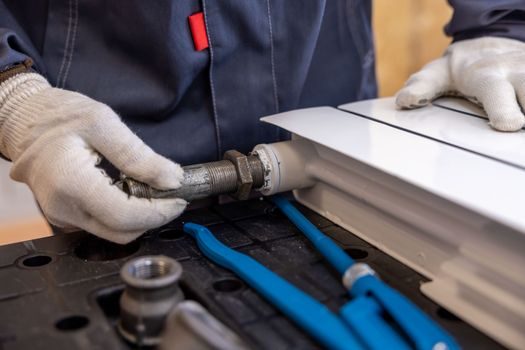
Five plumbing scenarios drive mixer selection more than any other: cast-iron soil pipe lead and oakum joints (rare but still specified in some hospital and federal work), PVC and CPVC solvent-cement puddle testing (no mixer needed), cementitious grout for shower-pan receptors, mortar beds under shower drains and tub surrounds, and self-leveling underlayment (SLU) for floor-flatness correction prior to fixture set [S3][S5].
Shower-pan grout and tub-deck mortar are the cases that justify a dedicated 2.2 kW paddle mixer. Both require a stiff, low-water mix that paddle action delivers without over-aerating. SLU is a different machine entirely, pumped through a peristaltic or progressive-cavity pump and finished with a spiked roller; calling a paddle mixer an SLU mixer is a specification error that produces pinholes and fish-eyes. For water-heater replacement, faucet swap-outs, and lavatory or water-closet setting, no mixer is needed at all, the job is hand-mixed with a margin trowel and a 5-gallon bucket [S3].
When to choose drum, pan, or paddle: a decision matrix
The three configurations line up against four plumbing decision criteria as follows. Drum mixers win on raw throughput (cubic yards per hour) and on the ability to discharge directly into a concrete mixer truck chute for pour-back, but they lose on finish quality for any mortar or grout under 1/2 in. aggregate. Pan mixers win on mix homogeneity for stucco, fireproofing, and grout containing fine silica, but they are stationary and require a skip hoist to feed. Paddle/barrel mixers win on portability and on suitability for the actual materials a plumber handles day-to-day, but they lose on continuous-duty cycle, the gearbox overheats above roughly 4 hours of unloaded run time per shift [S2].
For a residential service-truck doing mostly fixture replacement with occasional shower-pan rebuilds, a 1.5 kW 120 V paddle mixer plus a spare paddle is the correct buy. For a commercial plumbing crew running back-to-back carrier-and-fixture installs in a high-rise, a 3.0 kW 230 V paddle mixer or a 7–9 cu ft barrel mortar mixer is the correct buy, and a drum mixer is not. The matrix is stable across manufacturers; what changes is gearbox rating, paddle geometry, and IP rating on the motor housing, which is the next decision layer.
Limitations, failure modes, and when not to repair
Mixer failures in plumbing work cluster in three places: the start capacitor on single-phase 120 V motors, the paddle-to-shaft key (or set screw) under reversing load, and the gearbox seal on units run with abrasive mortar slurry [S2]. A failed capacitor is a 15-minute swap and a $20 part; a scored armature from running the motor on a failing capacitor is a full motor replacement. A sheared paddle key is field-repairable if the shaft is undamaged, but a worn keyway means shaft replacement, which on most portable mixers is not economical on a unit older than five years.
The non-repair threshold is simple: replace the mixer when drum wall thickness on a steel drum drops below 3 mm (visible pitting plus measurable thinning on a UT gauge), when the motor frame shows cracks around the lifting eye, or when the gearbox has metal-on-metal grinding after a fluid change. Continuing to run a mixer past any of these three conditions risks catastrophic paddle detachment, which is a struck-by hazard on a plumbing rough-in with multiple trades in the same room.
Standards, sourcing, and what to verify before buying
For plumbing-fixture installation work, the binding reference is the manufacturer's installation instructions for the specific fixture, plus the code-adopted plumbing standard in the project's jurisdiction (the International Plumbing Code, or the Uniform Plumbing Code, with a fixture-unit sizing table used to determine water-supply and drain sizes) [S3]. For PEX supply systems, the Plastic Pipe and Fittings Association's PEX Plumbing Design and Installation Guide, third edition, and the manufacturer's residential plumbing installation guide govern tubing support, bend radius, and expansion-tank sizing on hot-water recirculation runs [S4][S5].
Before signing a purchase order, three documents should be on file: the motor's nameplate data (voltage, full-load amps, RPM, duty cycle), the gearbox service-factor rating (1.0 for occasional, 1.25–1.5 for production), and the paddle or drum capacity in dry volume, not wet weight, because vendors quote both. The dry-volume figure is the only one that lets you size batches against the bag yield on the mortar or grout sack. Locking those three data points up front prevents the most common field failure, a mixer that physically fits on the truck but cannot pull its rated load on a 120 V 20 A circuit without tripping the GFCI.
Trackable signals to watch over the next buying cycle: manufacturers migrating 1.5 kW portable mixers from universal-brushed motors to brushless DC for longer capacitor-free life, and rental fleets standardizing on 230 V inverter-driven paddle mixers to drop fuel usage on gas units. Both shifts show up first on contractor-buyer pricing sheets in Q4 2026.
See also our earlier report, Carbon Steel Selection for Electronics: 2026 Grade and Spec Map.