Selecting a power mixer for masonry work reduces to three decision variables: batch volume per cycle, mixing action (paddle versus auger versus continuous), and silica-dust mitigation, with OSHA's construction crystalline-silica rule framing the dust-control requirement that applies to over 600,000 US workplaces [S1].
The US concrete mixer market reached 489,000 units in 2024 [S3], and the North American mobile mixer segment is projected to grow to $3.3 billion by 2030 [S3] — figures that frame how aggressively masonry-grade power mixers are now being specified for both small commercial builds and infrastructure work. For a side-by-side look at drum and engine sizing on a related steel-construction application, see the power mixer spec map for steel construction.
Mixer Categories That Apply to Masonry
Three mixer families cover essentially every masonry scenario: gravity mixing systems, power auger delivery systems, and continuous mixing systems [S1]. Gravity systems (G7000 silo, Ten Bagger, Split Silo, Load N Go) are non-powered and rely on the weight of preblended material dropping into a receiving vessel, making them suited for low-output, low-overhead work where crews can accept manual bag handling at the station.
Power auger systems (PA1000 and PA4000) use a motorised auger to convey preblended dry mortar from a silo or bag into a mixing chamber, and SPEC MIX positions the PA4000 as its "low-profile, high-output" unit engineered for interior and exterior masonry projects of all sizes, with contractor crews of any size able to run it [S2]. Continuous mixing systems — the D2W family, including a gas-powered variant and the D2W Workhorse — feed dry material and water in parallel, producing mixed mortar at a steady rate without discrete batch cycles [S1].
Auger vs Paddle vs Continuous: Decision Criteria
For a masonry crew weighing options, the three families line up against four decision criteria drawn from the research: batch integrity, throughput, dust mitigation, and crew size required at the mixing station. Paddle mixers — the traditional masonry workhorse — are governed by ASTM C270 guidance that says mixing time "should usually be a minimum of 3 and a maximum of 5 min after the last mixing water is added," and the mixer should be "charged to its full design capacity for each batch and completely emptied before charging the next batch" [S4].
Power auger systems replace that batch loop with continuous feed: SPEC MIX states the PA4000 is "engineered for dispensing all SPEC MIX dry, preblended products" and lets contractors "maximize" productivity because the auger handles material delivery to the point of use rather than a discrete drum cycle [S2]. Continuous D2W-style mixers go one step further by metering water and aggregate simultaneously, which removes the batch boundary entirely — relevant when a single crew is laying block all day and the mixing station should not be the production bottleneck. For a comparison with high-pressure pumping hardware that sometimes shares the same jobsite, the plunger pump spec-driven selection guide is worth scanning.
Power, Site Electrical, and Control Requirements
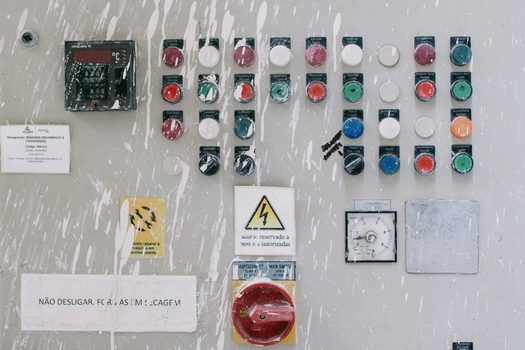
Power requirements scale with mixer capacity and dictate whether a jobsite needs an upgraded electrical service before the equipment arrives — higher-capacity mixers "typically require more electrical power, potentially necessitating upgraded site electrical service," and "understanding power specifications early in planning prevents costly surprises during equipment installation and commissioning" [S3]. Gas-powered continuous units (D2W Gas Powered) exist specifically to bypass that electrical-service constraint on remote or rough-in sites [S1].
Control sophistication varies widely across the same product family. Basic portable units feature manual controls suitable for simple applications, while automated continuous systems handle water metering, additive dosing, and throughput setpoints without operator intervention [S3]. For masonry grout and mortar — where water-cement ratio consistency drives colour and bond strength — that control layer matters more than raw drum size, and is a stronger argument for auger or continuous systems than for traditional paddle mixers run by hand. Where lifts and vertical delivery of mixed material are involved, the multistage centrifugal pump selection spec map addresses the equipment chain downstream of the mixer.
Silica Rule and Dust-Mitigation Integration
OSHA's construction crystalline-silica standard frames equipment selection because the rule "does not apply where exposures will remain low under any foreseeable conditions; for example, when only performing tasks such as mixing mortar" — meaning that the moment a crew moves beyond incidental mortar mixing into continuous production, dust mitigation at the mixing station becomes a regulatory expectation, not an option [S1]. The same research notes OSHA's estimate that "more than 840,000 of these workers are exposed to silica levels that exceed the new permissible exposure limit (PEL)" across the 600,000-plus covered workplaces [S1].
That is why every SPEC MIX mixing-system category in the selection guide closes with an "Accessories & Dust Control Mitigation" section (pages 16–18), covering mixer shrouds, upper shrouds, and sealed hoppers that integrate with both auger and continuous units [S1]. For crews working at height or in confined masonry shafts where ventilation is poor, oxygen monitoring is a parallel control — the oxygen detector selection spec map covers that side of the safety stack.
Matching Mixer Type to Crew and Project Size
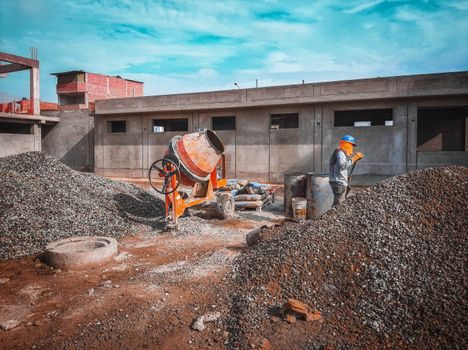
Small residential masonry — single foundation walls, chimneys, small additions — is still best served by a paddle mixer on a 110 V or 230 V single-phase circuit with a 3-cubic-foot drum, following the ASTM C270 charge-then-empty batch discipline [S4]. Mid-size commercial masonry (50–500 bag/day) is the sweet spot for power auger delivery from a silo, because the per-bag labour saving compounds across a full crew; SPEC MIX frames the PA4000 explicitly for "interior and exterior masonry projects of all sizes" with "contractor crews of any size" [S2].
Large infrastructure and repetitive block work — the 44.5% infrastructure share of 2025 mixer demand [S3] — justifies continuous mixing systems such as the D2W Workhorse, where the bottleneck is no longer mixing but rather placement, and the mixer is plumbed directly to a pump or conveyor. Crews should treat mixer selection and material-handling conveyor selection as one decision rather than two, since the throughputs have to match; the overhead conveyor selection spec map covers the downstream side of that chain for warehouse-scale operations.
Limitations, Failure Modes, and Sourcing
Three failure modes dominate masonry power-mixer field experience. First, under-charging a paddle mixer to extend cycle count produces inconsistent mortar because the ASTM C270 procedure assumes full design capacity per batch [S4]. Second, dust-mitigation accessories ordered separately from the mixing system often get skipped on installation, defeating the purpose of the OSHA-aligned shroud and upper-shroud options that SPEC MIX lists in its accessories section [S1]. Third, site electrical service undersizing causes nuisance breaker trips on larger mixers — preventable only by checking motor FLA and starting current against the available service before delivery, as AMIX Systems explicitly warns [S3].
Sourcing for this map draws on the SPEC MIX Mixing Systems Selection Guide (Buildsite PDF, 2024-06-27) [S1], the SPEC MIX Power Auger product page for the PA1000 and PA4000 [S2], the AMIX Systems concrete mixer selection guide (2025-07-16) [S3], and ASTM C270 — Standard Specification for Mortar for Unit Masonry [S4] for the paddle-mixer mixing-time and batch-loading procedure. Two trackable signals to watch: OSHA silica-PEL enforcement citations on masonry jobsites that name dust-mitigation equipment, and any 2026 update to the SPEC MIX selection guide adding higher-throughput D2W variants or revised PA4000 motor specs.
For component-level specifications, see power mixer, sand mixer, and concrete mixer truck.