Low-carbon steel is the workhorse of electronics hardware: AISI 1006 carries 0.080 wt% carbon with a tensile strength of 330 MPa and elongation at break of 20% in 50 mm, making it the dominant choice for server rack panels, switch chassis, and stamped EMI/RFI shields [S1].
Electronics designers pick from three families — low-carbon sheet (AISI 1006/1008/DC01/SPCC), low-carbon plate and bar (AISI 1018/A36), and HSLA (ASTM A607) — with the decision driven by gauge, weld method, plating line, and magnetic shielding target rather than ultimate tensile strength [S2][S3].
Why low-carbon dominates electronics fabrication
Carbon steels in the 0.05-0.32 wt% C range combine low cost with the ductility and formability that PCB rack hardware demands: AISI 1006 cold-drawn bar delivers 330 MPa tensile, 285 MPa yield, 95 Brinell hardness, and 50% machinability versus AISI 1212 baseline [S1].
Two specific data points drive the electronics preference. First, the silicon and manganese residuals in AISI 1006 — about 0.4% Si and 0.25-0.40% Mn on an Fe base of 99.43-99.75% — keep the steel non-hardenable by air cooling, so stamped parts do not warp during subsequent zinc or tin plating. Second, the elastic modulus of 190-210 GPa and density of 7.872 g/cm³ (0.2844 lb/in³) give predictable spring-back for shield cans, which is why the same grade is used in carbon steel chassis, battery contacts, and structural server frames [S1].
Grade selection by component: sheet, bar, structural
Sheet steel for cabinets, brackets, and shielding is typically specified as AISI 1006, AISI 1008, DC01 (EN 10130), or SPCC (JIS G3141) with cold-rolled gauges from 0.5 mm to 3.0 mm; these grades weld cleanly with ER70S-x filler and accept continuous galvanneal or electrolytic tin plating without hydrogen embrittlement [S2][S3].
Machined and structural parts move up to medium-carbon or mild structural grades. A side-by-side comparison for the three principal families: AISI 1006 sheet has 330 MPa tensile / 285 MPa yield with 20% elongation — best for stamping; AISI 1018 bar has roughly 440 MPa tensile / 370 MPa yield with 15% elongation — best for machined and tapped parts; HSLA A607 Grade 50 reaches 410 MPa min yield at thinner gauges — best where mass matters and the plating line accepts higher strength [S1][S2].
Welding, plating, and electromagnetic behaviour
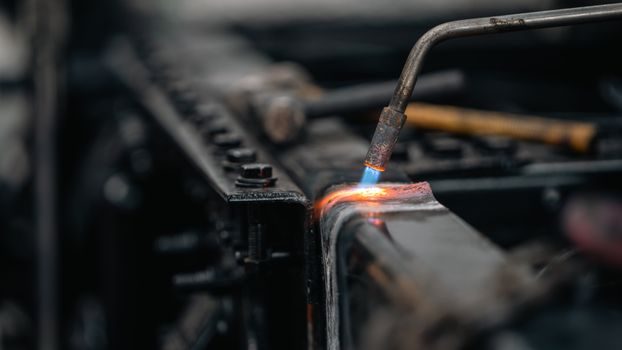
For electronics assemblies, weld filler selection follows AWS A5.18: ER70S-3 and ER70S-6 are the default GMAW/GTAW fillers for low-carbon sheet, with E6010 / E7018 SMAW electrodes used for thicker rack frames per the Carbon Steel Handbook guidance [S3].
Plating line compatibility is the second decision gate. Low-carbon sheet in the AISI 1006/1008 family accepts zinc electroplate, zinc-nickel, hot-dip galvanneal (AISI 1006 with 0.080% C is the canonical galvanneal substrate), and tin or tin-lead reflow coatings without post-plating baking, because the carbon level is too low to put hard martensite at risk. For RFI/EMI cans, the 0.27-0.30 Poisson's ratio and 140 GPa bulk modulus of standard carbon steel give the predictable deep-draw behaviour that stamped stainless steel shields cannot match at the same cost. Where magnetic permeability is a problem for a specific sensor or coil sub-assembly, a non-magnetic insert is preferred over switching the whole chassis to austenitic stainless.
Standards map: AISI, ASTM, SAE, and the equivalents
The three U.S. standards bodies that govern carbon steel specification are ASTM International, AISI, and SAE International, with ASTM the most widely invoked designation in electronics OEM drawings [S2].
Cross-reference is critical for sourcing. ASTM A1008 covers cold-rolled low-carbon sheet, AISI 1006/1008 cross to DC01 (EN 10130) and SPCC (JIS G3141), and AISI 1018 bar is supplied to ASTM A108 or A29. AWS A5.18/A5.20 filler families (ER70S-x, E70xx) are the welding-side anchor, while SAE J403 defines the chemistry limits for the 10xx series. Engineers working on telecom outdoor cabinets should align the carbon steel enclosure with the same AISI 1008 + galvanneal stack-up used in telecom enclosures cast in zinc — a related design choice covered in the vacuum die casting reference for that segment [S3][S5].
Common failure modes and what to avoid
Three electronics-specific failure modes drive grade choice. Hydrogen embrittlement strikes when high-carbon or hardened parts (>0.30% C, or any case-hardened grade) are zinc-plated without a 200°C / 4 h post-plate bake; AISI 1006 / 1008 / 1018 all sit below that carbon threshold. Galvanic corrosion at the steel-to-copper or steel-to-aluminum interface requires a tin or zinc chromate conversion coating, not bare steel, for any electronics chassis that also mounts a copper busbar. [S2]
Magnetic interference is the third mode, and is usually handled by keeping the chassis in low-carbon steel (which has high but linear permeability) and isolating inductors, Hall sensors, or compass modules behind a Mu-metal insert rather than substituting the whole frame. The same drafting discipline that keeps a PCB chassis in AISI 1006 sheet is why automotive harness brackets, automotive body panels, and consumer-electronics enclosures cluster around the same AISI 1008 / DC01 / SPCC band, with alloy steel reserved for shafts, gears, and fasteners only [S1][S2].
Sourcing signals for 2026 builds
Electronics OEMs specifying AISI 1006 cold-rolled sheet should expect 0.5-3.0 mm gauge in mill coils with ASTM A1008 / EN 10130 / JIS G3141 certifications, ER70S-6 weld wire on the production line, and either galvanneal (ZF) or electrolytic tin (T1-T4) coating for chassis and bracket applications [S1][S3].
Trackable next nodes for sourcing teams: (1) confirm the cold-rolled mill cert cites AISI 1006/1008 plus the equivalent JIS or EN grade before release; (2) verify the galvanneal coating weight is in the 60-120 g/m² ZF band for indoor electronics, with Z275 hot-dip galvanizing for outdoor cabinets; (3) for CNC brackets move to AISI 1018 bar to ASTM A108 with a 4-20 mA equivalent mechanical-test report on every heat. The same grade logic that picks AISI 1006 sheet for stamped panels is the logic behind selecting AISI 1018 bar for transformer mounting plates and A36 plate for the structural members of a carbon steel power-distribution rack [S1][S2][S3].
This topic is covered further in Concrete Fiber Selection for School Buildings: Spec Map.