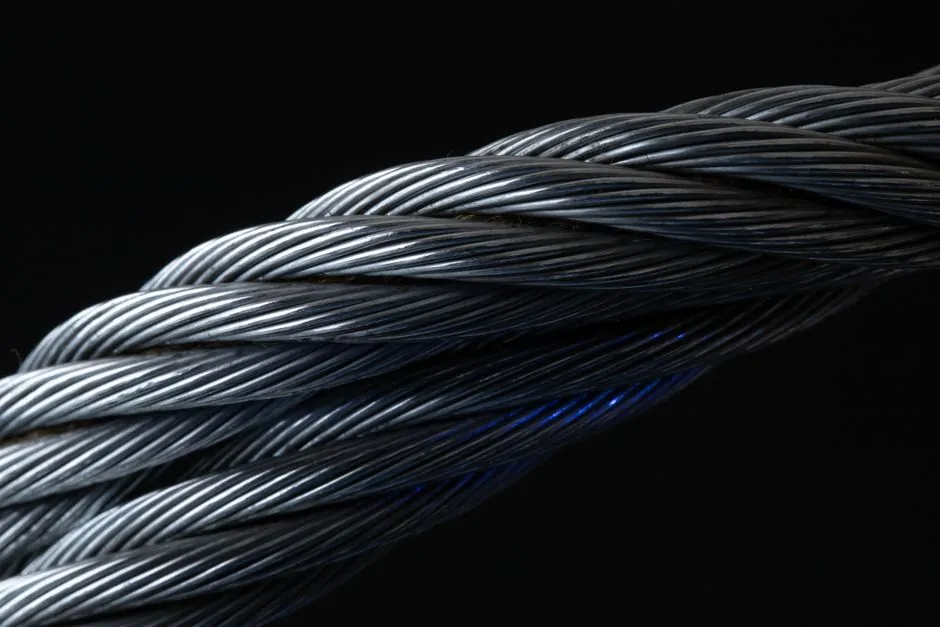
For prefabricated component plants, ASTM A416 Grade 270 seven-wire prestressing strand at 12.7 mm (0.5 in.) or 15.24 mm (0.6 in.) diameter is the default for pretensioned hollow-core slabs, double tees, and bridge girders, with 2026 Tianjin ex-works offers clustered at US$ 400 to $1,100 per ton depending on configuration [S4][S5].
Selection is driven by four variables: standard (ASTM A416 vs ASTM A910 for compacted 2- and 3-wire strand), diameter, relaxation class (low-relaxation vs stress-relieved), and coating (bare, unbonded greased, or PE-sheathed) [S4][S5].
Bond Behaviour in Self-Consolidating Concrete Mixes
Self-consolidating concrete (SCC) is the dominant cast mix in modern precast beds because it eliminates vibration, cuts labour, and shortens cycle time, but admixture-rich SCC historically raised bond concerns at the strand/concrete interface [S1].
Large block pullout (LBPT) and NASP tests on 12.5 mm Grade 270 strand showed R² = 0.93 correlation between the two methods, with both parametric and non-parametric analyses confirming that SCC bond strength was statistically higher than conventional concrete bond strength, not lower, so the historical concern is not borne out by the data [S1]. The NASP test protocol is now formally adopted as ASTM A1081, giving precasters a standardised acceptance method instead of a job-built pullout rig [S1]. In absolute terms, the NASP test passed all three acceptance sets, while LBPT passed only one of three, so a precast QC department standardising on ASTM A1081 will see fewer false rejects of incoming strand lots [S1].
Specification, Diameter, and Configuration Options
Three product families dominate 2026 procurement: 1×7 standard seven-wire strand to ASTM A416 in 9.53 mm, 12.7 mm, 15.24 mm, and 17.8 mm; 1×2, 1×3, and 2×2 compacted strand to ASTM A910 for slab, T-beam, and rail-sleeper prestressing; and 7-wire or 19-wire cable assemblies for heavy precast [S4][S5]. The 15.24 mm 1×7 unbonded ASTM A416 strand was listed at US$ 400 to $700 per ton with a 25-ton MOQ in 2026, while 2×2.9 mm ASTM A910 strand for T-beam and slab was listed at US$ 900 to $1,100 per ton at a 1-ton MOQ [S4]. General wholesale steel strand from the same Tianjin corridor was priced at US$ 430 to $700 per ton, with low-relaxation 7-wire and 19-wire cable options at US$ 600 to $700 per ton at 5-ton MOQ [S5].
For typical 12.7 mm low-relaxation strand, 1 ton contains roughly 1,250 to 1,300 m of strand (cross-section 98.7 mm², mass 0.774 kg/m), so per-metre raw cost in 2026 sits around US$ 0.31 to $0.55 before sheathing, anchorage, and labour [S4][S5].
Selection Criteria: When to Use Which Strand
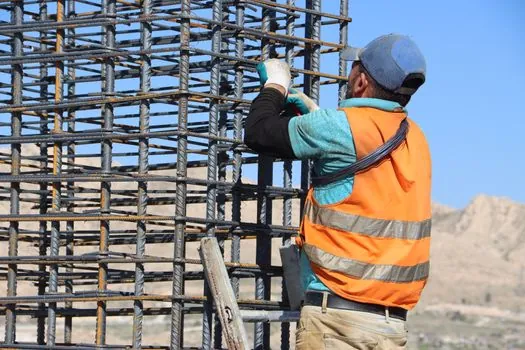
The decision is governed by member type, release strength, and exposure class, not by raw unit price alone. For long-span pretensioned beams and bridge girders where 1,860 MPa ultimate is required, 15.24 mm ASTM A416 Grade 270 low-relaxation is the baseline, sized 0.6 in. to match standard 25 mm and 32 mm chuck anchor heads [S4]. For thin slab and hollow-core lines where cover is tight and bond length is short, 9.53 mm or 12.7 mm 1×7 strand at 1,860 MPa gives better bond per kilogram and easier stressing at lower jacking force [S5]. For T-beam stirrup zones and small panel reinforcement, 2-wire or 3-wire compacted ASTM A910 strand (e.g. 2×2.9 mm, 2×2.25 mm) cuts the cross-section while retaining bond, and was the listed high-price item in 2026 catalogues at US$ 900 to $1,100 per ton [S4].
Coating choice then locks in application: bare strand for bonded pretension, factory-applied grease plus PE sheath (unbonded) for post-tensioned slabs where individual strand replacement is desired, and epoxy-coated or galvanised for aggressive chloride exposure such as marine piles and deck soffits [S4][S5]. The unbonded option carries roughly 15% to 25% material premium over bare strand of the same diameter due to the extrusion line and grease filling.
Logistics, Storage, and Site Constraints Around Strand Choice
Strand diameter feeds directly into transport and hoisting decisions, not just structural design. Prefabricated component logistics are typically planned under a Just-In-Time (JIT) scheme, with carbon emissions and customer satisfaction as the dual optimisation objectives and delivery tolerance driven by traffic and crane cycle uncertainty [S2]. A single 15.24 mm ASTM A416 coil at 2,000 to 3,000 kg per pack is a full forklift load and typically arrives on a dedicated flatbed, so precast yards in dense urban sites (over 80% of Hong Kong prefabricated sites face space constraints, per the JIT study) need to align strand deliveries with stressing schedules, not stockpile [S2].
Yard siting is therefore a strategic input, and GIS-based weighted-overlay models balancing market proximity, transport cost, and land cost have been used to centralise demand points for new PC component plants, reducing the risk of stranded strand inventory in low-utilisation facilities [S3].
Comparison: Bare 1×7 vs Unbonded 1×7 vs Compacted ASTM A910
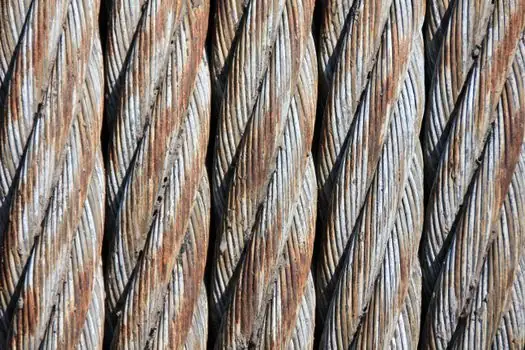
On four decision criteria (cost, application fit, bond performance in SCC, handling in dense urban sites), the three main configurations separate clearly. Bare ASTM A416 1×7 at 12.7 to 15.24 mm is the lowest-cost option at US$ 400 to $700 per ton, is ideal for bonded pretension in double-tees and bridge girders, has the largest body of LBPT and NASP bond data in SCC [S1], and is the easiest to handle because there is no sheath to strip. Compacted ASTM A910 2×2.25 mm and 2×2.9 mm strand is the highest-cost at US$ 900 to $1,100 per ton, is specialised for thin slabs, T-beams, and rail sleepers where rectangular cross-section aids cover, has lower absolute bond area per kilogram but adequate bond for short transfer lengths, and packs more metres per coil for the same tonnage [S4].
Common Pitfalls and Failure Modes
Three field issues dominate non-conformance reports on incoming strand lots. First, transfer length overshoot: AASHTO LRFD and ACI 318 transfer-length equations have been observed to under-predict measured transfer length in modern strand, with the suspected root cause being the industry-wide shift from convection heating to induction heating during stress-relief, which alters surface condition and bond [S1]. For deeper analysis of this in high-rise applications, see the 2026 field data on strand selection for tall buildings. Second, end slip at release: the absolute (not relative) bond metric is where LBPT fails strands that NASP passes, so precasters running only LBPT risk rejecting acceptable strand and should add ASTM A1081 (NASP) as the second method [S1]. Third, storage corrosion: bright strand stored at the yard for more than 2 to 3 weeks under rainfall develops light surface rust that, while not a structural problem in bonded applications, triggers site rejection in unbonded jobs where sheathing is already fitted, so the JIT delivery model is not just a cost play but a corrosion-prevention tool [S2].
Related Tools, Equipment, and Site Handling
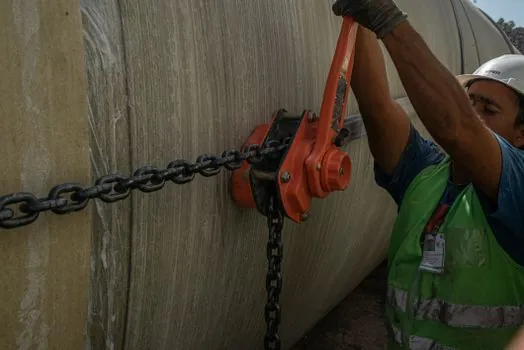
Strand selection does not stop at the coil; the stressing jacks, chuck anchors, and sheathing cutters must be sized to match. For 15.24 mm strand, single-pull jacks at 250 to 300 kN capacity are typical, while 12.7 mm strand can use 200 kN jacks, and the chuck cone and wedges must be matched to the same standard (ASTM A416 or A910) to avoid slip at lock-off. General construction tools used on a precast bed include hydraulic cutters, stressing pumps, and grout mixers; these are usually procured in parallel with strand, not after, to avoid bed downtime. For a sister application in school buildings, the PC strand spec map for floor spans walks through the same selection logic with different span targets. [S4]
The next node to track is the 2026 revision activity on ASTM A1081 (NASP) acceptance limits for high-strength SCC, since the existing data set is built on Grade 270 strand at 12.5 mm and high-strength SCC above 70 MPa is still expanding. A second signal is the prestressing strand price band itself: if Tianjin ex-works offers move outside the US$ 400 to $1,100 per ton corridor in late 2026, that will be a leading indicator of either rebar-linked steel cost moves or container freight shifts from the Bohai rim.