
PTFE flat sealing washers withstand continuous service near 260°C (500°F), resist virtually all corrosive fluids, and carry FDA clearance for food and pharmaceutical contact, per manufacturer published data [S1]. Compressed fiber washers (cellulose fibre bound with elastomer or resin) remain the default drain-plug, banjo-fitting, and hydraulic-summation sealing element where the joint runs cool and the budget matters.
The two materials answer different design questions. PTFE is the chemically inert, low-friction, non-adhesive option with a melt point around 327°C (620°F) and a published dielectric strength near 500 V/mil [S1]. Compressed fibre is the compressible, low-cost, torque-tolerant option that conforms to minor surface defects on a parallel mating face and absorbs vibration at the fastener head.
Material Composition and Mechanical Behaviour
PTFE (polytetrafluoroethylene) is a fully fluorinated semicrystalline thermoplastic with a density near 2.15 g/cm³, the lowest coefficient of friction of any solid, and near-total hydrophobicity [S1]. Compressed fibre washers are typically cellulose or aramid fibre bound with nitrile rubber, phenolic resin, or a nitrile-PVC blend, pressed to a controlled thickness and density. The material distinction drives every downstream property: PTFE washers are dimensionally stable and do not cold-flow under bolt load in the way nylon does, but they are not compressible; fibre washers are designed to crush a defined amount and recover elastically.
Mechanically, PTFE retains a useful tensile strength in the 10–35 MPa range and shows viscoelastic creep under sustained load above 20 MPa, which is why design guidelines limit its use as a load-bearing gasket on high-bolt-load flanges. Compressed fibre is compressible by design, typically 10–25% crush at recommended seating stress, which is the property that lets it seal a rough or slightly warped face without a high-finish machine.
Temperature, Chemical, and Pressure Envelope
PTFE flat washers are rated for continuous service from cryogenic temperatures up to about 260°C (500°F), with a melting point near 327°C (620°F) [S1]. They are described as the most chemically resistant plastic commercially available and remain stable against acids, bases, and solvents that would degrade elastomer- or cellulose-bound products. Compressed fibre washers are typically limited to a continuous service ceiling of 80–120°C, depending on the binder system, and degrade in the presence of hydrocarbon solvents, strong oxidising acids, and glycol-based hydraulic fluids over time.
On pressure rating the picture flips. PTFE in a flat washer geometry is not a high-pressure gasket by itself; it is normally paired with a proper raised-face or ring-type joint when the system pressure climbs above 1 MPa. Compressed fibre, by contrast, is the standard hydraulic sealing element at banjo bolts, sump plugs, and brake caliper bleed screws operating at line pressures typically below 7 MPa (1000 psi), where the crush-to-seal mechanism and the fibre's retention of the bolt clamping force dominate the engineering decision.
Sealing Geometry: Parallel Face vs Tapered Thread

Thread geometry decides the right material more often than chemistry does. Tapered-thread joints (NPT, BSPT, metric taper) generate their seal by thread deformation and need a soft, compressible medium: PTFE tape, hemp with paste, or a soft fibre ring. Parallel-thread joints (BSPP, metric parallel, UN/UNF with O-ring or face seal) make the seal on a machined face, not on the threads, and that is where the flat washer choice lives. [S5]
For BSPP and metric parallel fittings, PTFE flat washers and compressed fibre washers are both specified, but with different intents. A PTFE flat washer is chosen where chemical compatibility or temperature rules fibre out, or where the joint is opened and re-closed frequently and the anti-seize property of PTFE matters. A compressed fibre washer is chosen where a defined crush is required to seal a slightly imperfect face, or where the joint is in a vibration-loaded bracket and a softer material dampens the fastener. Forum-side experience over decades is that fibre washers leak more often than metal or PTFE crush washers when the inner diameter is mismatched, because the seal area is not centred on the bolt [S3].
Decision Matrix: PTFE vs Compressed Fibre by Criterion
For procurement and specification, the four criteria that matter are temperature, chemical compatibility, joint type, and cost-per-seal. [S3]
On continuous service temperature, PTFE wins with a 260°C ceiling versus 80–120°C for compressed fibre [S1]. On chemical compatibility, PTFE is rated against virtually all corrosive fluids, while compressed fibre is restricted to petroleum oils, water, and glycol within its temperature window. On joint type, tapered threads take PTFE tape or hemp plus paste, not flat washers; parallel-thread face seals take either material. On cost, compressed fibre is materially cheaper per part, often by a factor of 5–10 versus machined PTFE flat washers in small-quantity catalogue pricing [S7].
Per-use-case recommendation: choose PTFE flat washers for chemical dosing skids, pharmaceutical water-for-injection loops, and any flange or face seal above 120°C; choose compressed fibre for hydraulic banjo bolts, oil-pan drain plugs, and brake and clutch pistons where the joint is cool, parallel, and not chemically aggressive. The detail-level point that fixes most field leakage is matching the inner diameter of the washer to the outside of the male thread, not to the bolt shank, so the seal area is centred [S3].
Installation Pitfalls and Field Failure Modes
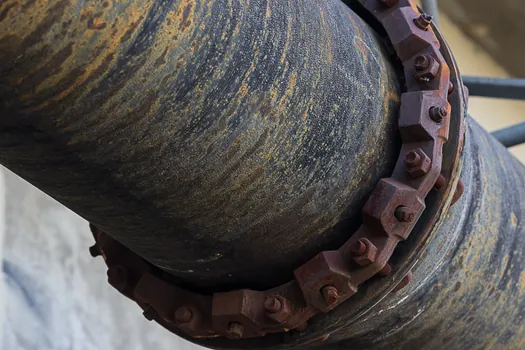
PTFE flat washers fail in service from over-torque (cold flow past the bolt clamping force), from reuse after a high-load cycle (the material does not recover like an elastomer), and from being specified on a rough face where only a compressible material can conform. Compressed fibre washers fail from chemical attack (the binder swells or dissolves), from heat ageing above the binder's glass transition, and from re-use after the crush set has been taken out of the material. [S1]
Two installation details recur in field reports. First, dry assembly of a fibre washer on a dry face gives lower friction than a smeared face, so the torque-tension relationship is more predictable on a clean, lightly oiled joint. Second, when a fibre washer leaks, the typical root cause is not the material but the centering: the inner diameter is too large for the thread, so the sealing annulus is not under compression when the bolt is tight [S3]. For PTFE, the equivalent detail is surface finish: PTFE will not flow into machine-tool marks the way soft metal or fibre will, so a flange face finish of 0.8–1.6 µm Ra is the usual spec.
Standards, Approvals, and Sourcing Notes
PTFE sealing washers carry FDA approval for food, beverage, and pharmaceutical contact when manufactured from virgin PTFE, and meet USP Class VI biocompatibility testing in most catalogue grades [S1]. Material standards commonly cited on PTFE datasheets include ASTM D4894 (ram-extruded PTFE), ASTM D1710 (virgin PTFE), and AMS 3657. Compressed fibre sealing washers are typically specified against DIN 7603 (form A copper, form C fibre, form D aluminium) for hydraulic port plugs, with steel and aluminium crush washers as the alternatives on the same form.
On sourcing, PTFE flat washers are stocked in small-quantity catalogues from US manufacturers such as Superior Washer, which lists PTFE as a stocked flat-washer material alongside fibre, neoprene, and Nylatron [S2]. Compressed fibre sealing washers are stocked in both inch and metric sizes, including BSP-oriented sizes; buyers should note that the same nominal BSP thread can be dimensioned differently by different manufacturers, so once a working source is found it should be kept to maintain interchangeability [S3]. For background material science on PTFE as an engineering plastic, the PTFE engineering properties reference covers the broader polymer family.
For engineers comparing washer choices to other sealing elements on the same drawing, the sealing washer selection guide covers the full metal, fibre, polymer, and elastomer matrix in one view. The physics of how a washer stops a joint from leaking, and how it differs from a gasket, is laid out in the sealing fundamentals entry. For spring-style washers that complement flat sealing washers in vibration-loaded joints, the spring washer reference covers Belleville, curved, and three-wave geometries.
Trackable signal: DIN 7603 form C fibre washer dimensional tables continue to anchor European hydraulic plug-seal practice, while PTFE and filled-PTFE envelope materials are taking share in sanitary and chemical dosing skids where the temperature or chemistry rules out cellulose binders. The next confirmation to watch for is supplier-side publication of fatigue and creep data for PTFE flat washers at sustained bolt load above 15 MPa, which would extend their use into higher-pressure face-seal applications.
Background reading: Hall vs magnetoresistive magnetic encoders: a spec-level selection guide.