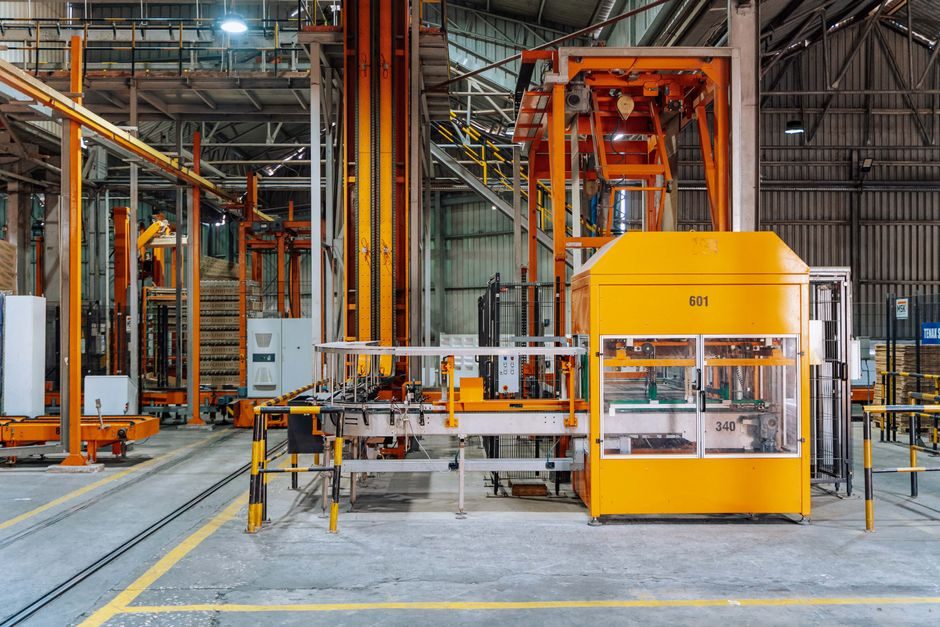
A vertical lift module in a pulp-and-paper operation most often stores maintenance spares, roll cores, chemical additives, cutting blades and SBR/Stainless wire reels in a footprint roughly one-tenth of an equivalent static shelving block, with internal lift heights commonly spanning 7-12 m and per-tray payloads in the 250-1,000 kg band [S3][S7].
Mill-floor realities - airborne paper dust, humidity swings near the paper machine, fork-truck loading, and batched consumables of varied geometry - drive the spec, not brochure claims. Economic evaluations of VLMs in small-items order picking show labour productivity gains and a measurable reduction in picker walk distance versus carton racks, which is the same physics applied inside a mill storeroom [S1].
What a Mill VLM Has to Withstand
Paper-dust exposure above ISO 16890 ePM10 50% loading is the baseline environment near a pope reeler or winder, so any VLM specified for a paper-mill storeroom needs sealed extractor bearings, IP54 control cabinets, and trays that can be hosed or wiped down without corrosion [S3].
Humidity in a paper-machine hall runs 50-80% RH with short spikes during broke-recovery washdowns, which is why galvanized steel trays and powder-coated enclosures out-perform painted cold-rolled steel in a 5-year cost-of-ownership comparison, though a stainless upgrade is justified only near bleach-plant chemical stores where chloride and peroxide vapours concentrate [S2][S5].
Cleaner side: a finished-goods warehouse or a central spare-parts room operates near ambient 20-25 °C / 40-60% RH, and a standard VLM cabinet with a 1,500-3,000 kg total payload and a single 500-kg tray is the typical fitting [S3][S7].
Spec Bands That Matter on a Mill P.O.
Internal height drives SKU density: a 7 m unit holds roughly 30-40 m³ of tray volume, a 10 m unit 45-60 m³, and a 12 m unit 60-80 m³, all behind a single ~3 m² footprint, with the global VLM market valued at US$ 950.19 million in 2024 and projected to US$ 1,766.08 million by 2031 [S7].
Access speed is set by the lift hoist, typically 1.0-1.5 m/s, with an extractor shuttle cycle of 2-4 s; total pick cycle lands between 10 and 25 s for a single SKU, which is fast enough to keep a 6-10 person maintenance crew supplied without a dedicated runner.
Where the VLM Pays Back - and Where It Does Not
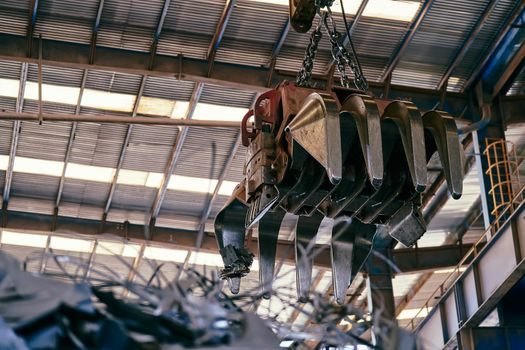
VLMs pay back fastest where SKUs are numerous, individual items are small to medium (under ~50 kg), and floor space is at a premium, which exactly matches a paper mill's MRO storeroom, blade room, and chemical additive room [S1][S3].
VLMs do not pay back for full-size paper rolls, jumbo tissue parent reels, or pulp bales: a single 30-ton reel of finished paper has 30x the mass of the heaviest VLM tray and a 3.0-3.5 m face width, so a roll-handling ASRS with chain conveyors or a ground-level roll warehouse is the correct fit, not a VLM.
Liquid chemicals in IBC totes (1,000 L, ~1,200 kg) sit at the upper edge of VLM feasibility and only when the chemistry is non-corrosive; for sodium hydroxide, hydrogen peroxide or sodium hydrosulfite stores, a bunded floor block with a VLM for the dry additives beside it is the more defensible layout [S2][S5].
Options Comparison: Standard VLM vs Paternoster vs Carousel
A standard enclosed VLM delivers the best floor-space ratio, ~10:1 versus static shelving, with a single operator access point, but it caps tray weight at the 500-1,000 kg range and runs at 1.0-1.5 m/s hoist speed [S3][S7].
A vertical carousel (paternoster) costs less per cubic metre of storage and tolerates heavier individual trays up to 1,500 kg, but it exposes the SKU to ambient dust and humidity, which is a deal-breaker in a paper-dust zone.
A horizontal carousel is the right answer only when the SKU mix is dominated by long, rigid items such as fabric wires, press felts and dryer fabrics in 6-12 m lengths; for everything else, the VLM wins on density and pick ergonomics [S1].
A useful spec-side rule of thumb: if SKU density above 1.5 SKUs/m² of floor and pick rates above 60 lines/hour are both required, the VLM is the cheapest way to hit both targets; below those thresholds, a static shelf-and-bin block with a fixed pick face is usually the lower-capex answer [S1].
Sourcing, Standards and Mill-Side Caveats
Major VLM OEMs ship globally with multi-language HMI and dual 400 V / 50 Hz plus 480 V / 60 Hz electrical kits, but lead time on a custom-height unit in 2026 is 16-24 weeks ex-works Europe and 12-18 weeks ex-works North America, with on-site installation adding 2-4 weeks [S3][S7].
Control integration into a mill ERP (SAP PM, Maximo) is a standard option on Modula-class units and on Chinese OEM offerings such as the Chenlift range of vertical lifts and aerial work platforms, where the WMS/WCS layer exposes a REST or OPC-UA interface to the host MES [S3][S4].
Two engineering watch-outs that engineers commonly miss: dust ingress into the extractor carriage, which forces a quarterly vacuum-and-grease cycle in a paper-mill install versus an annual cycle in a clean room, and the need to coordinate VLM base isolation with the mill's pit drainage so washdown water does not pool beneath the cabinet [S3].
For the broader factory-floor context, an adjacent AMR selection guide for 2026 covers the picking and kitting side that often pairs with a VLM tote-out feed, while harmonising motion-control spec bands for a VLM's extractor and hoist with the harmonic drive reducer supplier map keeps the spare-parts bill of materials aligned with what is on the mill's preferred-vendor list.
Reference Architecture in a Pulp-and-Paper Storeroom
A typical Tier-1 install pairs the VLM with a 3-4 m run-out conveyor, a put-wall of 24-48 slots, and 2-3 AMRs or tugger carts that feed work-in-process parts to the paper-machine basement; this is the same architecture that smaller e-commerce order-picking operations use, scaled up to a paper-mill maintenance load profile [S1][S3].
Chem-side adjacent storage for pulping, bleaching and coating additives - defoamers, wet-strength resins, sizing agents, dyes and OBA - is typically held in a separate VLM with stainless trays and a stainless extractor, and is fed from the same mill ERP via a shared item master so the kraft and BCTMP lines can pull a 25 kg bag from a controlled-FIFO pick face [S2][S5].
For component-level specifications, see vertical lift module, linear module, and relay module.