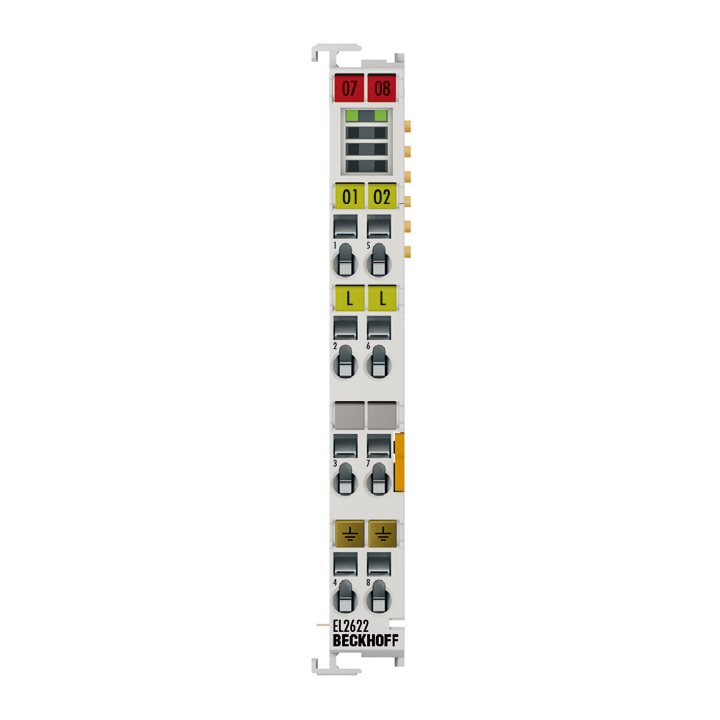
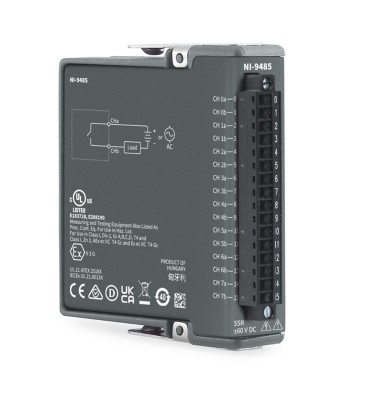
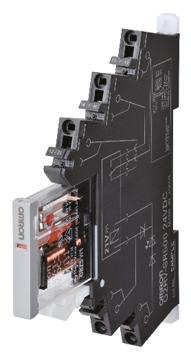
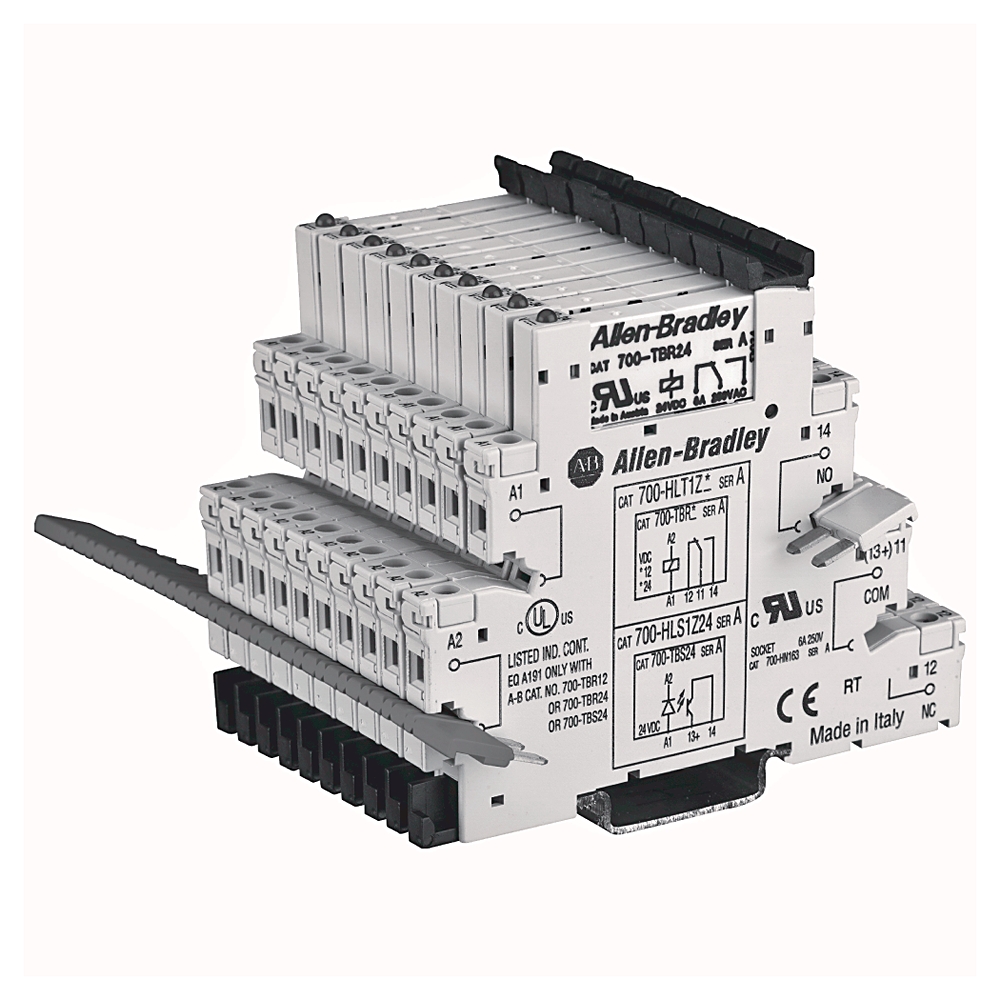
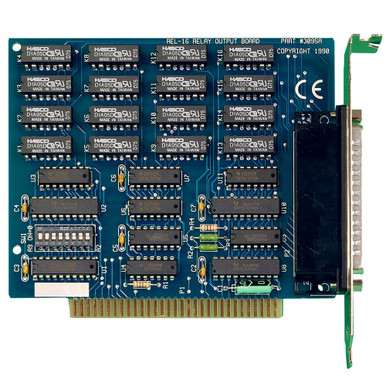
A relay module is the panel-ready packaging of a relay: a coil-driven switch combined with a plug-in socket, DIN-rail foot, status LED, and built-in coil suppression. In modern control cabinets it almost always serves as an interface relay, bridging a low-current PLC or DCS output to a heavier field load such as a contactor coil, solenoid valve, lamp, or motor starter. The module form lets a maintenance technician replace a worn relay in seconds without touching the field wiring.
Relay modules split into two families that share the same purpose but almost nothing else physically: electromechanical relays (EMR), which move a metal armature to make and break real contacts, and solid-state relays (SSR), which switch the load with a triac, SCR, or MOSFET and no moving parts. This guide decodes both, the contact and coil specifications that govern selection, and the IEC standards that define their ratings.
Photo: RELAYGO, CC BY-SA 4.0, via Wikimedia Commons
This guide is aimed at industrial purchasing engineers and design engineers. It covers 6 chapters from what a relay module is, electromechanical versus solid-state types, contact configurations and materials, coil and load standards, key spec-sheet parameters, to selection decisions, with 7 selection FAQs and manufacturer comparisons. All parameters reference the IEC 61810 series for elementary electromechanical relays, IEC 60947-5-1 for control-circuit utilization categories, IEC 60715 for DIN-rail mounting, and IEC 62314 for solid-state relays.
Chapter 1 / 06
What is a Relay Module
A relay is an electrically operated switch. A small current through a coil creates a magnetic field that pulls an armature, and the armature moves one or more contacts that open or close a separate, usually much larger, circuit. The principle is electrical isolation plus amplification: a milliamp-level control signal commands an ampere-level load, with no electrical connection between the two sides. A relay module takes that bare component and adds everything a control panel actually needs to deploy it: a plug-in socket or screwless terminal block, a foot that clips onto a DIN rail, an LED to show coil state, and a coil suppression circuit so the relay does not damage the device driving it.
The decisive feature of the module form is serviceability. The relay sits in a socket and is retained by a plastic clip; when its contacts wear out after millions of operations, a technician ejects the old relay and presses in an identical spare in seconds, with the field wiring undisturbed on the socket. This is why the interface relay module, rather than the soldered-in component relay, dominates industrial control cabinets. A modern panel may hold dozens of identical 6.2 mm or 14 mm wide modules in a row, each one isolating and amplifying a single digital output channel.
Historically, the relay predates almost all of modern electronics. Joseph Henry demonstrated the electromagnet relay principle in the 1830s, and Samuel Morse and Alfred Vail used relays to regenerate telegraph signals over long lines, the original meaning of the word relay. Through the first half of the 20th century, electromechanical relays built the first telephone exchanges and the earliest digital computers: the Harvard Mark I and the German Zuse Z3 computed with thousands of relays before vacuum tubes and transistors displaced them in logic. Relays never left power switching, where their galvanic air gap and ability to handle real fault current keep them indispensable.
The solid-state relay arrived with power semiconductors. Once the triac (1960s) and the optically isolated phototriac driver made it practical to switch mains AC with a photocoupler and no moving parts, the SSR took over high-cycle and silent-switching duty. Today the two technologies coexist: the EMR for galvanic isolation and mixed AC/DC duty, the SSR for fast, frequent, arc-free switching. Both are sold in the same DIN-rail interface module footprint so a panel builder can mix them channel by channel.
Functionally, three numbers define what any relay module can do, and they answer three separate questions. The coil side asks: what control voltage operates it, typically 24 V DC from a PLC supply, or 110 V and 230 V AC. The contact side asks: how much load can it switch and break, expressed as a current rating tied to a load type. The isolation side asks: how good is the electrical separation between control and load, expressed as a dielectric withstand voltage. The chapters below take each in turn, because mismatching any one of the three is the usual cause of a relay that fails early or never operates at all.
Chapter 2 / 06
Electromechanical vs Solid-State
The first selection fork is technology. An electromechanical relay (EMR) physically moves a metal contact; a solid-state relay (SSR) switches the load with a semiconductor and has no moving parts. They are interchangeable in many sockets and serve the same wiring role, but their failure modes, switching behavior, and limits differ so much that choosing wrongly guarantees trouble. The table below compares the two on the metrics that actually drive a decision.
Attribute
Electromechanical (EMR)
Solid-State (SSR)
Switching element
Moving metal contacts
Triac, SCR, or MOSFET
Mechanical life
10 to 30 million ops
No moving parts
Electrical life at load
100k to 1 million ops
10 to 100 million+ ops
Operate time
5 to 15 ms
under 1 ms (DC), 1/2 cycle (AC)
On-state voltage drop
under 0.1 V
1.0 to 1.6 V (AC triac)
Off-state leakage
~0 (true air gap)
1 to 10 mA
AC and DC switching
Both with one part
AC or DC type-specific
Contact bounce / arcing
Yes
None
Electromechanical relay. The EMR remains the default interface relay because of three intrinsic advantages. It opens a true galvanic air gap, so an open contact provides genuine isolation that no semiconductor can match. Its on-state voltage drop is below 0.1 V, so it wastes almost no power and needs no heat sink. And one part switches AC or DC, resistive or inductive, in any polarity. Its weaknesses are mechanical: contacts wear and weld, the armature bounces on closing, switching produces an audible click and an arc, and electrical life under load is measured in hundreds of thousands of operations rather than millions. Representative interface families include Finder Series 38 (built on the Series 34 and 40 relays), Phoenix Contact PLC-RSC, and Omron G2R and MY ranges.
Solid-state relay. The SSR replaces contacts with a power semiconductor optically coupled to the control side. For AC loads the output is a triac or back-to-back SCRs; for DC it is a power MOSFET. Because nothing moves, the SSR has effectively unlimited mechanical life, switches in well under a millisecond, makes no sound, and produces no arc, which makes it the only sane choice for tens of thousands of cycles per day, for hazardous areas, and for fast heater pulse-width control. Its costs are physical: an AC triac drops roughly 1.0 to 1.6 V across the junction, so it dissipates over 1 W per ampere and must be heat-sinked and thermally derated above a few amps; it leaks a few milliamps when off rather than truly isolating; and it is sensitive to voltage transients and overcurrent, requiring snubbers and fast fuses. Representative families include Omron G3 series and Phoenix Contact PLC-OSC.
A practical SSR sub-decision is the turn-on method. A zero-cross SSR waits for the AC waveform to pass through zero volts before conducting, which minimizes inrush and electrical noise and suits resistive heaters and transformers. A random-turn-on (non-zero-cross) SSR conducts the instant it receives the control signal regardless of waveform phase, which is required for phase-angle dimming of lamps and for inductive loads where you must control the switching instant. Choosing a zero-cross device for a phase-control application, or vice versa, produces flicker or fails to control the load at all.
A third hybrid exists: the hybrid relay, which parallels an EMR with an SSR. The SSR makes and breaks the load at the AC zero crossing to eliminate arcing, while the EMR carries the steady current to avoid the SSR's on-state heat loss and to provide a real open gap when off. Hybrids deliver SSR-grade electrical life with EMR-grade efficiency and isolation, at higher cost and complexity, and are used in high-cycle heater and lamp circuits where both long life and low loss matter.
Chapter 3 / 06
Contact Configurations and Materials
For an electromechanical relay, two physical choices shape what it can do: how the contacts are arranged (the contact form) and what metal they are made from (the contact material). Both are encoded on every datasheet and both have direct consequences for the load you can switch and the life you will get. This chapter decodes the contact form notation first, then the material selection.
Contact arrangement is described by pole and throw. A pole is one independent switch path controlled by the coil; a throw is one position that path can connect to. The industry also uses contact-form letters from the IEC and NARM convention. Form A is a single normally open (NO) contact: it makes the circuit when energized. Form B is a single normally closed (NC) contact: it breaks the circuit when energized. Form C is a changeover (CO) contact: a common terminal that transfers between an NO and an NC contact. The table below maps the common pole-throw labels to their form notation and typical use.
Label
Meaning
Form
Typical use
SPST-NO
1 pole, 1 throw, normally open
1 Form A
Simple on/off of one circuit
SPST-NC
1 pole, 1 throw, normally closed
1 Form B
Fail-safe break on energize
SPDT
1 pole, 2 throw (changeover)
1 Form C
Most interface relay modules
DPDT
2 pole, 2 throw (2 changeover)
2 Form C
Switch two circuits, motor reverse
4PDT
4 pole, 2 throw
4 Form C
Multi-circuit signal switching
Most slim interface relay modules carry a single SPDT (1 changeover) contact, because one channel of a PLC output typically commands one field device. Where two circuits must switch together, or a motor must be reversed by swapping two phases, DPDT modules in the wider 14 mm housing provide two changeover contacts on one coil. Multi-pole 4PDT relays appear in signal and logic switching rather than power, often with gold-flashed contacts. A key rule: paralleling two poles to double current is unreliable, because the contacts never close at exactly the same instant, so one pole carries the full make-and-break stress. Always rate a single pole for the full load.
Contact material determines erosion resistance, contact resistance, and minimum reliable load. The choice trades arc resistance against the ability to switch tiny signal currents. The most common power-contact alloys are silver alloys, because silver has the lowest electrical resistance of any metal and conducts heat away from the arc.
Silver nickel (AgNi): the general-purpose workhorse for interface relays, good arc erosion resistance and low contact resistance, used across Finder Series 38 and most 6 A to 16 A modules.
Silver tin oxide (AgSnO2): excellent resistance to contact welding under high inrush, the preferred alloy for lamp, capacitive, and motor loads with heavy make currents; used in Phoenix Contact PLC-RSC power-contact relays.
Silver cadmium oxide (AgCdO): long the standard arc-resistant alloy, now restricted under RoHS in many markets and largely superseded by AgSnO2.
Gold-plated or gold-flashed silver: for dry-circuit and low-level signal switching (millivolt, milliamp logic levels) where a clean, non-oxidizing surface is essential; the thin gold protects the contact until first switched.
Material choice also sets the minimum switching load. A power-rated AgNi or AgSnO2 contact relies on a small arc to clean off oxide and sulfide films; below roughly 5 V and 10 mA it may fail to make reliable contact. IEC 61810-1 references a minimum reference load on the order of a few volts and tens of milliamps for this reason. For genuinely dry logic-level signals you must specify gold contacts, otherwise the relay will work on the test bench at full voltage and then fail intermittently switching a low-level sensor line in the field.
Chapter 4 / 06
Coil, Load Standards, and Suppression
The two electrical interfaces of a relay module, the coil that operates it and the load it switches, are each governed by parameters and standards that the datasheet abbreviates heavily. Misreading either side is the most common field failure, so this chapter unpacks both, plus the coil suppression circuit that the module form usually builds in.
The coil side. The coil has a rated (nominal) voltage, typically 24 V DC for PLC-driven modules, or 12 V, 48 V, 110 V, and 230 V in AC or DC variants. Three thresholds matter beyond the nominal value. The pull-in (operate) voltage is the minimum coil voltage that reliably closes the armature, usually about 70 to 80 percent of nominal. The drop-out (release) voltage is the level the coil must fall below for the relay to reliably reopen, often around 10 to 30 percent of nominal; the gap between pull-in and drop-out is the relay's hysteresis. The coil power (or current) sets how much the PLC output or driver must supply: a sensitive DC coil may need only 170 mW, while an AC coil draws a higher inrush than holding current because the magnetic gap is largest at the moment of energizing. A 24 V DC interface module coil typically draws on the order of 9 to 20 mA, well within a PLC transistor output's capability.
The load side and utilization categories. A single headline current rating is meaningless without the load type, because an inductive or lamp load erodes contacts far faster than a resistive one of the same current. IEC 60947-5-1 defines control-circuit utilization categories that specify the realistic rating for each load character. The table below lists the categories you will see on interface-relay datasheets.
Category
Current
Load type
Severity
AC-1
Highest (e.g. 6 to 16 A)
Resistive, non-inductive AC
Lowest
AC-12
Near AC-1
Resistive and opto-isolated loads
Low
AC-14
Derated
Small AC electromagnets
Medium
AC-15
Heavily derated
AC electromagnets (contactor coils)
High
DC-1
Highest DC
Resistive, non-inductive DC
Lowest
DC-13
Most derated
DC electromagnets, solenoids
Highest
The practical lesson is to read the category, not the big number. A Finder Series 38 SPDT module is rated 6 A at AC-1 (250 V AC resistive) and 6 A at DC-1 (30 V DC resistive), but switching a contactor coil at AC-15 derates it substantially, and a DC solenoid at DC-13 derates it further still. DC inductive switching is the harshest case on any list because a DC arc has no current zero to extinguish it: the arc must be physically stretched until it self-extinguishes, which is why DC breaking capacity is always lower than the AC figure and why DC inductive loads demand explicit attention.
Coil suppression. Because the coil is itself an inductor, switching it off generates an inductive kickback spike that can exceed 100 V and destroy the driving transistor or PLC output. On DC modules the standard remedy is a free-wheeling (flyback) diode connected in reverse bias across the coil: in normal operation it blocks current, and when the coil de-energizes it forward-biases and gives the stored energy a circulating path that clamps the spike. The cost of a plain diode is slower armature release, which lengthens arcing on the load contacts, so high-cycle modules add a Zener or transient-voltage-suppressor in series for a faster, harder release. AC coils cannot use a polarized diode and instead use an RC snubber, sometimes with a varistor. Interface relay modules almost always build the appropriate suppression and a polarity-keyed status LED into the housing, which is a substantial reason to specify the module rather than wire a bare relay and add discrete protection.
Separately, the load side of an EMR may need its own contact suppression when switching an inductive load such as a solenoid or motor: an RC snubber or varistor across the contacts absorbs the load's own inductive arc and extends contact life. This is distinct from coil suppression and is sized to the load, not the coil.
Chapter 5 / 06
Key Specification Parameters
A relay module datasheet may list 20 to 40 lines, but a manageable set of parameters actually drives selection. The Key Specifications comparison below contrasts three representative interface-module classes, a slim EMR, a wider power EMR, and an SSR, on the parameters that matter, using figures from published manufacturer data. Treat the numbers as typical class values and confirm against the exact part datasheet before purchase.
Parameter
Slim EMR (e.g. Finder 38.61)
Power EMR (e.g. PLC-RSC)
SSR module
Contact form
1 SPDT (changeover)
1 SPDT (changeover)
SPST-NO (1 path)
Rated current (AC-1)
6 A @ 250 V AC
6 A @ 250 V AC
2 to 3 A typical
Max switching voltage
250 V AC
250 V AC/DC
up to 280 V AC
Contact material
AgNi
AgSnO2 / AgNi
Triac (no contact)
Coil / input voltage
24 V DC
24 V DC
24 V DC
Coil current
~10 mA
~9 mA
a few mA
Operate / release time
~6 / ~8 ms
~5 / ~8 ms
under 1 ms / 1/2 cycle
Mechanical life
10 million ops
~20 million ops
No moving parts
Module width
6.2 mm
14 mm
6.2 to 14 mm
Contact rating and category. The single most important contact parameter, always read together with its utilization category from Chapter 4. The headline AC-1 figure (6 A, 16 A) applies only to resistive loads; derate for AC-15 or DC-13 inductive duty. Also note the maximum switching voltage and, for DC, the maximum breaking capacity, since DC arcs do not self-extinguish.
Mechanical versus electrical life. These are two different numbers and beginners conflate them. Mechanical life, the number of operations with no load on the contacts, is in the tens of millions (the Finder 34 relay is rated 10 million mechanical operations). Electrical life, the number of operations switching the rated load, is far lower, often 100,000 to a few hundred thousand at full current, because each switching event erodes the contact. A relay rated 10 million mechanically may give only 100,000 operations breaking a heavy inductive load. SSRs have no mechanical wear, so their life is governed by junction temperature and thermal cycling, not operation count.
Coil parameters. Nominal voltage must match your control supply, and the pull-in and drop-out thresholds must sit comfortably inside your supply's tolerance, including the voltage drop along long coil runs. Coil power decides whether a PLC transistor output can drive the module directly: a 24 V DC interface coil drawing roughly 10 mA is well within a standard digital output, which is precisely the point of an interface relay.
Timing. Operate time (5 to 15 ms for EMRs) and release time set the maximum useful switching frequency and the response latency. Contact bounce on operate (1 to 5 ms) adds settling time and, for fast counting inputs, requires debounce. SSRs operate in under a millisecond for DC and within half an AC cycle for zero-cross AC, which is why they own high-frequency duty.
Isolation and environment. The dielectric strength between coil and contacts, commonly specified around several kilovolts for interface relays, sets the safety isolation. Mounting follows IEC 60715 (DIN rail NS 35/7.5), and the housing carries an ingress rating, typically IP20 for a terminal module inside an enclosure. Approvals to UL 508 / UL 61810 and the CE marking against IEC 61810-1 round out the compliance picture.
Chapter 6 / 06
Selection Decision Factors
To turn the preceding chapters into a specific part number, work the decision sequence below in order. Most selection errors come not from a single wrong value but from deciding a later step before an earlier one is settled. These steps double as a fixed RFQ template for interface relay modules.
Define the load and its category: identify exactly what the relay switches (contactor coil, solenoid, lamp, heater, signal) and its steady current, voltage, AC or DC, and inrush. Translate that to a utilization category (AC-1, AC-15, DC-13) so you size against the realistic rating, not the resistive headline figure.
Choose EMR or SSR: pick SSR for high switching frequency, silent or arc-free operation, and very long electrical life; pick EMR for true galvanic isolation, mixed AC/DC duty, multi-pole changeover, and near-zero on-state loss. Consider a hybrid relay only where both long life and low loss are essential.
Select contact form and material: SPDT for one channel, DPDT for two circuits or motor reversal, gold contacts for dry signal levels. Match material to load: AgNi for general duty, AgSnO2 for high-inrush lamp and capacitive loads, gold for low-level signals.
Match the coil to the control supply: nominal coil voltage equal to the control voltage (commonly 24 V DC), with pull-in and drop-out thresholds inside the supply tolerance and coil current within the driving PLC output's capability.
Size life against duty cycle: estimate operations per day, multiply over the design lifetime, and confirm the electrical-life figure at your load exceeds it with margin. If not, move up a contact rating, switch to an SSR, or add contact suppression.
Specify suppression and indication: require integral coil suppression (flyback diode for DC, RC for AC), a status LED, and, for inductive loads, contact-side suppression. Confirm reverse-polarity protection on DC coils if the wiring risk exists.
Fix the mechanical and electrical interface: module width (6.2 mm for density, 14 mm for two poles), terminal type (screw or push-in spring), DIN rail per IEC 60715, ingress protection (IP20 inside an enclosure), and bridging or jumper accessories for shared potential.
Confirm approvals and total cost: require the relevant marks (CE to IEC 61810-1, UL 508 / UL 61810, and for SSRs IEC 62314), then weigh purchase price against expected replacement frequency. A cheap relay on a high-cycle load that fails every few months costs far more in downtime than a correctly sized module bought once.
One frequently overlooked dimension is serviceability and standardization. The whole value of the module form is fast field replacement, which only pays off if the spare relay is in stock and the panel uses as few distinct part numbers as possible. Standardizing on one or two module families across a plant, keeping spares on the shelf, and labeling each socket with its part number turn a five-year maintenance headache into a sixty-second swap. Established interface families from Finder, Phoenix Contact, Weidmuller, Wago, Schneider Electric, and Omron all maintain wide regional distribution and long-term part availability, which matters more over a control panel's 10 to 20 year service life than a small unit-price difference at purchase.
FAQ
What is the difference between a relay and a relay module?
A relay is the bare switching component: a coil, an armature, and a set of contacts. A relay module is the field-ready assembly that wraps that relay with everything a control panel needs: a plug-in socket or terminal block, a DIN-rail foot, an LED status indicator, a coil free-wheeling diode or RC suppressor, and often a manual test lever and reverse-polarity protection. The pluggable design means a failed relay is swapped in seconds without rewiring. In modern panels the term almost always means an interface relay module bridging a PLC output card to a heavier field load, with the relay itself rated for 6 A to 16 A while the PLC output handles only milliamps.
When should I choose a solid-state relay module over an electromechanical one?
Choose a solid-state relay (SSR) module when switching frequency is high, when silent operation is required, or when long electrical life matters more than galvanic isolation. An SSR has no moving contacts, so it survives tens of millions of operations, switches in under 1 ms, and produces no arcing or audible click. It suits resistive heater control, fast pulse-width duty, and hazardous areas where arcing is unacceptable. Choose an electromechanical relay (EMR) when you need a true galvanic air gap in the open state, very low on-state voltage drop, multi-pole changeover contacts, or the ability to switch both AC and DC with one part. SSRs leak a few milliamps when off, drop roughly 1 to 1.6 V on-state, and require heat-sinking and thermal derating above a few amps.
What do SPST, SPDT, and DPDT mean on a relay module?
These describe pole and throw count. A pole is one independent switch path; a throw is one position it can connect to. SPST (single pole single throw, form A) has one normally open contact that simply makes or breaks one circuit. SPDT (single pole double throw, form C, also called changeover) has one common terminal that transfers between a normally open and a normally closed contact, the most common interface-relay configuration. DPDT (double pole double throw) carries two independent changeover contacts driven by the same coil, used to switch two circuits at once or to reverse a motor. Contact form designations A, B, and C come from the NARM and IEC convention: A is normally open, B is normally closed, C is changeover.
How do I size the contact rating for an inductive or lamp load?
Never use the headline resistive (AC-1 or DC-1) figure for inductive or lamp loads. IEC 60947-5-1 utilization categories tell you the realistic rating: AC-15 for AC electromagnets such as contactor coils, DC-13 for DC electromagnets, AC-14 for small electromagnets. A relay rated 6 A at AC-1 may be derated to roughly 3 A at AC-15 and far less for DC-13, because the inductive collapse draws an arc that erodes the contacts. Tungsten-filament lamps and capacitive LED drivers create inrush of 10 to 15 times steady current for a few milliseconds, so size for that peak, not the running current. For DC inductive loads always check the maximum breaking capacity, since DC arcs do not self-extinguish at a zero crossing the way AC arcs do.
Why does a relay coil need a flyback diode or RC snubber?
A relay coil is an inductor. When the drive transistor switches it off, the collapsing magnetic field forces current to keep flowing, generating a high reverse voltage spike (inductive kickback) that can exceed 100 V and destroy the driving transistor or PLC output. A flyback diode placed in reverse bias across a DC coil clamps that spike by giving the stored energy a circulating path, the standard suppression on DC interface modules. The trade-off is that a plain diode slows armature release and lengthens contact arcing on the controlled side, so high-cycle applications use a diode plus Zener or a transient-voltage-suppressor to release faster. AC coils cannot use a diode and instead use an RC snubber across the coil. Most interface relay modules build the suppression in, which is one reason to buy the module rather than a bare relay.
What is contact bounce and why does it matter?
When a relay armature closes, the moving contact strikes the fixed contact and rebounds several times over a few milliseconds before settling, an effect called contact bounce. Each bounce draws a tiny arc, so heavy bounce accelerates contact erosion and can register as multiple pulses to a fast counter or PLC input. Typical electromechanical relays bounce for 1 to 5 ms on operate. It matters in three ways: it limits useful switching speed, it shortens electrical life under load, and it requires debounce logic when a relay output feeds a digital counting input. Solid-state relays have zero bounce because they switch electronically, which is one reason they dominate high-frequency duty. For EMRs, gold-plated bifurcated contacts and proper coil suppression both reduce the practical effect of bounce.
Which manufacturers and series are common for interface relay modules?
For DIN-rail interface relay modules the established European brands are Finder (Series 38 modules built on Series 34 and 40 relays, 6.2 mm and 14 mm widths, 6 A to 16 A), Phoenix Contact (PLC-INTERFACE PLC-RSC plug-in relays and PLC-OSC solid-state versions), Weidmuller (TERMSERIES), Wago (859 and 2042 series), and Schneider Electric (Zelio RSL/RSB). Component-level relays inside modules come from Finder, TE Connectivity (Schrack, Potter and Brumfield), Omron (G2R, MY, G3 SSR families), Panasonic, and Hongfa, the largest global relay maker by volume. For domestic Chinese supply Hongfa, Chint, and Delixi cover most general-purpose duty. Match the module to your I/O density, the load utilization category, and whether you need EMR galvanic isolation or SSR long life.
Relay Module Manufacturers
Source-backed product routes. Open a company dossier for procurement scope and cited evidence.

-50/ADAM-4068_820x82020210705164031.jpg)