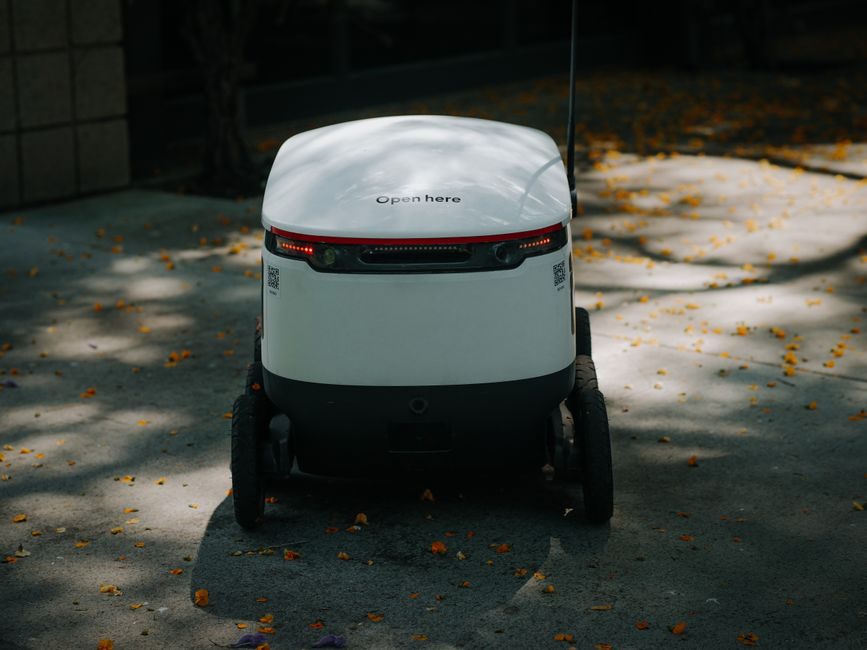
Autonomous Mobile Robot (AMR) supply is consolidating around seven dedicated industrial vendors listed on the DirectIndustry 2026 manufacturer index — including SMP Robotics, Robotnik, Enova Robotics, Capra Robotics, Otsaw Digital, GuangZhou AoBo and ZhenRobotics — with a combined catalog of ten autonomous platforms spanning outdoor surveillance, parking-lot patrol, warehouse, and industrial-site duty cycles [S1].
Buyer-side momentum is anchored by a $14.4 billion 2030 AMR market forecast, growing at a 21.4% CAGR from a 2023 base, with intralogistics, e-commerce fulfillment and last-mile delivery named as the dominant demand verticals [S3]. A 2025 ScienceDirect review confirms the shift from fixed-path Automated Guided Vehicles (AGVs) to free-navigation AMRs as the dominant planning-and-control paradigm, driven by SLAM, sensor fusion and ROS 2 toolchain maturity [S5].
Selection reality, however, is brutally mechanical: payload, SLAM stack, fleet manager and safety rating decide fit, not brochure language. The AMR Selection 2026 spec guide walks through those four levers in the order a process engineer should weight them, and the encyclopedia entry is the canonical reference for AMR vs AGV vs mobile crane distinctions on the same plant floor.
Manufacturer Map: Seven Dedicated AMR Vendors, Plus the China Tier
DirectIndustry's 2026 industrial-manufacturer index lists exactly seven companies against the "autonomous surveillance robot" filter, with SMP Robotics Systems Corp. carrying the broadest catalog at four platforms and the remaining six — Capra Robotics (DK), Enova Robotics, GuangZhou AoBo, Otsaw Digital, Robotnik (ES) and ZhenRobotics — each shipping a single listed model [S1]. Application tagging on the same page splits cleanly: eight platforms are rated for exterior use, five for indoor, with one each specified for parking-lot, warehouse and industrial-site duty [S1].
That seven-vendor count is the visible supply slice for security/surveillance AMRs only; the wider material-handling AMR supply base is dominated by Chinese OEMs catalogued on Roboct Global and Made-in-China.com, where generic "differential-wheeled robot" platforms and universal servo-motor drivers are listed as modular building blocks for OEM integrators [S6]. For buyers in mainland China, Made-in-China aggregates AMR-adjacent mobile-platform listings with MOQ and FOB price bands that materially undercut European list prices, though certification traceability varies by seller.
Payload, SLAM and Safety: The Four-Decision Selection Frame
AMR selection collapses onto four mechanical decision points: rated payload, navigation/SLAM stack, fleet-manager interoperability, and functional-safety rating. A 50–100 kg tier typically pairs 2D LiDAR + fiducial-marker SLAM with ISO 3691-4 performance-level PL=d cat-3 stops; a 1000–1500 kg pallet-handling tier demands 3D LiDAR + safety-rated camera fusion and PL=d cat-3 with redundant encoder channels, per MathWorks' 2026 AMR development reference [S4]. The same reference confirms that ROS and ROS 2 are the de-facto middleware for sensor data ingest, with MATLAB/Simulink used for SLAM algorithm validation, point-cloud processing, deep-learning-based object detection and sensor-fusion prototyping before deployment [S4].
A collaborative robot cell that hand-shakes an AMR via VDA 5050 typically adds 2–4 weeks of integration effort versus a vendor-proprietary fleet manager, but removes single-vendor lock-in for greenfield builds [S4].
Intralogistics Use Cases and Last-Mile Delivery
Warehouse and intra-fulfillment AMR use cases centre on tote and pallet transport in 24/7 distribution-centre operations, where the ScienceDirect 2025 literature review identifies planning-and-control advances — dynamic task allocation, traffic management and multi-agent coordination — as the live research frontier [S5]. The same review frames the AGV→AMR transition as a move from inductive-wire or magnetic-tape guidance to SLAM-based free navigation, with simultaneous localization and mapping now the standard reference layer [S5].
Last-mile delivery is a separate vertical: ShinMaywa Industries' 2026 R&D disclosure documents a delivery-system programme built around autonomous mobile robots aimed at the labour-shortage-driven "last one mile" gap in Japanese logistics, with e-commerce small-lot delivery volume growth cited as the demand trigger. Buyers specifying outdoor AMRs should plan for IP54–IP65 ingress protection, an operating-temperature window of roughly -10 °C to +50 °C, and GNSS-denied fallback SLAM for urban-canyon or indoor-to-outdoor transitions [S1].
Development Stack: ROS 2, MATLAB/Simulink, and Open-Source Reference Builds
Engineering teams building in-house AMR stacks converge on a common toolchain: ROS or ROS 2 for sensor-data ingest and inter-node messaging, MATLAB/Simulink for control-loop modelling, point-cloud processing, sensor-fusion prototyping and deep-learning-based perception, with the same MathWorks 2026 reference listing object detection, tracking, collision avoidance, mapping and pose estimation as the standard algorithm modules [S4]. Open-source reference implementations, such as the AWMR22 GitHub repository with 13 commits, expose the canonical warehouse-AMR layout for teaching and pre-production prototyping, and are a common starting point for academic teams.
For buyers short on in-house robotics talent, the articulated robot and SCARA robot encyclopedia entries cover fixed-arm adjacencies that often share a plant-floor PLC and safety bus with mobile platforms, reducing integration overhead on mixed cells. Vendor selection should weight reference-customer count, on-site mean-time-to-repair commitments, and the maturity of the fleet-manager REST/gRPC API as heavily as headline payload and speed.
Limitations, Failure Modes and Sourcing Constraints
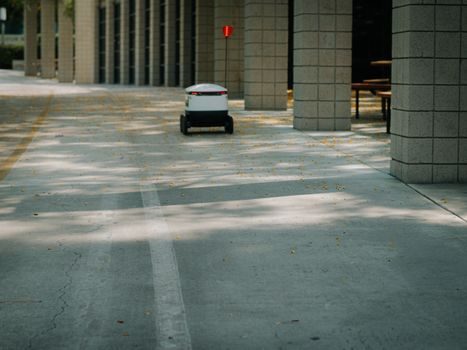
AMR adoption remains constrained by three documented failure modes: (1) SLAM degradation in highly repetitive or highly dynamic environments such as long, feature-poor warehouse aisles; (2) fleet-manager lock-in, where proprietary traffic-optimisation engines make mixed-vendor rollouts expensive; and (3) functional-safety certification gaps, where PL=d cat-3 stops per ISO 3691-4 are sometimes claimed without third-party audit, per the ScienceDirect 2025 review's planning-and-control agenda [S5].
Sourcing-side, lead times for 3D LiDAR units and safety-rated servo drives extended materially through 2025–2026, and buyers should expect 14–22 week lead times on European-spec AMRs versus 6–10 weeks on Chinese OEM platforms [S6]. Process-engineer buyers should also confirm the warranty scope distinguishes mechanical structure, drive train, sensors and battery cells separately, since battery cycle-life (typically 2000–3000 cycles at 80% depth-of-discharge) is usually the first sub-assembly to fail in a 24/7 deployment.