
Push-in fittings look cheap on a quote sheet, but the line item that shows up in a purchase order is roughly 10% of what that fitting will actually cost over its service life, per the TCO breakdown used in asset-heavy industries [S1].
The TCO formula applied to fluid-handling components is TCO = I (initial) + O (operation) + M (maintenance) + D (downtime) minus R (residual value) [S1]. For push-in fittings on a 200-point pneumatic manifold, the I term is small, the O term is dominated by install labour, and the M and D terms are where engineering decisions made at the spec desk either pay back or punish the maintenance budget for the next 10 years.
Push-to-connect technology is specified specifically because it eliminates thread sealant, torque wrenches, and re-work loops; industry-side TCO analyses consistently list installation labour and production downtime as the two largest non-purchase cost buckets [S4]. A threaded NPT elbow typically books 90-180 seconds of touch time on a calibrated torque wrench, plus 5-15 seconds of PTFE application, plus a leak-check pass; a push-in equivalent on the same OD tube runs 5-15 seconds of insertion plus a visual seating check, with no cure time.
For a 200-fitting manifold that gap is roughly 8-9 hours of eliminated touch time per build, and on a running line where downtime books at $5,000-$50,000 per hour depending on the process, the O term collapses dramatically. The deeper spec point is that push-in installation time does not scale linearly with fitting count the way threaded installation does, because the per-fitting tool-change and torque-cycle overhead is what threaded work hides; see the field guide on push-in installation for the step-by-step times that drive this delta.
Downtime (D): Leak-Driven Unplanned Stops vs Planned Rebuilds
Downtime cost in the TCO formula includes the labour for delayed workers, supervisory overhead, lost production, and any contractual penalties [S1]. For a push-in fitting, the dominant D contributor is unplanned leak stops, which on a Class 4 leak (per common ISO 8573-1 air-quality grading practice used in pneumatic plants) can bleed 1-3 CFM continuously from a 6 mm tube at 6 bar; on a 100-machine plant that is 100-300 CFM of compressed air the compressor has to make up, plus the safety/quality incident that triggered the shutdown.
The other D bucket is the planned rebuild at end of service life: a polymer-bodied push-in collet fatigues after roughly 5,000-10,000 mate cycles (manufacturer-published band, not a standard), and rebuilding 200 points at 30-60 seconds each is 1.5-3 hours of line stop, which on a high-mix cell can be $7,500-$150,000 of D cost. The honest limits, including temperature, pressure, and chemistry ceilings, are laid out in the 2026 specifier overview of push-in fittings.
Maintenance (M): Grease, Collet Replacement, and the 90-Day Rule
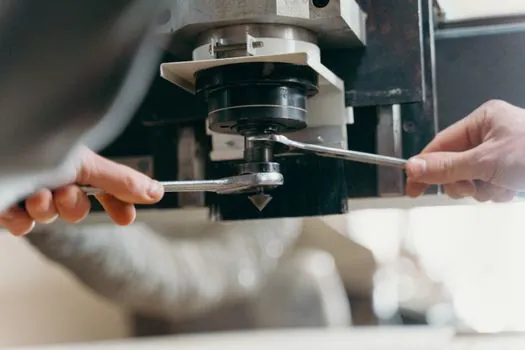
Maintenance cost under TCO is keeping the asset in peak operating condition [S1]. For push-in fittings, M is dominated by three line items: collet-and-O-ring replacement at the cycle-life limit, periodic silicone lubrication on the release sleeve (most makers publish a 90-day interval for high-cycle applications), and the labour to access fittings in dense panels where a 0.5-second sleeve push turns into a 10-minute dismantle job.
Spec-grade polymer fittings (PBT body, NBR or FKM seal) tolerate -10 to 80 C and up to 10 bar at the rated tube size; metal-bodied variants (nickel-plated brass, 304/316 stainless) push the upper limit to 150 C and 20+ bar. The M term is heavily influenced by material selection: an FKM seal that survives exposure to a R134a refrigerant or a mild cutting-fluid mist roughly triples seal life versus NBR in the same duty, which more than offsets the 1.5-3x unit-price delta on the I term over a 5-year window. The trade-off table looks like this:
Comparison, polymer NBR vs metal FKM push-in fitting over a 5-year, 200-point service:
- Initial cost (I): polymer-NBR wins, typically 40-60% lower per fitting.<br>- Operating cost (O): tie, install time is identical at the tube interface.<br>- Maintenance (M): metal-FKM wins, 2-3x longer seal service interval.<br>- Downtime (D): metal-FKM wins, fewer unplanned leak stops in thermal or chemical exposure.<br>- Residual (R): metal-FKM wins, residual value on a stainless-bodied fitting is non-trivial at end of life.
Energy Loss as a Hidden O: The Pressure-Drop Tax
Beyond labour and downtime, push-in fittings impose a small but persistent pressure-drop penalty on the moving fluid; the equivalent length (Le/D) of a typical elbow push-in fitting sits in the 30-50 range, meaning each elbow behaves hydraulically like 30-50 diameters of straight tube. On a 6 mm tube run with 8 elbows, that is roughly 1.4-2.4 metres of additional effective tube length, which a compressor must overcome to hold downstream pressure. [S1]
Spec-side mitigations are full-bore fitting selection (bore diameter matched to tube OD, not reduced) and minimising elbow count by favouring straight couplers and routed tube paths; both are standard spec moves in any pipe fitting or pneumatic fitting review.
Who Push-In TCO Is For, and Who It Is Not For

Push-in TCO modelling pays off where (a) fitting count is high (200+ points on a machine or cell), (b) the line is reconfigured or maintained frequently (automotive tier-1, packaging, electronics assembly), and (c) the fluid is clean, dry, non-corrosive compressed air or inert gas at -10 to 80 C and up to 10 bar. It does not pay off for steam service, aggressive chemicals, or sustained high-temperature hydraulic oil above 80 C; in those duties the unit price of a stainless compression fitting is justified because the polymer collet would fail the M and D terms, not the I term. [S1]
The honest limit is also pulse and vibration: push-in collets can walk back under sustained vibration above 5 g RMS, which is common on stamping cells and mobile-equipment hydraulics, so for those cabinets a threaded fitting with a thread-locking patch is the lower-TCO choice. Specifiers should not treat push-in as a universal answer, and the real-advantages review of push-in fittings maps exactly which service envelopes are in and out.
Sourcing, Standards, and Trackable Numbers
There is no single ISO or ASME standard that governs push-in fitting TCO directly; relevant underpinning standards include ISO 14743 for compression-type fittings used in fluid power, ISO 8573-1 for compressed-air purity classes, and ISO 4414 for pneumatic system safety, all of which bound the M and D terms by setting leak-rate and contamination limits a fitting must hold to remain in service. Manufacturers publish cycle-life (typically 5,000-10,000 mate cycles for polymer collets) and pressure/temperature derating curves; the engineering move is to obtain those curves, then run the I + O + M + D - R formula against the actual line's downtime cost and labour rate rather than against the catalogue price. [S1]
Trackable signals for the next spec cycle: (1) the spread between FKM and NBR seal pricing is narrowing as FKM volumes grow, which will shift the metal-FKM TCO case closer to breakeven by 2027; (2) several major makers are now publishing per-fitting install-time data on request, which lets the O term be quoted as a hard number rather than a range. A working specifier should pull install-time and cycle-life curves on the next RFQ and rerun the TCO formula against the actual plant's downtime rate.
The underlying component specifications are covered under total station.