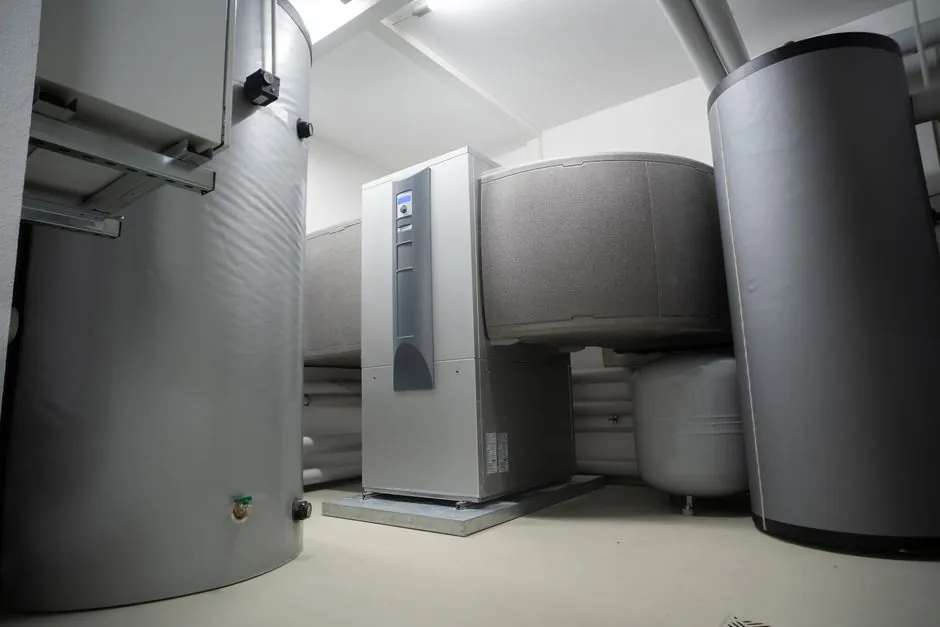
Centrifugal pumps are the most widely specified type in HVAC water circuits, with end-suction, inline, and split-case constructions covering virtually all commercial chilled-water, hot-water, and condenser-water duty points [S1][S2].
For hydronic HVAC, the design question is rarely whether to use a centrifugal pump; the engineering work is matching construction (end-suction, inline, split-case, circulator) to flow band, head, available NPSH, and part-load profile [S1][S4].
Where Centrifugal Pumps Sit in an HVAC Plant
Hydronic HVAC plants route water (or glycol mixtures) through three distinct loops: chilled water from chiller to air-handling unit, hot water from boiler to coils or radiant panels, and condenser water between chiller and cooling tower [S1].
Pumps carry the thermal-energy-transfer load in all three, which is why the U.S. Department of Energy places pumping at roughly 20% of industrial electricity consumption, a figure that frames the spec as both a hydraulic and an energy decision [S1].
The Four Construction Types You Will Actually Specify
End-suction pumps are the default workhorse: fluid enters axially, discharges radially through the volute, and the package is compact, base-mounted, and easy to maintain. Typical HVAC end-suction duty spans 10-5,000 GPM, head up to about 500 ft, fluid temperature 14-250°F, and best-efficiency 70-85% [S1].
Inline (vertical inline) pumps mount directly in the pipe run with suction and discharge on the same centerline, which cuts mechanical-room footprint and reduces structure-borne vibration in multi-story buildings [S1][S2].
Split-case pumps, single- or double-suction, are specified for the largest flows because the horizontally split casing gives full access to the impeller without breaking pipe, and the double-suction entry halves radial thrust on the shaft [S1][S4].
Circulators are the small end of the family: typically under 150 GPM and not rated above 125 psig, supported by the piping itself, and used on low-pressure, low-capacity hydronic branches [S4].
Selection Criteria the Hydraulic Curve Will Not Forgive
Flow rate (GPM or L/s) and total head (static height plus pipe and fitting friction) define the operating point; size the pump to the design duty, not the chiller nameplate, and always check the required flow against the best-efficiency point on the published curve [S3][S4].
Net positive suction head available (NPSHa) must exceed the pump's NPSH required (NPSHr) by a defined margin, otherwise cavitation at the impeller eye will erode rings and destroy bearings within months, particularly on hot-water returns above ~180°F and on condenser water at elevated tower-basin temperatures [S1].
Fluid compatibility covers more than water: glycol mixtures change viscosity and specific heat, which shifts both the duty point and the available NPSH, and material selection (cast iron, ductile iron, bronze, or stainless fittings) must match the water-chemistry regime to control corrosion and dezincification [S3].
Comparison: End-Suction vs Inline vs Split-Case vs Circulator
End-suction covers the broadest flow band (10-5,000 GPM) and is the lowest-cost base-mounted option, but it consumes floor space and transmits vibration through a concrete pad [S1][S4].
Inline pumps trade the upper flow headroom for a near-zero footprint and direct pipe mounting, making them the right answer in retrofits and high-rise secondary loops where mechanical-room area is the binding constraint [S1][S2].
Split-case (double-suction) units handle the largest chilled-water and condenser-water flows above the end-suction ceiling, with a horizontally split casing that allows impeller service without disturbing the pipe, and they remain the preferred choice for flows beyond about 4,000 GPM [S1][S4].
Circulators sit below 150 GPM and 125 psig on residential and small commercial branches, supported by the piping itself rather than a baseplate [S4].
Variable Speed, Efficiency, and the Part-Load Reality
Variable-speed drives (VSDs) on centrifugal pumps follow the affinity laws: cut speed by 20% and power drops by roughly 49%, which is why most new HVAC specs pair an end-suction or inline centrifugal with a VSD for chilled-water and condenser-water loops that operate well below design load for most of the year [S2][S3].
The Hydraulic Institute's efficiency guidelines and DOE pumping-system data are the practical benchmarks engineers cite when justifying the VSD premium against kWh savings; oversizing a constant-speed pump to handle peak load is one of the most expensive mistakes a hydronic spec can make [S1][S3].
Who This Is For, and Where It Breaks
Centrifugal pumps are correct for clean, thin, near-Newtonian HVAC fluids at moderate to high flow and moderate head; they are not the right tool for viscous slurries, very high pressure boiler-feed duty, or precise metering, which is where positive-displacement and multistage-booster designs take over [S2][S3].
Inline pumps also have a practical ceiling: very large chilled-water plants still need the hydraulic accessibility of a split-case, and base-mounted end-suction pumps in seismic zones require anchored inertia bases and flexible couplings, not the bare pad mount common in older drawings [S6].
Sourcing and Standards Discipline
For broader background on pump operating principles, the centrifugal pump reference covers volute, diffuser, and impeller geometry in detail. The wider industrial pump page sets out positive-displacement vs dynamic selection logic, which is useful when an HVAC loop drifts outside centrifugal territory. [S2]
When HVAC water circuits tie into seawater or brackish cooling on marine or coastal sites, marine HVAC specifications override standard indoor ratings for corrosion, vibration, and ambient-temperature derating. For diaphragm and gear-driven ancillaries on the same plant, the diaphragm pump and gear pump references cover the positive-displacement options that occasionally appear on chemical-feed and oil-lubricant skids.
Trackable signals for the next planning cycle: published efficiency curves at part load (50% and 75% of design flow) from shortlisted vendors, and the seismic-installation detail (anchorage, flexible couplings, inertia base) called out on the mechanical drawing set, both of which decide whether the centrifugal pump selection will hold up over a 20-year service life [S1][S6].
For related coverage, see Clutch and brake selection for cement plant drives: a 2026 spec map.