
Push-in fittings, also called push-to-connect fittings, let a technician join tubing by hand in seconds: insert the tube until it bottoms out, an internal collet grips the OD, an O-ring seals the bore, done [S1][S5]. Most catalog parts carry a 1.0 MPa (10 bar) maximum operating pressure rating, with the pressure actually held below that ceiling to certify safe operation [S4].
That simplicity is exactly why the format has spread from compressed air lines into water filtration, beverage dispense, lubrication, and laboratory gas circuits [S2][S4]. The trade-off is that the seal depends on an elastomer, the grip on tube hardness, and the price on precision-molded plastic or brass bodies, so the fitting is a system choice, not a default.
How the seal actually works
The push-in joint is a three-part stack: an outer release collar, an internal lock-claw or collet that bites into the tube OD, and an O-ring that seals against the tube OD inside the bore [S4][S5]. To install, the operator pushes the tube past the collet until the claws snap behind it; to remove, the collar is depressed, the claws open, and the tube slides out without tools [S4].
Because the seal lives in the O-ring, not in metal-to-metal contact, the joint tolerates minor tube surface variation and reassembly cycles that would scar a compression ferrule. The same geometry is what makes the format reusable across dozens of connect/disconnect cycles without losing sealing force, a property traditional threaded joints cannot match without re-taping [S1][S5].
Where push-in wins on the shop floor
Installation time is the headline gain: a connection that takes a wrench, thread sealant, and a torque check on a compression fitting collapses to a single push stroke on a push-in, and the labor delta multiplies across panels with hundreds of ports [S1][S3]. In packaging machinery, automated assembly cells, and lab test rigs, that delta shows up directly as reduced changeover time and lower rework on field service calls [S5].
Reusability is the second hard win. A push-in joint can be disconnected and reconnected repeatedly without replacing consumables, while a threaded joint that has been sealed and cycled usually needs new tape or paste each time [S1][S2]. Technicians also avoid the contamination path that thread sealants introduce, which matters in clean-room pneumatics and food-grade water lines [S2][S5].
The compact body suits confined panels where a wrench cannot swing, and the lack of torque dependence removes a class of installer error, no over-tightened ferrules, no cracked fittings from a final half-turn too many [S3]. For multi-port manifolds, branch tees, and elbow drops in a pipe fitting stack, the tool-free install is what makes dense layouts buildable in the first place.
Honest limits and failure modes

Push-in joints are pressure-limited. Common catalog ratings sit at 1.0 MPa, well below the working envelope of a compression or threaded joint in the same bore size, so any line spec'd above 10 bar typically steps back to a metal compression or flare fitting [S4]. The same source notes the plastic body and O-ring stack can be ineffective in hot environments or when hot air passes through the joint, which caps upper temperature roughly at the elastomer rating of the fitted O-ring [S4].
Pull-out under vibration is the documented failure mode. Modern collets hold well in steady service, but excessive axial pull or sustained vibration can work the tube free, a real concern on mobile equipment, compressor manifolds, and any line routed next to a pneumatic fitting that is itself pulsing. Material choice on the tube side matters: PE, nylon, and PU tubes are recommended for flexibility, while overly soft tubing lets the collet deform the bore and lose grip [S4].
Unit cost is higher than a plain threaded elbow or barbed nipple, sometimes by a factor of several, and that gap widens on large-bore or stainless variants [S1][S5]. O-ring ageing is the long-tail cost: the seal eventually hardens, especially in chemical, UV, or thermal-cycling service, so the joint is best treated as a planned-replacement item rather than a fit-and-forget part [S1][S3].
Push-in vs compression vs threaded: a spec-side comparison
On installation speed and reusability, push-in leads compression and threaded by a wide margin; on raw unit cost, threaded NPT/BSPT fittings lead, with compression in the middle, and push-in the most expensive per port [S1][S5]. On upper pressure and temperature ceiling, threaded metal bodies and compression ferrules carry higher ratings than typical 1.0 MPa push-in catalog parts [S4][S5].
On vibration tolerance and pull-out strength, threaded and compression joints win because their retention comes from metal deformation, not from a plastic collet biting a polymer tube. On contamination control and clean-room suitability, push-in leads because it needs no thread sealant and leaves no tape residue in the bore [S2][S5]. For an air-side quick disconnect on a Venturi pad where the line is reconfigured often, a push-in pays back its premium in labor within a handful of service events, the same logic covered in a vacuum generator installation spec-first field guide.
Selection criteria engineers should pin down first
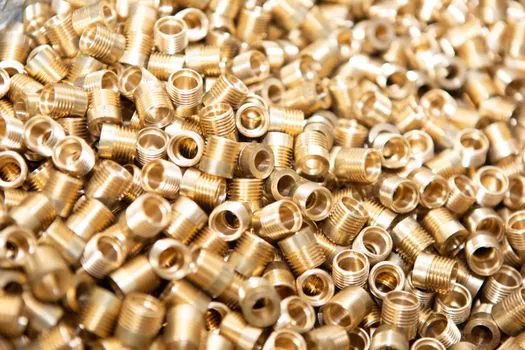
Before picking a push-in, four numbers fix the part: tube OD and tolerance, tube material and hardness, maximum working pressure including any spike, and the fluid or gas compatibility of the O-ring compound [S1][S4]. A 1/4 in OD nylon tube at 0.7 MPa shop air is comfortably inside any catalog push-in; the same 1/4 in fitting on a 1.6 MPa hydraulic line is not, and the spec must step to a metal compression or a flange-style joint [S4][S5].
Environment closes the gap: ambient temperature, chemical exposure, UV, and any washdown cycle all degrade the O-ring and plastic body faster than they degrade a brass or stainless threaded body [S1][S4]. Where any of those are aggressive, the right move is a metal-body push-in with a fluorocarbon O-ring rather than a standard nitrile/EPDM stack, or a return to compression on a metal piping fitting.
Where to use it, where to avoid it
Use push-in for shop-air drops at the machine, lab bench gas and water, packaging and assembly pneumatics, OEM builds with hundreds of ports, and any line that will be reconfigured more than a few times a year [S1][S2][S5]. Avoid it for high-pressure hydraulic, high-temperature steam or hot oil, mobile equipment subject to shock and vibration, and any buried or concealed line where a slow O-ring leak cannot be seen and caught [S1][S4][S5].
A practical rule: if the line is built, pressurized, and then left alone for years, the cost premium of push-in buys nothing and a threaded or compression joint is the rational call. If the line is built, reworked, tested, and reworked again, push-in is almost always the cheaper joint once labor is counted [S1][S3][S5].
Trackable signals to watch on the 2026-09-10 horizon: the wider rollout of metal-body push-in with higher pressure ratings above 1.0 MPa, and more fluorocarbon-O-ring options for chemical and thermal service, both of which would extend the format's envelope into jobs that today still default to compression [S2][S5]. Watch also for any revision to ISO 14743 for pneumatic push-in fittings, which would tighten the test pressure and temperature protocol that the current 1.0 MPa catalog ratings are anchored to.